Without raining on parade, we need to talk about Dublin
Timing is everything.

Without raining on parade, we need to talk about Dublin

Timing is everything.

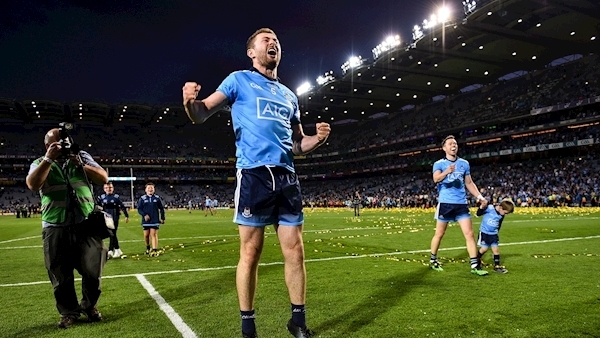
Earlier this week RTÉ’s Prime Time focused on the GAA’s funding of Dublin, with the tinsel still airborne around Croke Park after Jim Gavin’s side collected a historic fifth title in a row last Saturday.

Feathers were ruffled, with a few Dublin people questioning whether it was appropriate to rain on the sky-blue parade so soon after the final whistle. Parking the obvious retort (when is the appropriate time?), the programme did underline the most pressing question in the GAA at present.

What to do about Dublin’s immense advantages?

Dispelling some myths might help. First, the GAA at all levels needs the serenity to accept the things it cannot change, and as the Dublin County Board and its representatives have pointed out many times, the demographic shift east in recent decades has not been driven by the GAA. The concentration of population, resources, finance and employment opportunities in and around Dublin has nothing to do with the Dublin County Board.

A programme of decentralising those opportunities and resources across the country is a far bigger task — one for government, not Croke Park — than appointing a few more GDAs in smaller counties.

Second: Dublin have endured lengthy All-Ireland famines at senior level despite those natural advantages: hence the view often promoted by Dublin supporters, that their current dominance is a passing phase driven by an extraordinary group who have squeezed out some narrow All-Ireland wins, a couple coming in replays.

This argument can be both true and untrue, however. The presence of once-in-a-generation quality on the field and the sideline has come in parallel with the advent of the back door championship and more professional preparation of teams generally.

This means the better-resourced teams come to the fore. This is true in professional team sports, where well-resourced clubs dominate in every league format because the element of the shock championship exit is removed.

In the old dispensation of knock-out Championship a minnow might catch a superpower once in every ten games, but nowadays, with the Super 8 format and variants thereof, the big battalions are harder to dislodge, which Dublin have proven time and again.

Three: There’s a natural inclination to focus on the Dublin senior team, which is completely understandable. They’re the lads filling Croke Park.

But any suggestion that there is no dividend at senior level from the investment at underage level is undone by common sense. And also by some astute observations which surfaced during the week.

“Between the two canals in Dublin there is a serious population, maybe 300,000-400,000 people, and there’s probably one GAA club there. Soccer and rugby are the dominant sports in Dublin 1, Dublin 2, and most of Dublin 4 and 6.

“We haven’t conquered this in terms of participation. And it’s not trying to beat the other sports, but it’s about participation and to give people the chance to play the games. Whether we like it or not, a third of the population lives in Dublin so you’d say a third of the funding should go into the development of the games.

“That doesn’t mean that the senior team should be getting one-third of the funding, but if we want participation in the games it makes a lot of sense to put the money that way . . .”

The speaker was Pat Gilroy, who was talking to RTÉ. The former Dublin manager added this coda to summarise his views: “If funding is doing one thing for Dublin, it’s getting a lot more kids playing the game, which means you have a lot more chance of getting players through.

“I couldn’t see an argument that makes sense for cutting that funding because all that means is less children play the games.”

Yet if the area “between the canals”, with one-third of Dublin’s population, has one GAA club, that surely means Dublin’s GAA funding is funnelling into clubs servicing two-thirds of the population - into clubs which are already powerful and among the biggest GAA clubs in the country?

This is not an option open to other county boards, who would probably see standards rise if two-thirds of their clubs got almost all the funding available.

Which brings us to the units which are uniquely placed to act on the capital’s advantages: those other county boards, which tend to avoid the blame being dished out for the creation of the Dublin juggernaut.

Yet the championship structure, now utterly dominated by Dublin, was an innovation agreed by the GAA as a whole, not one introduced through subterfuge by the capital. If counties wish to restore the lottery of straight knock-out to level the playing field, they need only do so at Congress.

This is another element in the current dissatisfaction outside the M50 with Dublin’s funding: the willingness to blame Croke Park for not addressing the anomaly rather than county boards themselves.

Five years ago tentative steps were taken to make some move on the huge funding being received by Dublin. At a meeting in Croke Park, scheduled to discuss a report on funding to counties drawn up by the National Financial Management Committee of the Association, senior GAA officials from all over the country considered a proposal which would have reduced the funding made available by the GAA for coaching in the capital.

This was strongly opposed by the Dublin representatives at the meeting, unsurprisingly, who pointed to the different nature of the challenges facing the GAA in the capital compared to other counties in terms of competition from other sports, playing numbers and so forth.

Here you had the rumbling discontent among other counties with Dublin’s resources showing the need for action, and a course of action outlined which might have dealt with it (even if only in draft form).

What has happened, however? Nothing.

This underlines the interconnected strands of the Dublin conundrum. An altered championship structure favours a county receiving heavy investment from the central governing body of the sport; investment aimed at helping participation, though one third of its population is served by just one club. The other counties are unhappy with the situation but are unwilling to act when offered the chance to do so.

Among the reasons for this reticence may be the unforeseen consequences which could accompany actions intended to curtail Dublin.

The most obvious is the proposal to divide the capital in two. While this has led to numerous jokes about cutting other counties in two, or creating Dublin sides representing the northside or southside of the city, it also raises another question.

If Dublin is too big to compete with counties on a level playing field, how big do opposing counties have to be to compete with Dublin? Should Sligo and Leitrim be combined to face Dublin North? Should Laois come together with Offaly to offer Dublin South a challenge? What would be the criteria for collapsing a couple of counties together?

This brings us back to the start. The Dublin conundrum is an unending source of discussion and debate (and newsprint, and broadcasting minutes).

We haven’t even touched on why Dublin are not dominating hurling the way they dominate football. Or what the power of middle-class Dublin suburban clubs means in social terms. Or whether the graduates of Kerry’s All-Ireland-winning minor sides, or Jim Gavin’s eventual resignation, will level the playing field.

Are any of those elements enough to derail the drive for six titles in a row? As noted, timing is everything.

More in this section

Cookie Policy Privacy Policy Brand Safety FAQ Help Contact Us Terms and Conditions

© Examiner Echo Group Limited