How the GAA laid its legends to rest
Four of hurling’s greatest ever players died in a seven year span. recalls the outpourings of grief.
Two of tomorrow’s provincial finalists lost the central figures in their hurling histories within six years of each other. Mick Mackey of Limerick passed away in 1982, while Wexford’s Nicky Rackard died in 1976.
It was a rough stretch for hurling greats: John Keane of Waterford died the year before Rackard, while Cork’s Christy Ring died in 1979. Four of the Team of the Century gone in a seven-year span.
Those players embodied their counties because of their greatness, but that greatness took many forms. Mackey, for instance, was a powerful, marauding forward, but also a character that crowds warmed to instinctively.
In one unsparing championship encounter Mackey, then in his heyday, was a considerable threat to his Waterford opponents; Christy Moylan marked the Limerick star and in the parlance of the time, they were giving each other plenty of it, to the loud approval of Waterford supporters nearby.
An orange was flung on the field and Mackey picked it up, peeled it — and tossed half of it over to Moylan. The crowd broke into spontaneous applause. Little wonder that when Mackey was seriously unwell hundreds of Limerick people visited him in hospital to say their farewells: he was a link to their glory days in the thirties and they were keen to let him know he was in their thoughts.
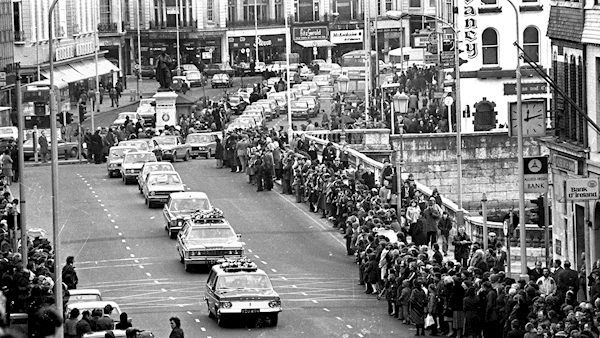
When he died, Limerick responded. Local League of Ireland side Limerick United were in European competition against Dutch side AZ Alkmaar at the Markets Field, and they held a minute’s silence in Mackey’s honour before the game, while flags were flown at half mast around the ground (the Dutch reaction is not recorded).
The funeral cortege stretched three miles into Castleconnell, and included Jim Phelan of Bohermore, one of Mackey’s former teammates. He had risen at 8.30 that morning to walk the 14 miles to the funeral and told local reporters:
I will always remember Mick Mackey as a good character and a good friend.
Nicky Rackard was selected at full-forward on the Team of the Century (Mackey was centre-forward) and, like the Limerick man, was larger than life, the attacking spearhead on one of the most popular teams in GAA history, the Wexford side of the 50s.
Rackard was an unusually colourful character in the GAA world of the time — he was a vet who rode to hounds, for instance — but he also had a long struggle with alcoholism, an issue all too common then and now.
He turned his life around, however, and eventually gave up drink and became active in Alcoholics Anonymous, helping others through their darkest times.
When the GAA named one of its inter-county competitions after Rackard in 2005, his son Bobby told the media those latter days, rather than his All-Ireland glory, were what his children preferred to focus on: “I think as a family that that’s the legacy we would be most proud of.”
In his final years Rackard would travel the length of the county to help fellow alcoholics, or put them up in his home for weeks. He went further, writing a series of articles for The Sunday Press which opened people’s eyes on what alcoholism truly meant.

“There were spells of being on the dry,” Rackard wrote in one of the articles. “There were other spells of being on the bash. There were car crashes and wild binges. There were blackouts, which experts know are nearly always a certain sign of alcoholism.
“Once I went to a ball on a Friday and came to myself in the local pub on the following Tuesday morning, still in my dress suit.”
It was a curiously modern approach — Rackard’s searing honesty seems more familiar to us in the 21st century, and back in 2005 his son Bobby identified the motivation behind it.
“There was the sense of him being larger than life, that he wasn’t really my father, that he belonged to someone else, there was a bit of that. So I never really connected with the man I suppose. My sense is he was telling it (his story) because he felt somebody might learn from it. I think he struggled long and hard before he decided to do it.
“I’ve a vague recollection of receiving letters from England, I’m sure there were others from Ireland, people that found it an inspiration. To him that would have made it worthwhile. It is a kind of a soul-baring.”
In 1974 Rackard noticed lumps in his neck, the first signs of the cancer that would claim his life two years later. He passed away in St Vincent’s Hospital, reading The Irish Field, having dropped in weight from a championship-ready 15 stone to less than six stone at the end. Ten thousand attended his funeral in Bunclody, where four of his teammates from that great Wexford side carried the coffin: Nick O’Donnell, Jim English, Paddy Kehoe and Jim Morrissey.
After the burial, when the crowds finally drifted away from the cemetery, members of Alcoholics Anonymous gathered at the grave and recited their own prayer for Nicky Rackard. Though Waterford aren’t involved in tomorrow’s Munster final, the icon that county lost in the seventies ties Mackey and Rackard together.
John Keane was the linchpin on the Déise side through the late thirties and forties as they battled to make the breakthrough. As a 20-year-old centre-back he marked Mackey in the 1937 Waterford-Limerick Munster championship game: Keane held Mackey scoreless and though Limerick found a way through, winning by two points, the fair-haired Mount Sion man in the number six jersey had made his name.
He was still the key man when Waterford eventually got to the All-Ireland final 11 years later, hitting 2-2 from centre-forward. He duly became a leading light in Waterford senior hurling management, helping their great side of the late fifties and early sixties to three All-Ireland finals, winning the title in 1959.
In 1975 Keane knew his health was failing, so he hit the road to visit some old adversaries. He headed to meet Jim Langton in Kilkenny, then pointed the car west for Kinsale in Cork and Jack Barrett.
Keane then went on to Tralee to meet Jackie Power of Limerick. The Waterford man was on the way to Limerick to meet Mick Mackey and some of the other Limerick stars of the thirties when he was taken ill and died at the side of the road near Tarbert. He was just 58.
When he was taken back to Waterford there was a huge turn-out for the funeral, with a meal laid on for invited guests afterwards. A member of the Mount Sion club noticed somebody had been left behind in the cemetery and invited him to come to the meal.
“I came here to bury John Keane, and now all I want to do is go home,” said the solitary mourner. It was Nicky Rackard.