True Gaels set sights on the biggest stage of all
A speech with a line such as, ‘My heart is lifted to heavenly heights’ is always going to leave an impression.

True Gaels set sights on the biggest stage of all

A speech with a line such as, ‘My heart is lifted to heavenly heights’ is always going to leave an impression.

When it comes from an All-Ireland winning captain, when it is delivered entirely in Irish, then it transcends a passing nod to the language.

In accepting Sam Maguire in 2004, Kerry captain Dara Ó Cinnéide set in train a set of circumstances that leads today to the Leitrim town of Carrick-on-Shannon that pauses from its’ reinvention as a latter-day Mecca for Stag and Hen dos, to play host to the All-Ireland club semi-final as Gaoth Dobhair gear up for their biggest ever day in taking on defending champions Corofin.

After making that speech 15 years ago, a communication came down the line from a fellow Gaeilgeoir, 300 miles to the north. Donnchadh MacNiallais, a PE teacher who had played for Gaoth Dobhair in the 1977 Donegal county final wanted to acknowledge Ó Cinnéide for his speech but after some back and forth, he found himself in a coachload of underage players heading to Kerry to pay a visit to Ó Cinnéide’s An Ghaeltacht club and play a challenge match.

“We beat them handy. And we wouldn’t have been that good. They said, ‘we should be better than what we are,’” recalls Ó Cinnéide.

They sat down and talked. Gaoth Dobhair could sense some fallow years were coming for the club and they needed to know if their five-year plan, drawn up by the likes of Brendan Boyle — father of county player and hat-trick destroyer of Crossmaglen, Dáire — Kevin Cassidy, Tom Beag Gillespie among others, was fit for purpose.

“The next thing they were back to me asking if I would become some kind of an ambassador, that ‘we want somebody outside of Donegal with the Gaeilge,’” explains Ó Cinnéide.

He’s keen to play down his role, which amounted to three or four weekends a year, for four years. He would go up on a Friday and train various underage sides but as far as he could see, they already had it covered with Gillespie a particularly impressive but humble individual.

“I would come in and give a talk and say, ‘this is what we do in Kerry’, and they might say, ‘that’s kind of primitive’, so I told them they were on the right track already, they just needed to hear it from somebody else,” he laughs.

“But it was Tom Beag who was the revelation there. I remember thinking, ‘this is an amazing guy.’

“He was all about the skills and even from his point of view, his curiosity. He made you feel you were the one with all the answers.”

No more so than his own community, Gaoth Dobhair had an ongoing identity struggle.

Some traditions were set in stone from previous generations but when you are struggling to win things, then everything is questioned.

The atheists and agnostics were still getting down on their knees to say the Rosary in Irish before each game, but the worth of it must have been pondered.

“They wanted to hold onto some of the elements of their traditions and wanted the likes of me to re-emphasise that it was important, an outside voice saying it,’” says Ó Cinnéide.

Dara Ó Cinnéide
Dara Ó Cinnéide

“Even back then I remember having to change my dialect as they weren’t understanding me and Cassidy said, ‘Can you speak the Donegal Irish?’ And I had to plug into them and speak their lingo.”

When Ó Cinnéide went to college with a crew from Tralee, they confessed how they could never get to grips with An Ghaeltacht. How their games were played right beside the Atlantic at Gallurus, with the hosts communicating exclusively in the native tongue and a wind howling from one goal to the other. In that moment, he got it. Their difference would be their strength.

So it would be for Gaoth Dobhair. Under Mervyn O’Donnell, they have all the trappings of a modern set-up but cling to the traditions that matter as they reach this stage.

For the aforementioned Brendan Boyle, now PRO of the club, it’s been one of the busiest times of his life.

“It’s normally a really sleepy, quiet time of the year. But the last couple of months and leading up to the Ulster final, I would be involved in other parts of the club as well. We were buying in gear, hats, flags and banners,” he explains.

“Then when we won the three cups, we had to co-ordinate that and everybody was looking for the cups on certain days, certain functions. We tried to get around as many people as possible but there are a few to do yet.”

And then came a most terrible event to arrange, in the funeral of 24-year-old Micheál Roarty, the popular clubman killed in a car accident the week after they returned from a challenge match against London in Ruislip.

“He was at training with them on a Saturday and then on the Sunday he was gone, it’s a massive loss,” says Boyle.

They went back to training that Thursday – the evening after the funeral, and on the Saturday, Tyrone manager Mickey Harte came up to speak about how to cope with the grief of losing a popular member of a team – something Harte is all too familiar with.

“Whatever contacts were made with Mickey, to come at such short notice, and to think he had a game the following day, but he made the effort to come up the road and had a great chat to the lads and the lads had immense comfort from that,” says Boyle.

“We travelled to Dublin the following day to play St Brigid’s and I was sitting with a few different lads on the bus, seeing how they felt and they all felt it was amazing. Then to go out of his way to meet the family afterwards, it was a help for them as well.

“It shows you the type of Gael he is. You know the preparation that goes into a league game the day before. The players were lining it up for the following week but Mickey’s advice was that it would have been too late. They needed to meet then when it was so raw and yet two weeks out from the game.

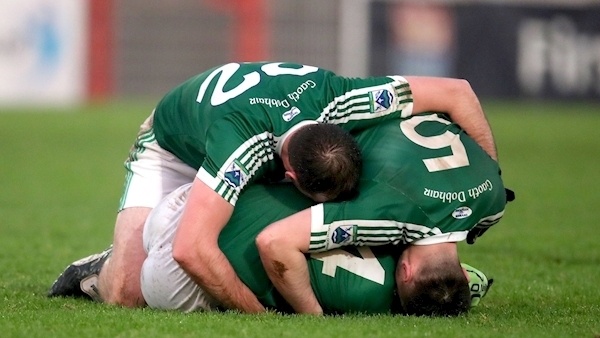
Gweedore celebrate their Ulster Club SFC win. Picture: Inpho

“‘Roycee’ was a character. A talented footballer but a lad who liked to party and be around people. He was just 24.”

It’s been several years since Ó Cinnéide has been up in Gaoth Dobhair, but the link remains. Every Christmas, he sends Donnchadh MacNiallais a card. When his son Odhrán started developing into one of the most elegant ball-players of this generation, indeed one that would be more typical of Kerry than Ulster, Ó Cinnéide recognised the class.

“He was the classic cliché of a footballer, out kicking frees after everybody else went home. I just felt, ‘this guy hasn’t anything to be coached on.’ He was working on the skills already.”

The parallels between Gaoth Dobhair and An Ghaeltacht are there for all to see. It’s there in the landscape, with the Atlantic hemming the people in and the mountains shouldering them back out, through the language, the old songs, the old ways.

“I think speaking the language bonds us naturally and the work that TG4 are doing, the radio and TV, they help us to understand each other. The different dialects are not as alien to each other anymore,” explains Ó Cinnéide.

“You can get isolated only for someone speaking your language and that’s where the TV and radio comes in.

“But there was a huge affinity for us in 2004 (when An Ghaeltacht reached the All-Ireland club final to be beaten by Caltra of Galway), and they underestimated how many came there to support us on the day. I would say it was a record crowd on the day. We were a small population, but there was a huge crowd there and that’s because of the Ghaeltacht.”

Like anyone else, Ó Cinnéide was tickled by the scenes that greeted Gaoth Dobhair’s first-ever Ulster title, posted up on social media after beating Scotstown. “When I saw the celebrations, I felt like jumping in the car to have the craic with them.”

Perhaps the wild nights are not done yet.

x

More in this section

Cookie Policy Privacy Policy Brand Safety FAQ Help Contact Us Terms and Conditions

© Examiner Echo Group Limited