Two become one in pursuit of excellence for Clare
They grew up only six miles from one another, the self-described sons of two cranky East Clare farmers, but for nearly 20 years after leaving school in Scarriff Donal Moloney and Gerry O’Connor barely crossed paths.

Two become one in pursuit of excellence for Clare

They grew up only six miles from one another, the self-described sons of two cranky East Clare farmers, but for nearly 20 years after leaving school in Scarriff Donal Moloney and Gerry O’Connor barely crossed paths.

Then when Moloney got married, he moved into the same Ennis housing estate as O’Connor. Living in the same neighbourhood invariably meant drinking in the same bar, the one just across the road.

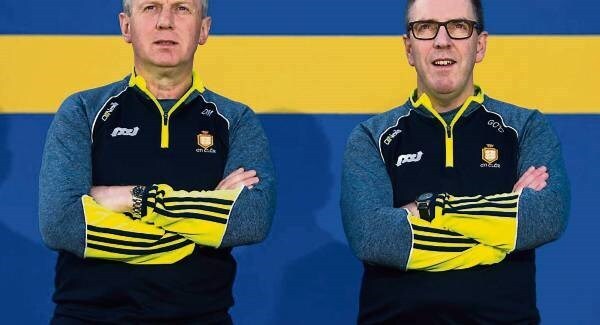
Joint Clare managers Donal Moloney and Gerry O’Connor. Much of their management philosophy centres on looking out for the personal and professional development of their players. Picture: Diarmuid Greene.

One evening they got talking properly. O’Connor had been managing the Clare U14s and was now being asked to take the U16s. After liking how his old schoolmate looked at things, he asked him a few days later if he’d join his team looking after the U16s.

Soon Moloney was more than just a member of his backroom. The name of that bar had been the Halfway House and when it came to delegating managerial duties O’Connor was prepared to go halfway with Moloney.

Ten years, five underage Munster titles, three U21 All-Irelands and now a sixth All-Ireland semi-final across all the grades later, that remains the arrangement. While joint management teams as a rule don’t tend to work out, the record clearly shows it works for O’Conner and Moloney, and for Clare. Before we go into how they’ve managed to get the Clare seniors back to Croke Park for the first time in five years, we first have to go back to east Clare.

Moloney was by a distance the better hurler of the two, good enough to play a few league games for Clare if just a bit short of being good enough to play championship, though never for a lack of effort.

“He would have been probably Scarriff’s best player year in year out,” says one old opponent from those days. “He’d back down from nothing. The bigger the name, the more relished it. He was a real hardy wing back.”

O’Connor, by his own admission, was a modest club player and an accidental coach. “When I first moved to Ennis working with the ESB at the time, I was quite happy to finish out my career with Killanaena,” he’d tell this writer five years ago ahead of the U21 All Ireland U21 final.

“Then my two sons got involved [with Éire Óg], I went along to one of these matches and then realised, ‘Hold on a second, there’s no one else here.”

And so he got roped in helping out with the U8s. When he brought them up to win the U14 Féile, he was then brought in to look after the county teams at that grade. There is little separating O’Connor and Moloney from their day jobs, just as there can be no divorcing them now as a management tandem.

Both work for multi-national companies. Moloney is a senior manager at DePuy Johnson & Johnson in Cork. On any given weekday O’Connor could be anywhere in the world in his work for the Shannon-based company Mincon who design and manufacture rock-drilling equipment, yet still attempts to be back for Clare training that same night.

For O’Connor, it’s been huge in his development as a hurling man, and by extension, Moloney.

“I grew up in a very small rural area of east Clare,” he’d explain in that 2013 interview, “my parents are farmers. And if you stay in that area you will adapt a certain idea and outlook on things. But if you travel and move around the world and allow yourself to think about what’s going on around you, you will express yourself differently.”

That informs much of their management philosophy; to look out for the personal and professional development of their players. Over the years, from minor to senior now, summer and full-time jobs and career advice have been found for players. Both would have given their blessing to Shane O’Donnell winning a Fulbright scholarship in Harvard that will see him missing next year’s league. O’Donnell has also spoken about how at the height of his post-2013 hat-trick fame, Moloney reached out to support him.

“I was shirking responsibility,” he’d tell Malachy Clerkin of The Irish Times a couple of seasons later.

“I didn’t want to leave the house, I didn’t want to see anybody. Even with Donal, I was going, ‘Ah, I don’t know. I might leave it. And he was like, ‘Shane. We need to meet up. I’m not taking no for an answer… He was extremely good and he had loads of good advice.”

For O’Connor and Moloney, humility is a cornerstone of their setup, something they preached long before the

All Blacks popularised the concept. And they’re very conscious that it has to start with them. O’Connor once said when they were over the three-in-a-row U21 All Ireland winning teams that if you came to one of their sessions you would be hard-pressed “to know who is the manager and who is the water carrier”.

They’ve constantly credited the input of their fellow selectors and coaches. “We would have been very clear that if we were going to bring someone into our setup that they were going to challenge us,” O’Connor in that interview five years ago.

“They nearly had to be better than us. So we set very high standards. If someone is coming into our setup, they need to be almost a threat to us. A lot of managers don’t like that but that’s the advantage of us being a joint management team. And in a setup like this one [the 21s of 2013], we look at it as if we have four joint managers [with Jimmy Browne and Paul Kinnerk]. We manage through consensus.”

Now in 2018 there has been some – actually considerable – tweaking to that approach.

The most obvious one is that the coaching staff is almost completely different: the quasi-joint management team is now up to seven with Browne the one other survivor of that 2013 U21 setup and now joined by Gavin Keary, Liam Cronin, Kieran Corcoran and S&C coach Kelvin Harold.

O’Connor and Moloney delegate most of the hurling on the training ground to the aforementioned five, though O’Connor has pointed out how some aerial drills and games that Moloney developed in the early years of their partnership was formative in the development of the team; the benefits of that intervention are still evident today, best demonstrated by a critical high ball Shane O’Donnell brought to ground with his hurley against Wexford a fortnight ago in Cork before laying it off to John Conlon to point on the right touchline and stem a late Wexford comeback.

The most significant change this year though is that the consensus has extended more to the players.

Last season was testing enough for all parties. Some players who wouldn’t have worked with O’Connor and Moloney before found it difficult to know which one of them to approach when they had an issue.

Team meetings also tended to consist more of management standing up and relaying to the players their assessment of things.

This year meetings are far more player-driven. They’re taking more of the analysis and offering suggestions as to how the team play and set up. From such player involvement has come greater player empowerment, and as a consequence, greater player and team performance.

O’Connor and Moloney though remain very much the leaders, complementing and dovetailing with each other impressively. In most joint-management setups, one figure tends to do more of the talking; Pat Holmes, for instance, would have been seen to be very much the senior figure in the ill-fated Mayo football combo of 2015. With O’Connor and Moloney the split is almost 50-50.

On game day though, Moloney, the more blood-and-thunder of the pair as cerebral as he can be too, tends to be the more vocal, certainly just before the team goes out and again for the second half.

That’s when he lets them go out for the second half. Against Wexford there was nearly a game of cat and mouse, with the fourth official darting from one dressing room to the other, like the poor porter boy in For A Few Dollars More caught in a stare-off between the Colonel and the Man with No Name (“Take it to the station.” “Take it back.” “Take it to the station”…).

Whether it was a form of psychological warfare or sheer childishness, Clare were determined not to blink. In the Munster final they had been the first out. Whether it was a factor in Cork quickly wiping out the second part of Clare’s one-time eight-point lead, no-one really knows, but Clare’s actions against Wexford suggests they felt it was.

Tellingly, Moloney wasn’t in the dressing room for the Munster final, serving a suspension. In Clare they’ll tell you, a Donal Moloney team never goes out early and rarely goes out first. He was missed.

When O’Connor says this wouldn’t work as well without the other, he’s not just saying it. A Halfway House tandem divided isn’t quite the same.

x

More in this section

Cookie Policy Privacy Policy Brand Safety FAQ Help Contact Us Terms and Conditions

© Examiner Echo Group Limited