When ‘unbeatable’ Dublin were beaten
On the morning of the 2014 All-Ireland semi-final, Jim McGuinness turned to his flip chart.
When ‘unbeatable’ Dublin were beaten

“Two or three goals,” the Donegal manager stressed pointing towards what he had just written as his panel watched on at Johnstown House.

“Sixteen or 17 points,” McGuinness added. “This score is achievable today.” Donegal were 7/1. Their opponents, Dublin, were said to be ‘unbeatable.’

Three years previously, at the Ashbourne Hotel, McGuinness had been in the exact same situation with a completely different strategy.

Everyone in the room was instructed to put their mobile phone into a bag as McGuinness rolled out the most unconventional plan ever to win a football match.

“We thought of bringing all 15 men behind the ball, of leaving no player in the Dublin half,” he wrote in Until Victory Always: A Memoir.

“That morning we spoke about keeping Dublin scoreless at half-time. We believed there was a fair chance of that happening.”

A game of stares developed at Croke Park in front of 81,436.

Dublin scored only twice in the first-half but didn’t blink and won 0-8 to 0-6.

By 2014, the perception of Donegal was dented considerably having been hammered as holders of Sam Maguire by Mayo 4-17 to 1-10 in the previous year’s All-Ireland quarter-final.

McGuinness spent that whole spring, in Glenties or Glasgow, studying Dublin. Forward and back. Over and over. Time and again. He deciphered them, although he admitted he couldn’t crack Stephen Cluxton’s kick-outs.

Donegal needed a late Patrick McBrearty score to sneak a one-point quarter-final win over Armagh, who were hurtling towards Division 3.

McGuinness skipped the post-match interviews. Instead, selector Damien Diver sat in the Cusack Stand media room, which had no lighting that afternoon; a media blackout of sorts.

Diver was illuminated only by mobile phones being used as voice-recorders as McGuinness, out in the open, saw Dublin play Monaghan.

When sections of the media got whispers he would field questions after the second instalment of the double-header, in which Dublin had swatted away Donegal’s beaten Ulster finalists 2-12 to 0-11, they scampered to the fourth floor.

They were there well before the game finished, only to learn McGuinness had left for the Skylon Hotel. He, presumably, had seen nothing new.

“Jim informed his players directly after the Armagh game he had a plan he had been working on for a while on how Dublin would be defeated,” Donegal secretary, Aodh Máirtín Ó Fearraigh, wrote in his annual report that December.

That Tuesday, McGuinness spoke to his players.

“I know how to beat Dublin,” he began. “I’ve been tracking them all year. It’s all bullshit ... All this talk of them being the team nobody can beat … it’s all bullshit.”

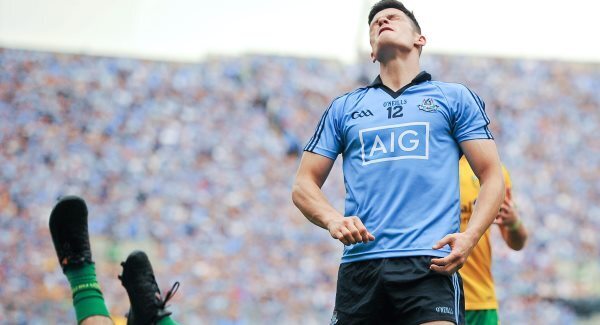
Dublin had an electric forward line; their winning margins that summer were 11 points, 15, 16 and 17, with their average return 28.75 points. But they craved goals. Monaghan were level at 0-3 to 0-3 on 25 minutes before Diarmuid Connolly side-footed a goal that changed the atmosphere at Croke Park.

McGuinness noted Dublin would push up on kick-outs, swarm and turnover from the front and manufacture a large quantity of their scores from there.

If opponents got past that initial surge, they’d panic – get “nose bleeds” and needlessly kick away possession in the wide open spaces — even though Dublin would only mark man-for-man and always, out in front.

“Nobody gave us a chance in hell,” wrote Rory Kavanagh in his autobiography Winning. “And for the first 25 minutes, that was still the unanimous verdict.”

Dublin led 0-9 to 0-4.

While Donegal defended what McGuinness called “the U” they accepted Dublin had it in their locker to score boomers.

McGuinness said Dublin doing this would not break Donegal’s spirit, but the concession of goals would.

Paul Durcan saved from Connolly, who’d started brilliantly. Christy Toye came on. Connolly and the impressive Paul Flynn, who’d boomed in points for fun initially, skied a couple. Donegal scored three in a row.

Then, it happened.

“The momentum just swung,” Bernard Brogan would later say. “Donegal went down, they got a high ball in, the bounce of the ball went to Ryan McHugh and he stuck it in the back of the net.” Donegal, despite only playing for 10 minutes, went in 1-7 to 0-9 up. In the second-half, their choreographic breakaways, perfectly embedded through McGuinness’s repetition at a five-day training break in Enfield, clicked.

“He’d set up a particular drill with two groups and the ball was played over the head of one of the groups and a man ran onto it,” Kavanagh added. “The man was told to solo down the field towards a two-on-two or a three-on-three.

“McGuinness wanted us to develop our decision making on the ball. As we raced down the field, he told us we were in Croke Park.

“‘You’ve broken through Dublin’s high surge’ ...

‘You’re on the ball ...

‘You’re on your own ...

‘What are you going to do with the ball?’

‘Don’t kick it away needlessly.’

‘Don’t panic.’

‘Don’t get a nose bleed.’

Anthony Thompson fashioned a second goal for McHugh to slap home on 39 minutes and from then on, Donegal were rampant ,ripping through Dublin’s undermanned defence time and again. It was the perfect storm.

Colm McFadden punched over. Frank McGlynn opted for a point when he might’ve gone on. McFadden rounded Cluxton for a third Donegal goal in front of Hill 16 as the Ulster champions had a five on three breakaway.

McHugh was denied a hat-trick following a fabulous fingertip save from the Dublin goalkeeper. Dublin, scoring from 50 metres in the first half, were missing from 15 in the second. McBrearty came on to kick two fabulous points.

“In my opinion,” McGuinness said afterwards. “… in football you can win every single game if your mind is right and your preparations are right.”

Dublin 0-17 Donegal 3-14 - not far off what McGuinness had predicted that very morning.

The ‘unbeatable’ team had been beaten.

More in this section

Cookie Policy Privacy Policy Brand Safety FAQ Help Contact Us Terms and Conditions

© Examiner Echo Group Limited