Dessie Farrell: Let’s learn from Congress 2016
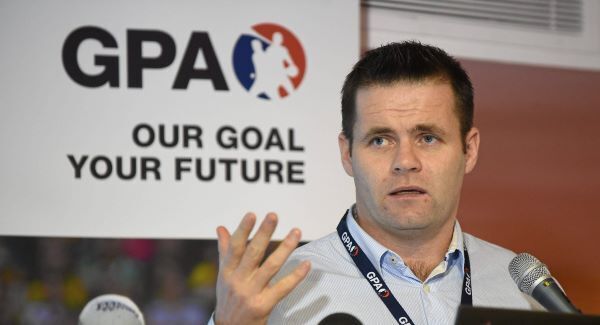
In 2011, the GAA agreed a five-year deal to fund the GPA and its various projects; an agreement worth €8.5m but in the more recent past, the findings of various player task forces and workgroups have received little traction from the powers that be.
Last year, the GPA’s innovative proposal for a new football championship was dismissed by Central Council.
And last weekend at Congress, Aoife Lane’s in-depth and tailored report on burnout concerns for students was scarcely referenced in a debate on player welfare which eventually rubber-stamped the abolition of the U21 and U18 age groups.
Reacting to the events at Carlow last weekend, GPA chief executive Farrell expressed his satisfaction that the “big ticket” items for players aged between 18 and 21 had been addressed but expressed the hope that the GPA’s research in other fields could be adapted in the coming years.
“In our report ‘Never Enough Time’ we had other recommendations to help the younger, more vulnerable players who are on U21 teams, county senior teams and playing Sigerson or Fitzgibbon Cup,” Farrell said.
“What happened last weekend with the moving of the grades was very encouraging but the GPA is part of the Minor Review Group as well, so we can see that more work is needed.
“For example, there is now the potential for a player in the U20 group to remain under pressure with exams because, naturally, they could be drafted into the U20 set-up much earlier than U21. Many of those involved will still be preparing for the Leaving Cert at that time of year, so it will be interesting to see how that works out.
“Our report also recommended that players be with just one team for set windows. For example, you play only for the college for a certain number of weeks, then play only with the U20s for a certain spell and if you’re good enough, you will have the county senior team after that. There will always be an overlap with clubs but that can’t be helped.
“I still think there are another three to four elements of this burnout issue to tackle before we get to the complete heart of it but the GAA generally gets to right place — it just might take a little bit longer. What’s encouraging is that debate has started and momentum built up on the matter.”
With their student welfare report coming in under the radar and their plans to restructure the football calendar getting short shrift, Farrell feels the GPA should be engaged with a lot more. He is still disappointed that Central Council rejected their football proposal so swiftly last year.
“We have been disappointed with the level of engagement around some of the work being completed in the association and the very obvious one was our championship proposals,” he admits.
“What followed after the dismissal of our plan was a quite unsavoury debacle regarding the mechanism that was put forward for a fixture overhaul. Central Council had to withdraw their motion for change and there was an adverse reaction from Division 4 teams pledging to boycott a ‘B’competition if the move was passed at Congress.
“All of that was unnecessary. For all of us — the GAA, the GPA, provincial councils, and Central Council. But there is a lesson to be had from that.
“There just has to be better ways of doing business. Sure, everyone will have a vested interest when certain plans and motions come up for discussion but with proper engagement and dialogue we can surely all find a set of solutions that are required.
“So I think everyone has to be more efficient on that front and the championship proposals are a good example. Ours were dismissed while some of the ones that did go forward were withdrawn or rejected by counties. The only point I would make is that the research we conduct each time we have a motion to present is acknowledged and debated. We gain insights from the players at the coalface and that should be put more vehemently into the mix.”
Farrell had hoped that the All-Ireland finals would be brought forward to condense the inter-county playing season and allow more high-profile games as he felt the the training-to-games ratio and the culture of overtraining are both overwhelming.
However, he said Congress dependancy for a two-thirds majority to effect policy change was a huge obstacle to that happening and made the task of evolution all the more difficult.
“With that in mind the two-thirds majority rule is outdated and needs to be changed,” he said.
“Every week, there are serious issues and new information is emerging in the world of Gaelic Games. There is new evidence coming to light on a weekly basis — important research from medical and scientific people, the GAA, the GPA, and academics who shine a light into areas that are important to us.
“How quickly can we react and respond to this emerging data?
“I would say we need to react much quicker and it’s time to look at the two- thirds majority ruling now and try to tackle that as well because it is a huge block to motions getting through, many of which are innovative and progressive.”
Meanwhile, Farrell confirmed the GPA will present another attempt to change the structure of the inter-county senior football championship in 2017 and hopes to have a vote motion on the clár for next year’s Congress.
He said the new proposals would be even more comprehensive than the last and more inclusive.
“We will have all the information assimilated well in advance and whether that is with the cooperation and input of county board, provincial councils, clubs, or supporters, we will be able to put this matter back in the mix and come again with another set of proposals,” the former Dubs star continued.
“We will be going ahead in a format that will be inclusive to all. People will have a chance to read our proposal and there will be sufficient time for necessary adjustments to be made before it goes in front of next year’s Congress.
“We feel there is an opportunity to readdress the championship structures again. In fact, work has commenced immediately on that front and we have officially engaged in robust correspondence with Croke Park.”
But why go back to the drawing board after such little success last time?
“To ensure the players’ voice is heard in all of this,” he replied. “We put in huge time, research, and work into developing a new path forward — based on what the players were telling us and while it was rejected, we’re not giving up.
“We know this is a very emotive issue and there are so many diverse views involved but quite simply players have to have a voice at that table and on their behalf we have all the necessary homework and research conducted.”
CONNECT WITH US TODAY



Be the first to know the latest news and updates