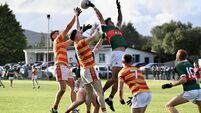
Hooter to ensure ball kept in play longer
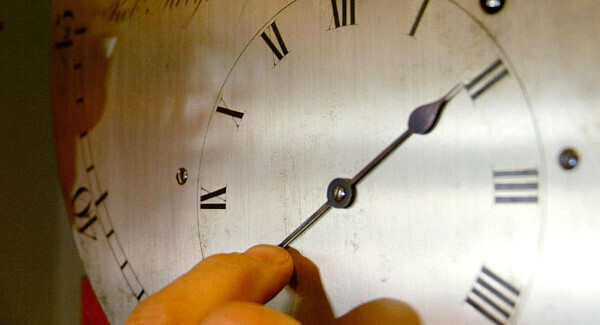
Time-keeping has long been an issue in both games, although it wasn’t until the Football Review Committee put forward a motion in late 2012 that it was actually addressed. Prior to that, Croke Park officials were reluctant to move on what they saw as taking away from the authority of the referee. But this is one duty they can do without. Last year’s All-Ireland football final and this year’s All-Ireland quarter-final between Cork and Mayo are just two examples where referees’ time-keeping has been seriously questioned by players.
The public clock, when it, as expected, comes into force for next year’s championship, will make the issue a lot more transparent. Initially passed at last year’s Congress for Championship football (69%), the motion to extend it to the hurling competition was supported by 84% of delegates at this year’s annual convention in February.
The following month, it was decided to delay its introduction until 2015 as a few teething problems arose during its trial on Sigerson and Fitzgibbon Cup weekends. A fifth official operated the clock on the sideline, taking his lead from the referee but only stopping when he signalled it due to injury or “other incidental delays not otherwise provided for in the playing rules”. They included a referee discussing a matter with an umpire, a melee and backroom teams being warned about their behaviour.
Substitutions weren’t included but either all replacements or just those in the last five minutes of games are included as “stop-the-clock incidents” in the series of recommendations which will form motions to Congress next month. Personally, for consistency’s sake we favour all substitutes being deemed stoppages.
What’s also included is a proposal that the end of a game should only come once the ball has gone out of play after the hooter has sounded. For the same reason as the subs, we feel the same should also apply for the first half.
Already, this column knows of some football managers who are preparing themselves for the likelihood that the duration of games will be longer than has been up until now. The trial games in the Sigerson and Fitzgibbon Cup games didn’t give rise to such concerns, with the longest half coming to 32 minutes and 30 seconds (college games being 30 minutes a half).
However, pausing the clock for substitutions, never mind other instances, will only add to the amount of time the game is alive, so to speak.
Also, while it might not be entirely applicable to hurling given how quickly a sliotar can be exchanged, it may be two or three minutes before a ball is eventually kicked dead to confirm the conclusion of a match. Combined with those late substitutions, hold-ups for injuries, melees and deliberations, we can kiss goodbye to the ubiquitous two minutes of additional added time.
What we can surely expect to see next summer as a result of the pending rule changes is an increase in the amount of time the ball is in play in both codes, something that is badly needed. In the 2011 All-Ireland football championship, statistician Rob Carroll found the average amount of time the ball was in play per 70-plus minute game was 34 minutes and 38 seconds, which represented just 46%.
Those numbers haven’t got any better. For instance, in last year’s Ulster SFC final between Monaghan and Donegal, the ball was in play for 33:48 (44%). In this year’s provincial SFC game between Armagh and Cavan, it was in play for 37:07 (51%) but in the Tyrone-Down drawn game it was again 44% (33:33).
Rugby shows similar statistics but that’s understandable in what is a more attritional sport. Australian Rules football on the other hand shows significantly higher returns around the 60% mark. Hurling’s numbers are similar if slightly less than Gaelic football because in a more fast-paced, stop-start sport the sliotar is more likely to go dead than a football. Another statistician, former Tipperary goalkeeper Damien Young, found the ball was in play for just 41% of game-time in the 2003 All-Ireland final between Kilkenny and Cork.
What the rules are sure to do is put even more of an emphasis on fitness of players in both games. We’re not talking a drastic amount but enough to ensure players are capable of lasting the pace in what will be longer matches. May we even see 30 minute halves at Championship level? Like the black card, it is sure to have a hiccup here and there is genuine concern in officialdom about how teams may run down the clock by retaining the ball through a series of hand-passes. Who knows, that may just precipitate on limit on them.
Of course, the public clock/hooter won’t be to the liking of everyone but from an observer’s perspective at least, the more football and hurling that is played the better.
CONNECT WITH US TODAY



Be the first to know the latest news and updates