Paul Galvin in his own words: The notebook slap - 'It was basic instinct'
Context. It is easy to overlook and ignore context in any story. Context is malleable of course, which makes it dangerous too. It is important for me to add some to this story. For the previous four months I had staved off the advised surgery on my hamstring tendon.
By the time the Clare game came around there was a lot of water under the bridge from 5 December 2007, but no football played. The physio and flexibility work as well as the eccentric loading, fitness and core-stability work had paid off. The morning of 15 June 2008, Paddy Russell and his officials got on their way to Killarney to officiate our opening championship game against Clare.
The game is stuck in my memory for obvious reasons. Clare are a difficult team to play against any day, at club or inter-county level. It was physical from the off. We never minded that. We could be physical ourselves. You have to be. I was probably our most physical player. Physicality on a given day is fine once it’s backed up with football; when it’s physicality followed by physicality for the sake of it you can get a bit pissed off with it. That’s where good referees and officials come in. After only a few minutes Declan went through on goal on a solo run towards the scoreboard goals, and the tackle that came in burst his nose and left him on the ground. No free. Paddy Russell ran past me as play continued while Declan was laid out on the ground. ‘Are you leaving that go, Paddy?’ I wasn’t aggressive towards him but as captain I had a right to ask him, and I was entitled to some degree of communication in return. He didn’t reply. Not communicating with players appeared to be standard practice back then. It seemed to be regarded as an insult by some referees if you asked any kind of question of them regarding a decision made, and a sign of weakness if they answered you.
By the second half I was right where I wanted to be. I was playing well after half-time. That is a point of context also. As I run back out to my position, having just scored a point, one of the Russell brothers lays into my direct opponent to get tight.
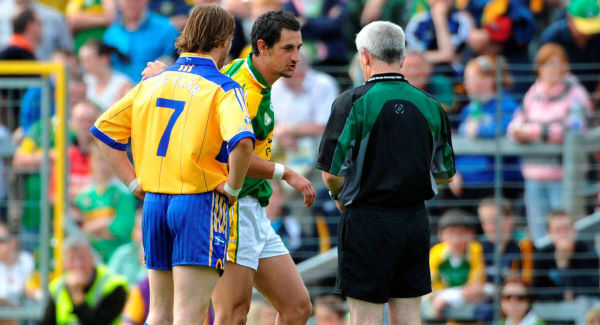
Not long after that I receive another ball, and he decides to try to get tight at last. Darragh had won a ball at midfield and slipped it to me. I spin and look inside. A give and go is on. I give the ball inside to Gooch and look to attack the space behind their half-back line which has been sucked out under the kick-out. I try to go by my man, but now he has taken the advice of his teammate to heart. He gets tight. Very tight. He grabs me, preventing my run for the return pass, pinning my arms down. I’m stood up and taken out of the play as it develops. When I am released, after two or three seconds, I turn to the linesman with my arms outstretched to bring his attention to it. (Was drawing the linesman’s attention the right thing to do? I don’t know. It wasn’t a habit of mine to look to officials. I dealt with things myself.) The linesman calls the ref. I don’t hear what is being said. Paddy books my man and turns towards me. A hum rises from the terrace. I’m about to be sent off. I want to know what exactly it is I’m being booked for. Paddy, having booked me already, doesn’t ask my name. He just writes in his little book.
‘You can’t be serious, Paddy?’ No response. ‘What are you booking me for, Paddy?’ No response. ‘What did I do, Paddy?’ No response. As he reaches for the card I impulsively slap the book from his hand.
It was basic instinct, an impulsive reaction born out of frustration. Frustration at not finishing my first game as captain just as I was getting into my stride. Frustration at the seven or eight other games I didn’t get to start or finish as captain. Frustration at missing the whole year up to this point through injury. Frustration at the long hours of painful physio and rehab work to avoid surgery. Frustration at training on my own. Frustration at having played all through 2007 with the help of painkillers for the same injury. Frustration at the doubts about whether I was even injured in the first place because, in my desperation to play for Kerry, to captain Kerry, I continued to train and play on the injury. Frustration at watching us win a league semi-final. Frustration at watching us lose a league final. Frustration at being on the receiving end of a bad decision. Frustration at Paddy Russell’s omertà. Pure frustration. None of that offers any excuse, just a little context.
Because I’m getting no answers from him I turn my attention to the linesman. I ask him what I’ve done to be booked. ‘G’wan away now, boy,’ is his reply. I turn to walk off the field. I want to get off the pitch as quickly as I can. As I do so someone grabs me from behind by the end of my jersey and pulls me back. It’s Tomás, one of my good friends and probably the guy I grew closest to in the group as a room-mate. He is trying to calm me down. I break his grip and walk away. I’m gone.
I was suspended for six months.
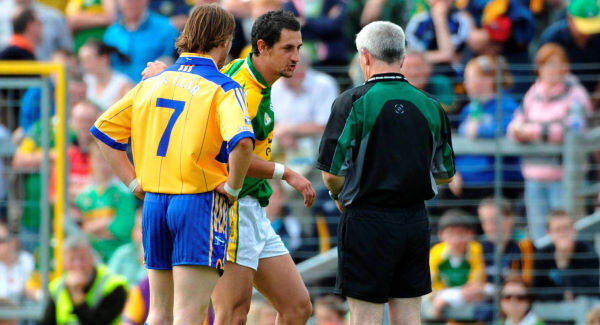
The county board contacted Croke Park to check out the situation regarding training with the team. Word came through from Paraic Duffy, the Director General of the GAA, who told the county board that he had no issue with me training with the group. I could return to training at any point. It was a Tuesday morning, if I recall rightly. I packed my gear bag for training later that evening. By lunchtime Paraic Duffy had called the county board back and changed his mind for some reason. I was banned from training with the group as well. The GPA were first on the phone offering help and support. Eamon O’Sullivan, the county board secretary, handled the case. A defence lawyer called Donagh McDonagh took on the case when it reached the DRA (Disputes Resolution Authority) stage. There was uproar in the media. I kept a low profile as the case was heard. Paddy Russell’s match report was fair. I was reported by the linesman for jostling, which earned me, Paddy Russell wrote in his report, a second yellow card. What Paddy didn’t say in the report was that I had knocked the notebook out of his hand intentionally.
That and the fact that the Central Hearings Committee neglected to introduce video evidence in support of their case meant there were possibilities and reasonable grounds for appealing the case. There was ambiguity. How did the Central Hearings Committee or Central Competitions Control Committee know that I didn’t knock the book by accident when they didn’t introduce video evidence? The members of the board were in danger of prejudicing their own case by talking about the incident like they had seen it happen, when in the strictest sense and going by the only admissible evidence submitted to them – the referees’ report – they couldn’t really know whether I had done it on purpose or not. They also had the opportunity to go back to Paddy Russell for a clarification, which they didn’t do in their haste to be seen to be acting. On top of this there was an issue with the proposed six-month ban by the CHC. It was being reported by the media as a fait accompli though it had yet to be imposed by the CCCC. This disclosure also gave rise to potential prejudice. It was getting messy.
The DRA had to accept that we had a strong case for the sentence to be overthrown, and so put the case back in the hands of the CCCC, who reduced the ban from six months to three months. The reduction meant I had the chance to play in an All Ireland final.
Paddy Russell struck me as a decent man. I shouldn’t have reacted the way I did. It was an impulsive thing to do. At least Paddy handled himself with some dignity afterwards. He issued a report which was fair and then kept his counsel, unlike his linesman, on whose advice he was acting. In his report, the match assessor, Eddie Cunningham, maintained that my second yellow card was harsh and that Paddy’s performance hadn’t been up to his usual standard — the first yellow card I got was equally harsh in my opinion.
Context? The whole day was a farce in my opinion. As for the linesman, the last place I saw him was the same place I first saw him. On a sideline waving a flag. Not in Killarney but in the new John Mitchels field in Tralee for a McGrath Cup game in January 2014 between Kerry and Cork IT. He’d had a lot to say in the aftermath, about the incident and about me personally. He publicly referred to my ‘stupidity’ and a lot more besides. His need to explain himself, though that didn’t appear to me to be standard practice, was telling; as the saying goes, when you’re explaining you’re losing. His decision to report me for jostling was incorrect in my opinion. My reaction made that irrelevant. Nonetheless I didn’t appreciate him talking about me so publicly. It was pretty small stuff. There’s a lot I could say in return but I don’t need to. Of course officials have a tough job, they get assessed. The linesman has been quoted as saying that, for officials, ‘there is no such thing as common sense - only the rules’. For me the game has to mean more than that.
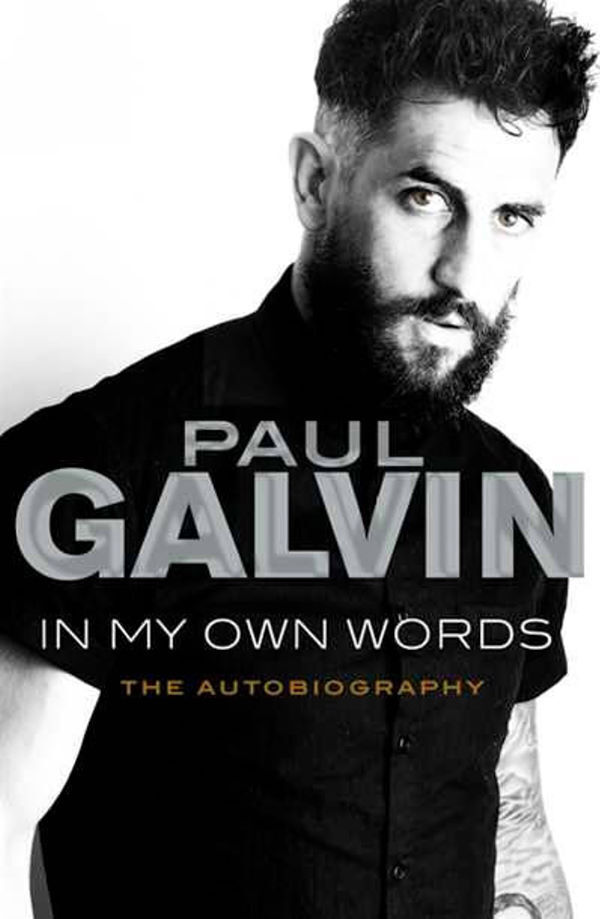
It would be eighteen months before I spoke about it publicly. And I never spoke about it again. I wasn’t interested in speaking to anyone. My inner dialogue was more important than anything I said publicly and would decide my reaction. I listened carefully to that. I am now happy to address this issue from my point of view, so as to contextualise the story and leave it at that. In what was one of the most talked about GAA incidents of recent times, there was the least amount of context offered around what actually happened. In fact there was no context at all. Maybe none of that matters when you take my reaction in isolation. Maybe it does. Make up your own minds. I made up my mind on it pretty quickly. I won’t underplay what I did. It was a moment of impulse. I can’t say it was blown out of proportion either. The problem for me was my reaction blew context out of the water. Something struck me early on which helped me to rationalise the whole situation. From the linesman to the referee, to myself, to the CHC, to the CCCC, to the CAC, to the DRA, and back to the CCCC again, the whole thing was unprofessional. Then again, aren’t we all amateurs? I’m not sure if it was the sadist or the survivor in me that eventually looked for levity in the situation. Paddy Russell provided it. I have to give him credit for the line he threw at Darragh on the field that day after Darragh told him he was having a stinker. Paddy stumped him by giving him some lip back. ‘You’re having a stinker yourself,’ he told him. Darragh told me the story on the phone one day. I had to laugh.


CONNECT WITH US TODAY



Be the first to know the latest news and updates