Kerry’s case for replay victory is sounder
— The Oxford English Dictionary Online.
Cuimhnigh ar Luimneach.
At some point during last week’s debate about today’s All-Ireland semi-final replay, it became possible to feel both deeply disappointed at the GAA’s willingness to play fast and loose with its own sacred traditions and a little queasy at some of the comments about Limerick.
In a proud sporting city that knows more than most about being unfairly maligned, the protestations that it was ‘nothing personal’ must have rang a little hollow at times.
One former inter-county player even went as far as to call the Gaelic Grounds a “kip” and a “hole”.
Comments like that were part of yet another unsavoury subplot to the main story: the GAA’s increasing tendency to ignore its better angels in the name of progress.
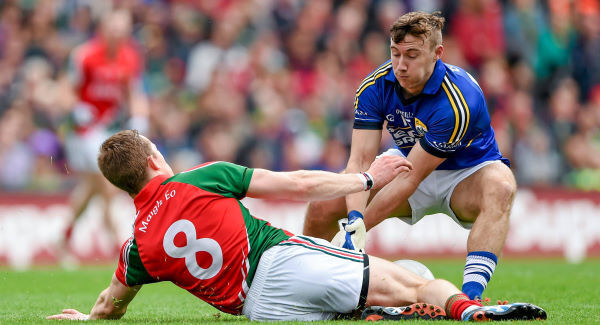
Limerick will get on with it. This evening Mayo and Kerry will have to do the same.
Some of those engaged in the business of punditry adopt a counterfeit certainty as their currency, but last week’s game had most of us struggling to predict an outcome. Well, almost a week on, and with the hard evidence of the drawn game piling up around us, it’s proving just as difficult to call.
But if sifting through the case file for that crucial clue has been arduous for the rest of us, imagine what it must be like for James Horan and Eamonn Fitzmaurice.
There’s exhibit A: Mayo’s disjointed first-half display. Then exhibit B: Kerry’s timid resistance to Mayo’s heroic recovery. Now, exhibit C: Mayo’s failure to close out a game they led by five points with five minutes remaining.
On and on it goes, and that’s before we even begin to summon the chief witnesses, among them one Mr Kieran Donaghy of Tralee.
Both managers, however, will ultimately relish the opportunity to build their case for the retrial from such a vast body of facts.
Buried in the post-match interviews last Sunday was a comment from Eamonn Fitzmaurice that suggested the Finuge man, although disappointed at not getting more out of a game that could have been won, was viewing the prospect of the replay as a-once-in-a-lifetime opportunity for a football obsessive.
“We’ve real context now this week to get our teeth stuck into something and see where we can improve,” he said.
The Kerry manager sounded more like a meat lover eyeing up a particularly choice fillet than a manager preparing for a marathon of video analysis and training-ground recalibrations. The word ‘context’ never sounded so appetising.
Earlier this summer, we wrote on these pages that Fitzmaurice, in spite of his low-key persona, was in danger of developing about him the same aura of invincibility once enjoyed by Jim McGuinness.
Now that the endorsements of his acumen have been flowing in, he would undoubtedly reject the idea that he has already proven himself, but there is an unavoidable sense that Kerry have found a manager with a singular footballing intelligence.
The question now is, what will Fitzmaurice do with all this ‘context’? Of course it would be foolish to turn this replay into a battle between two bright, driven, young managers. Good managers might crave ‘context’ more than anything, but all the granular analysis of kick-out strategies in the world won’t win a game of football if players are unable to act on the evidence presented in real time.
Last week, Fitzmaurice admitted that Kerry’s best-laid plans at half- time never came to fruition as his team sat back and invited Mayo onto them. At the end, it was players acting intuitively and thinking on their feet that rescued Kerry. In the case of Mayo, they only began to thrive when circumstances forced them to abandon their earlier caution.
So this evening’s replay will come down to more than who has learned what. The winner will be decided by who puts what has been learned to better use.
The statisticians have been busy all week telling us that Mayo, despite been down to 14 men, owned the second half, creating three more shots than Kerry whilst also impressively converting 71% of shots. We also note that while the pressure anticipated high up the field from Mayo did materialise, (five turnovers inside the Kerry 65 yielding 0-4), Kerry too had four turnovers of their own inside Mayo’s 65, resulting in 0-2.
Much has been made during the week of Kerry’s inability to secure their own kickouts during that period of Mayo dominance when they turned a five-point deficit into a five-point lead but the figures will show that of their 25 kickouts, Kerry actually won 19.
However, of the six kickouts that Mayo won, they turned five into viable possessions and worked a shot on goal from three of them.
Mayo, also, had 25 kickouts of their own, winning 18, securing 11 of these to launch an attack, and actually pulling the trigger for 10 out of the 11. Kerry won seven of Mayo’s restarts, launched attacks from all seven and got a shot off in three cases.
The devil in the detail is that Robert Hennelly and his intended targets lost three of their own kickouts in the final frantic five minutes which led directly to Kerry’s period of dominance at the end.
Prior to James O’Donoghue’s goal in the 68th minute, Hennelly went long because Kerry had squeezed the backs and limited his options. Killian Young retrieved possession and with the help of Peter Crowley and David Moran, launched the attack that led to Kieran Donaghy’s catch and the O’Donoghue goal that made it a one-point game.
On the very next restart, Hennelly went long again, David Moran got a hand in to tap down and Peter Crowley went after the ball as if his life depended on it. Even after Kerry had drawn level at 1-16 each, Hennelly kicked out to the Cusack Stand side of the field but it was Barry John Keane, not the most noted fielder, who pulled the ball down to earn the free that gave Bryan Sheehan the ultimate long-shot at glory.
So while Brian Kelly and his colleagues have had their second-half kickout strategy questioned all week, Mayo’s default restart (that of kicking out long to the better fielders, Tom Parsons, Aidan and Seamus O’Shea) didn’t deliver the expected results for them either.
The key question ahead of this rematch is which team’s kick-out strategy will prove more adaptable. After that, it’s a question of which team is willing to scrap the hardest.
Given that Kerry unexpectedly won the battle for kickouts that could be considered up for grabs (they won those 20-15), it is a small wonder Kerry didn’t push up more on Mayo’s short kickouts six days ago. They did, after all, have an extra man for the entire second half.
Directly after Crowley’s fisted point in the 64th minute, Rob Hennelly was able to go short from the next kickout. At this stage, Kerry were four points down with six minutes to go, and should have been contesting every ball as if it were the last. Mayo having 15 players on the field again must be a real concern for Kerry and they will have to force Hennelly to kick long as often as possible from the start this evening.
Why all the emphasis on possession stats from kickouts?
Simple really. Mayo and Dublin are perhaps the two teams that can do most damage to you when you don’t secure the ball from restarts. Only Mayo and Dublin commit as many bodies to attack and, without the ball, they simply can’t go on the offensive.
Kerry have obsessed for the best part of a decade about Stephen Cluxton’s kickouts and how best to limit the amount of times teams such as Dublin can attack. Under the current regime, they have learned the art of controlling the tempo of a game better than before.
Fionn Fitzgerald’s point just before half-time best illustrates this. Starting from a sideline ball under the Cusack Stand, Kerry strung together 17 passes in just under a minute and a half, with only Ger Cafferkey’s attempted interception near the Hogan Stand sideline threatening to disrupt their rhythm. The point at the end was a bonus, but keeping the ball out of opposition hands was just as crucial. It takes a serious amount of work to counteract such a game, but Mayo are one of the few teams conditioned to undertake such work.
So, given all that context, what’s the skinny this evening? The bookies have Mayo slight favourites, rightly so given their experience and expectations, but it mustn’t be forgotten that Kerry had six players starting their first semi-final last weekend and five more appearing in only in their second.
At least 10 of Mayo’s starting 15 are having their fifth bite at the cherry.
The potential for growth is greater in Kerry and I take them to win.
Tomorrow’s semi-final in Croke Park is, on the surface, a little bit easier to call.
Donegal, with Colm McFadden and Karl Lacey still showing some signs of the doubt that can hobble even good players, are going to have to come up with something exceptional to get to the final.
The five-day think-in at Johnstown House will have concentrated minds on the task at hand.
One of the key elements of Jim McGuinness’ game plans over the past four seasons has been the elimination of variables and the introduction of controllables.
The controlled response to Armagh’s late, late show a few weeks back gives great encouragement to many within the county, but the Tír Chonaill men must know that too many injuries to key players have disrupted their rhythm these past 12 months and given rise to too many variables.
I don’t doubt Donegal’s ability to stay in the game longer than any of Dublin’s opponents up to now and with the form the McGees, Mac Niallais, Murphy and McBrearty are in, they have enough talent at their disposal to make it a very busy day at the office for Dublin. But we must be true to the evidence in front of all of us this season.
Even if the anticipated, dour uncompromising game materialises, I expect Dublin can play it that way too.
CONNECT WITH US TODAY



Be the first to know the latest news and updates