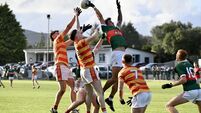
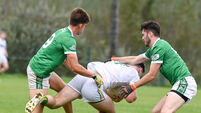
All about covering the angles for Allen
The second semi-final, Clare v Limerick on Sunday is unlikely to follow suit with Limerick manager John Allen anticipating a tactical battle from the outset.
“I suppose you factor in that it will be fairly full-on tactics. I won’t say a game of chess but we will both need to be very tactically aware of what the other is doing. We have discussed that with the players before the last two games. Things happen in games, a corner-forward comes out to midfield or a centre-forward comes out a bit. You saw the last day when Clare played a sweeper and Galway never seemed to use their spare man in the half-back line properly. You had Podge Collins dictating the play with a Galway back loose and it didn’t make sense to me. I think we have discussed that often enough with the players now that they know what to do if a corner-forward comes out to midfield, or if they are trying to isolate players, which Clare have tried to do in the last two games. They like to leave Darach Honan inside and give him plenty of space, pumping the ball into him.”
A test then to counteract those Clare tactics for former Cork All-Ireland winning player and manager John and his co-selectors, Eamon Mescall, John Kiely and Darach O’Donnell, but a test that excites him?
“Not at all! The last game I would say that went totally beyond me was the 2006 All-Ireland final when Cork were favourites (Allen was manager, had led them to the title in 2005); Kilkenny hit the ground running and we never got a handle on it. Sometimes you can see the way things are going and you can have time to respond. I don’t think we saw that Kilkenny performance coming. We are all aware of Clare and Davy — whatever you might say about Davy Fitz, he’s passionate about his hurling, he thinks about his hurling properly. It’s well documented that his teams were doing a huge amount of training from early on in the year, they have been together an awful lot and they know how each other plays. I know they’ve been criticised for over-playing the short game but I don’t think their game was that short the last day, their work-rate is extremely high. You will see players swarming around like bees and we need to contain that. I’m not excited by that at all!”
Allen though, is not the excitable type anyway, nor even a nervous type, more a calm, serene presence. “I wouldn’t say you get nervous. At this level everything is so measured in terms of the preparation, but the game itself is not measured. It moves so fast and so much happens, you’re on a wing and a prayer really — it wouldn’t be that you’re nervous. I wouldn’t fear any of the teams that are left. Kilkenny were playing two years ago and most teams feared that they would get a grip on the game after 20 minutes, score four goals and game over – you’re on the line like Jim McGuinness against Mayo a few weeks ago hoping that the bloody ground would open up and swallow you.”
The best you can hope for during a game is that the players themselves have the composure to deal with whatever new tactic is thrown at them. “Because the whole preparation is so measured and everybody has a fair idea of what they’re supposed to do on the field, I would have confidence our players know what’s expected of them. Once the players are involved in that decision-making I think it will go alright; the management really has no power on match-day because they can’t hear you.”
Limerick’s own tactics are now well-documented, in the forwards especially. Start with size and strength in the half-forward line, a powerful but skilful full-forward in Declan Hannon, pace in the two corners, then bring on the seventh cavalry in the final 20 minutes, big powerful ball-winners and finishers in Shane Dowling, Kevin Downes and Niall Moran.
“Like any manager, you’re trying to get the combination or the blend right. You want a number of scorers in your forward line, a number of hard workers; I’m not saying you finish with your best 15, you finish with a different 15. Limerick are lucky this year that there are a number of top quality players who are not making the first 15 who have come in and made a significant difference. That’s great, that’s what you want, 15 starting and five more you are confident will make a difference when they come in.”
It’s a tactic that’s been tried and tested in the Munster semi-final and final wins over Tipperary and Cork respectively. “The first day we started out against Tipperary we were obviously aware that Tipperary’s half-back line was particularly good and could influence the game and put our half-backs under pressure by delivering quality ball. You could make the same case for the Clare half-back line, which is particularly good and has three very good players in the air as well. You’re probably looking at a similar enough situation where we’d be hoping that the three half-forwards that we play won’t allow them dominate. We want to keep the pressure off our half-backs and our midfielders and not allow Clare to have the run of it, dictate the way the games go. Up to a month ago Tony Kelly was being written up as the playmaker but now you’re adding Podge Collins into that. They were very good against Galway, very good for the U21s. We need to ensure that they’re not getting quality ball in there and scoring points from 80 yards out.”
Not a chess game then but as near as you’re going to get, with 15 ‘pieces’ on each side. “We played them a good number of times. The players know each other well and anyone who played knows that there are certain players you don’t like playing on or against. I’m sure it will be the same with the Clare and Limerick players who have played each other pretty often.”
Where will those mismatches come? Who will make the first wrong move? At the final whistle this Sunday, will it be John Allen or Davy Fitz crying ‘Checkmate!’?