When two giants’ paths crossed
A year later the Cats were back; captained by Willie O’Connor, they walloped Offaly in the All-Ireland final and thus began a run of success unprecedented in the history of the GAA, nine All-Ireland titles in 13 years, seven National League crowns.
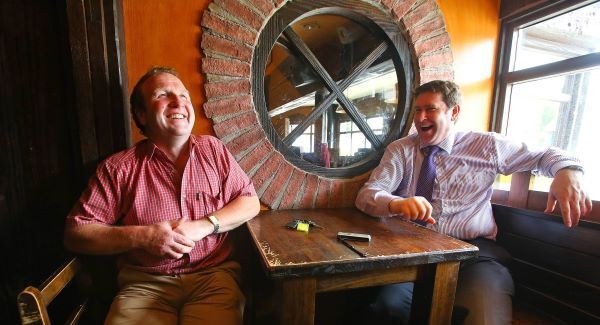
This week, Mark and Willie got together with Diarmuid O’Flynn to discuss that era, why Kilkenny went one way, why Cork went another.
DO’F: Were ye surprised by Cork in 1999?
WO’C: We were, and not taking away from Cork but I think Kilkenny didn’t perform at all that day. Fair play to Cork though and I thought that team would really come on from that but ye didn’t. Ye went away for a while, didn’t appear again for three or four years, while Kilkenny really drove on from that.
DO’F: So Mark, what happened?
ML: In 2000 we lost to Offaly in the All-Ireland semi-final but we were probably over-confident going into that game. We had an eye on the final rather than on the semi-final and that was fatal. I think we didn’t give Offaly their due respect but that was a great team, the likes of Brian Whelehan, Johnny Dooley, Johnny Pilkington, Michael Duignan and all those, a lot of outstanding hurlers. It was our own fault. We were very young, very naïve. I don’t think you’d get the same thing happening today with a similar team. Most of that side were only 22 or so in 2000 but had already won an All-Ireland, got complacent. They’d be handled very differently now.
WO’C: The way the thing is gone now, you can’t be complacent against any team. If you take your eye off the ball at all in a game. If a team loses concentration for even a second, they can be blown away.
ML: I think standards have gone up all over the place, in every county, and that’s in hurling and football. That’s been confirmed for me this year with the championship we’ve had so far, Dublin and Limerick as Leinster and Munster champions and serious contenders for the All-Ireland title, Kilkenny, Cork, Clare and Galway still in the mix.
WO’C: The skill levels are still the same but the fitness standards are gone way up. Go back to the ’80s and the ’90s and you had very skilful players but the pace of the game is going up and up.
ML: And fellas are getting physically stronger as well. Every inter-county player is in the gym several times a week now, stronger and heavier than they were even a decade ago. I’d say nearly a stone a man heavier than 10 or 15 years ago. Anyway, that was 2000. In 2001 we were without both Brian Corcoran and Seán Óg Ó hAilpín and were beaten by a point by Limerick down in the Park, a game I think we should have won. Limerick went to the All-Ireland semi-final that year. Then you had the hassle of 2002. So many things that affected us but all the managerial changes didn’t help either. Jimmy Barry-Murphy left the scene, he was replaced by Tom Cashman, then Bertie Óg after another year. There was no continuity like ye had in Kilkenny with Brian Cody and I think that’s been a major factor in your success. Brian Cody has overseen the coming and the going of a lot of great players over the last 14 years whereas we’ve had eight different managers in that time, and every one of those would have their own opinions on who should be on the squad, who shouldn’t, and on different styles of play. One manager might let a player go, another manager might want to keep him. Kilkenny haven’t had that problem. Brian Cody knew exactly the type of player he wanted to fit the model he had in mind for Kilkenny for that year and if a player didn’t fit that model, for whatever reason, he was gone. And there was never any talk in the paper, fellas complaining, whereas in Cork it’s been all over the place.
WO’C: The strikes were of no help to ye?
ML: No help, no, three strikes really and the effects are still lingering on. Fellas’ noses were out of joint at the time and some have never forgotten. As a county we have to move on from that and the younger generation are our best hope. There are fellas starting to hurl now who would know absolutely nothing about the strikes, no baggage. For a county to progress, administrators, management and players all have to be singing from the same hymn-sheet. If any one of those three is pulling in a different direction, you won’t win.
DO’F: Kilkenny have had that, but how important was Brian Cody to the whole setup?
WO’C: Brian has done a wonderful job but you have to remember, he has had wonderful players — a good greyhound will make a good trainer! Brian has had fantastic raw material but he’s the one who has gelled everything, pulled everything together and he has to get credit for that. He has managed to keep introducing new players but when something is going well, it’s easy to bring in one or two players every year and just keep the whole thing going. That’s how it’s gone with Brian for the last 14 years, he has kept things rolling along.
ML: But he has recreated Kilkenny on a few occasions. After 2000 he changed the team, had a different team by 2002/03, then a couple of years later he changed it again.
WO’C: He did but then you have young lads in a county trying to get to the top. It’s always easier when they have someone to reach towards, and Kilkenny have been very lucky that way. You had Eddie Keher years ago, then DJ, now Henry. Young lads are reaching for that standard all the time. Brian has shown a real stern side, the time of Charlie Carter and all that, but he brought the players along with him. No-one is stepping out of line. Look, Brian Cody is fair. It’s like anything else. If you go into your job in the morning and you do your work, the boss won’t say anything to you.
ML: He just wants you to get on with what you’re doing, no more.
WO’C: That’s it, and if you’re good enough you’re kept, if you’re not, you’re left go.
DO’F: After losing to Cork in ’99, coming back to win in 2000, did ye know Kilkenny were about to start building a dynasty, did ye see that coming?
WO’C: I don’t think so, no. In 2004 people were saying Martin Comerford was under pressure, captaining a Kilkenny team going for its first three-in-a-row. In 2000 I was captaining a Kilkenny team that was in line to lose three-in-a-row, that was pressure! There are plenty of lads there who would have been happy to point me out ‘there goes the three-in-a-row losing Kilkenny captain!’ But Brian was only learning at that time, and he’s still learning. We went on a team holiday after 2000 where everyone was together, players and management and we got caught in 2001. That doesn’t happen anymore. From then on, the players were here and the management were there. You’ve got to have that divide, even on holidays. But certainly there were some wonderful players coming through for Kilkenny at that stage and you had the likes of DJ still there, Henry only a young lad. But every young lad in the county was trying to get on that team. Things happened to favour Kilkenny too. The standard of hurling has fallen back a lot You look at Wexford, Offaly, even Laois, when can you see them winning an All-Ireland again? They were very strong teams in the ’80s and ’90s but they’re all gone back.
ML: That was a huge factor in Kilkenny winning so many All-Irelands in the ’00s. The fact they were able to win Leinster playing at about 70% then step it up for the All-Ireland semi-final and final, whereas in Munster every team had to be nearly at 100% from the start. Waterford and Cork were at each other’s throats for years, then you had Tipp coming through. Against Clare from ’95 to ’99 we couldn’t buy a win, and they were still strong into the ’00s.
WO’C: It’s like this Mark, if you have six greyhounds leaving the box together then crossing the line together you’re in trouble because you know the six of them are not going to be great. That was the situation in Munster. They were all playing at the same level and Kilkenny were able to sneak away from that level, stepped up a gear.
ML: There was such an emphasis on winning the Munster championship that everyone was cutting each other’s throats early on. Peaking at certain times of the year is very important, you can’t keep it up across a full season. Trying to play your best hurling in September is critical but I found you nearly had to be at full throttle in the Munster championship. It’s very hard to sustain that right up to the first Sunday in September. It’s different now. You have Galway in Leinster and you have Dublin, a new force. If you went back a few years ago and said Kilkenny wouldn’t win Leinster for two years in a row, people would have said you were raving. They came back to win the All-Ireland last year and fair play to them, brilliant, but then think back a couple of years ago and Dublin should have been in the All-Ireland final.
WO’C: That’s right, they should have beaten Tipp in the All-Ireland semi-final and they were without a few injured players that day, including Conal Keaney, who was a huge loss.
ML: There’s more work going on now in the teams that have gone backwards, the likes of Wexford, Laois and Offaly, they’ve all performed well enough in the championship this year. I think they’re going to improve over the next few years.
WO’C: And Kilkenny are coming back to the pack a small bit too. This is only a shadow of the team at its peak. They’re only hanging in there. Michael Ryan [Waterford manager] said it himself, they’re rebuilding yet they pushed Kilkenny to the limit.
DO’F: If they win it this year, it will be their finest hour?
WO’C: On the road they’re taking, definitely. Tipperary, Waterford, now Cork, and only in an All-Ireland semi-final after beating all those. If they do it, it will be a fantastic achievement.
DO’F: Can you see it happening?
WO’C: Certainly I can but they’re under pressure in the forwards. Eddie Brennan is retired, Henry is injured, TJ Reid is injured, Mick Fennelly is injured, Eoin Larkin is playing centre-field. Sure any team would struggle after that?
If all those lads are back, pushing everyone else, things could change. Richie Hogan is top-class and if gets the right ball, in my book he could end up as hurler of the year. He had a fantastic league, then above against Offaly he was my man of the match, he was the man who kept Kilkenny in it. He’s small but he can go up a lot higher than a lot of bigger men.
ML: And he’s strong. Fellas of that height can really adapt. They have to be that bit better at reading the game, have to have that extra bit of touch. He’s a fine player, great striker of the ball left and right.
WO’C: Against Kilkenny the last day Cody brought on Walter Walsh, took him off, brought him on again, took him off again. What does that say to the rest of the subs? No-one can assume anything.
DO’F: Which did you prefer as a defender Willie, a big fella like Walter or a small fella like Richie?
ML: Didn’t matter, he made small men of them all!
WO’C: No it didn’t matter to me, all I was interested in was the ball, win that and it didn’t matter what size he was.
DO’F: What do you make of Cork hurling at the moment?
WO’C: They’re in trouble, aren’t they? When was the last time Cork won a minor or an U21 All-Ireland? 2001, the minor, wasn’t it? That’s the problem. If you don’t have that foundation, you’re in trouble.
ML: It’s like the greyhounds. If you haven’t got good pups, you won’t have good greyhounds. It’s a lot harder to turn an older guy into an All-Ireland winner.
WO’C: Especially now with these development squads. A young lad at 18 now has as much done as we had at 23 or 24. If anything I think they’re getting too much hurling. Their fitness levels are way above what we were like at that age.
ML: You’re not getting too many fellas piking bales or picking spuds today.
WO’C: They brought in Health and Safety stuff and now you can’t even have young fellas picking strawberries anymore!
ML: I think the development squad idea is very important from a Cork point of view, in terms of preparing a minor team. It distills down the numbers and it means the manager doesn’t have to go through that process of trying to identify the best minor hurlers in the county. That’s only started happening in Cork recently but it’s the way forward. Of course you’d always keep the door open for the late developer but they’ll push themselves forwards in the club games.
DO’F: Who’s the next big team?
WO’C: If Kilkenny don’t win it this year I’d like to see Dublin or Limerick win it, that would be great for hurling. They’re doing great work in those counties and I really like John Allen. He’s very quiet, seems to be very intelligent, but he’s also very able. It’s not an easy thing to slip into a job after the previous manager has done well and he’s done it twice now, with Cork and with Limerick. I like Limerick. They look strong, they seem to be up for it. They’re strong at rugby, at football, at soccer so it’s a great achievement for them.
ML: Numbers suggest it will be Dublin. They seem to have sorted out the dual player scenario, it isn’t an issue anymore. Looking at their minor teams in the past, you could have 10 or 12 very good dual players but the managers seem to have come together and decided, look, there are three fellas neither of us can do without so we’ll share those. The amount of money that’s gone into promoting the games is huge. The one thing that might come against them is tradition. When they won the league in 2011 I don’t think they handled that success very well, they ended up going off the radar in 2012. They obviously took their eye off the ball. They weren’t prepared and Kilkenny wiped them out in the Leinster championship in Portlaoise. In fairness to Anthony Daly, he and his management team seem to have got them together. They’re still very strong, very physical, but hurling better than ever. Winning the Leinster title is huge for them. Their minors and U21s didn’t have a good season but that’s been the exception and this will bring them on again.

CONNECT WITH US TODAY



Be the first to know the latest news and updates