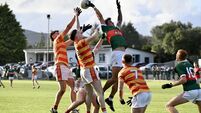
Are jersey numbers redundant and positions irrelevant?

Innovation is key in the modern game and ultimately could end up being the difference between winning and losing Championship 2012

Are jersey numbers redundant and positions irrelevant?

Is there any one position in Gaelic football that remains sacrosanct? The short answer is no, because as football has evolved, specialist players are becoming a rare breed.

Most teams now possess rounded individuals who can play in a couple of positions and perform numerous roles. Time was most teams filled certain key positions with a particular type of player. We all know the stereotypes. A vocal goalkeeper with a big kick out. A tight, pacy corner back. A full back with size and shovels for hands. A centre back that could hold the middle by any means necessary, a bonus if he could play a bit of ball. A midfielder that could fetch cleanly and run all day. A hard-working half forward. A playmaker (if you were lucky). A target man at the edge of the square and finally an assassin for a corner forward.

As skill levels and athleticism have increased, many modern footballers, particularly at inter-county level, are proficient at all of the above. As the game has developed greater breadth, so too have the requirements placed on the players. Mickey Harte has long been a master of this as he has invented new roles for his players to keep them fresh. Seán Cavanagh has played in virtually every position from 8 to 15. The best example of Harte’s innovation and his most ambitious manoeuvre was the relocation of Joe MacMahon from the half forward line to the full back line for a successful marking job on Tommy Walsh in the 2008 All-Ireland final.

In the modern game, rather than specialist positions such as corner back, players are considered full back line players. There is still room for the traditional attributes associated with this position but the player has to be comfortable anywhere in defence. Likewise at half back. The prototype now seems to be an Emmett Bolton-type that attacks and defends in equal measure, underlining their fitness. There is still room for a Kieran McKeever-style defender more interested in minding the house. The most important thing for a management team is achieving that balance.

With the advent of the new square ball rule, even the most specialised of positions is set for an overhaul. Traditionally a goalkeeper was expected to be safe under the high ball, have a long kick out and if he made the odd save or two, great. Now they’re also expected to be highly accurate with restarts and on occasion kick long-distance free kicks. Their ability under the high ball is sure to be tested as opposing forwards attack long deliveries.

Novelty is king. It’s a system of play that makes us sit up and take notice more than an outstanding individual redefining football. Last year Donegal’s all out defence marked the championship. Dublin were more conscious for their defensive shape and responsibilities and got the balance right between attack and defence. However, occasionally and more excitingly, a player revolutionises the game.

This happens in all sports. Tiger Woods emergence meant that golf course designers began to ‘Tiger Proof’ courses to guard against his length off the tee. Lionel Messi as a false nine for Barcelona has scored 68 goals this season forcing defences to sit deeper and deeper in an attempt to snuff him out.

Lawrence Taylor was another interesting ground breaker. The linebacker for the New York Giants in the 1980s and 1990s made such a ferocious impact that NFL commentators had to coin a new phrase to explain his phenomenal ability of catching the opposition quarterback in possession. Thus ‘sacking’ entered the sporting lexicon. Taylor combined size (6’3” and 17 stone), speed and determination to get at the quarterback again and again. One of their main rivals at the time were the Washington Redskins and their coach Joe Gibbs was constantly trying to come up with ways to protect his quarterback. Initially he had limited success as he struggled to contain Taylor.

The need to come up with a tactic to stymie Taylor moved into online folklore when he sacked Redskins quarterback Joe Thiesmann, breaking his leg in the process and ending the quarterback’s career. Taylor liked to attack his quarry from the left side of the quarterback or, as it became known, the blind side, as he studied his options down field. Eventually NFL recruiters began to seek out big, strong, agile and, most importantly, fast offensive linesmen that could play left tackle and could protect the blind side of their most valuable commodity. Because of Taylor, these much-sought after athletes joined the marquee names as the highest paid stars.

In the recent past in football, the individual that had the most impact in terms of the way football was played was Kieran Donaghy. He was a breath of fresh air when he announced himself on the national stage in August 2006. His obvious physical attributes combined with his aerial ability, his quick hands and forwards instinct meant he was a nightmare to mark. Throw in the fact that Colm Cooper was riding shotgun and it spelt serious danger for any opposition. Teams up and down the country began to imitate the modh díreach approach and midfielders were suddenly being converted to full-backs to counteract the aerial bombardment. Suddenly the full back, and his duties, were transformed. This summer as managers seek out their opposition’s blind side, I feel it’s at full forward again that may see the biggest stir. If Donegal’s Michael Murphy can rid himself of his injury problems and if Jim McGuinness decides to play him close to goal, he could be devastating. He has the ability to destroy teams with his strength, pace and finishing ability. If Donegal manage to get a decent supply to Murphy and isolate him, defences could be looking for a Lawrence Taylor style defender to bail them out.

TRENDS:

Square Ball

WITH the alteration of the square ball rule, it will be interesting to see how this impacts on championship games. Teams might try to come up with set plays in an attempt to snatch last-minute winners. Picture the bedlam when teams decide to lump ball after ball in around the goalmouth in the hope of getting a break in injury time. How the referees decide to police it will be crucial to how it plays out. If they decide to treat the goalkeeper as a protected species (as in soccer), it will result in a lot of frees out. However, if they decide to allow attacking players to make a genuine challenge for the ball — as they would around the middle of the field — it will cause pandemonium. In some ways it might make the referees job even more difficult as there is bound to be a lot of pulling and dragging as players jockey for position. Will more penalties result? With the removal of one controversial rule we will probably see plenty of controversy with the new one. TMO anyone?

Ball-playing goalkeepers

THE usual new season trend is to ape or replicate what made the reigning champions Kings of September. As if they don’t have enough to contend with, goalkeepers up and down the country will be judged by higher standards this year. Stephen Cluxton (below) proved he had the nerve and the skill set to convert long distance frees when he kicked the winning point last September. His kick-outs have long been appreciated. However, now all goalkeepers will be expected to have his range and variety of restarts. Expect to see much more accurate kick outs this summer and the occasional trot out the field to have a kick at goal. If a goalkeeper isn’t kicking well, if his team are coughing up kick-out after kick-out and if he is struggling under high balls could we see the unusual sight of the bainisteoir introducing a sub goalkeeper?

A McGuinness Special

I like Jim McGuinness (inset, right). I like the confidence in his approach and his players. The Donegal boss brought his side a long way last summer. He was demonised for the tactics used in the semi-final. Yes, they were negative and far from pretty but he operates in a results business. I would not advocate that style of football but I understand why he did it. People forget that Dublin were also very defensive in the same game, often leaving four backs marking Donegal’s lone ranger Colm McFadden (see main picture, above). It was as if both teams didn’t want to lose but were afraid to go and win it. I felt at the time that if McGuinness had played Michael Murphy in a more offensive position earlier the result might have been different. I will be very interested to see how he advances his game plan this summer. I expect Donegal to persist with their zonal defence when not in possession but I think they will be better going forward. If McGuinness can get a decent supply into a forward line featuring Murphy, Patrick McBrearty and Colm McFadden they could cause serious problems for any defence. As they won’t concede much, I’m looking forward to seeing what surprises McGuinness produces.

More in this section

Cookie Policy Privacy Policy Brand Safety FAQ Help Contact Us Terms and Conditions

© Examiner Echo Group Limited