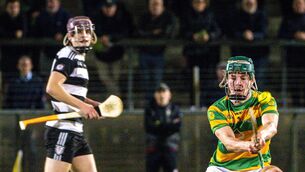
O’Flynn: standard greatly improved
O’Flynn also outlined rule changes which the Camogie Congress is to consider, ranging from allowing eight substitutions to awarding two points for a sideline cut put over the bar.
“There’s no question that camogie is better now,” said O’Flynn.
“The change from 12 to 15-a-side in 1999 was a factor in changing a game that was largely about ground hurling to a game with a mix of ground and aerial play. The approach to coaching has changed as well, and players are all doing gym work and conditioning work, just as hurlers are. The input into coaching has improved, and you’re seeing that on the field.”
O’Flynn said the proposed new rule changes were the result of an innovative online consultation process with the Association’s membership.
“We’re putting a new set of playing rules to Congress this year – we had an online consultation with our membership with how they wanted the rules changed. What we got back was a strong sense that there weren’t that many changes needed.
“What’s at issue is the increasing amount of physical contact, and whether that’s good or bad for the sport.
“We’re proposing to Congress that we have two points for a score from a sideline, as well as eight substitutions for league games.
“The thinking behind the eight substitutions is that everyone is carrying a panel of 30 at the moment, and it’s to acknowledge that – a lot of league games tend to be experimental anyway, and it’s a chance to give managers leeway to give games to as many players as possible.
“It’ll revert to five for the championship, but it’ll be interesting to see how the camogie membership responds to that.”
O’Flynn was positive about attendances at and interest in camogie nationally, and also paid tribute to intercounty players for being “vocal advocates” for the game.
She admitted: “Having our club finals in Croke Park is a big help, it puts the sport in the shop window and helps to generate a following.
“Of course we’d like more people going to our games, but our attendances have gone up year on year. Attendances at club, Ashbourne, Féile games (are up). We had over 5,000 at the club finals last year in Croke Park, our first time back there in 40 years, and that equals attendance at the men’s junior and intermediate club games. I see the glass as being half-full in that regard.
“Another advantage is that a lot of our intercounty players are vocal advocates for the game – like the Wexford players, All-Ireland champions, they’ve gone into other counties to help out. I compliment them on that, because it’s hard to do that when you put in the work required just to win. That’s the strongest advertisement you could have for the game.
“The growth of the game internationally has also been a boost – if a player in Boston can pick up a hurley and learn the game, there’s no reason a girl in any county in Ireland can’t do the same.”
Another development O’Flynn is proud of is the review of the organisation’s constitution, but her own immediate future is focused on more hands-on work.
“The national development plan is very important in terms of providing a road map for the game, and we also carried out a review of our constitution to make the administration of the game more reflective of contemporary needs. Any organisation is building on what went before, but it’s a very exciting time. I’m doing a coach education tutor course soon, so I’m not going too far from the game, just getting back on the pitch a bit more.”
CONNECT WITH US TODAY



Be the first to know the latest news and updates