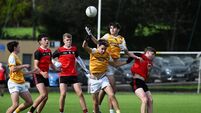
Players advised to be tactical in job interviews
Eoghan McDermott of the Communications Clinic points out in a new book that while intercounty stars need to show confidence on the field of play, that may not be fruitful when trying to get a new job.
“There would be things players need to keep in mind,” said McDermott. “They have to be clear on what they want to achieve. If they’re playing a match they need to be confident, but have a swagger.

“If they’re trying to convince someone that they’re the best man for a job, however, it’s like going to a coach and saying ‘I’m the man to play corner-forward’ they have to be able to present evidence, specific proof to support that. They need to give more, even if they’re the best known GAA player in the country.
“What they need to think of is ‘where I have done something like this before, what successes have I had in the past which relate to this’.
“They can’t go in overly confident, they must be able to prove they can do the job, that they have the skills rather than saying ‘I’m an intercounty player, give me a job’.
“Something I advise GAA players is to prepare answers to show they’ve done it in the past. If they want to play corner-forward they can tell the manager ‘I’ve scored in the last four games’; that’s something they need to apply in an interview process.”
McDermott added that while prominent hurlers and footballers may be accustomed to press interviews, employment interviews are quite different.
“The fact that one person is asking questions of another, they’re similar, in after-match interviews and so on, they’re probably thinking of what the interview will look like in the paper.
“In a job interview, however, they need to prove to the other person that they can do the job. In a job interview they need to be more proactive, to offer information to the interviewer and bring something to the table.
“In press interviews, however, you may find them to be more reactive.”
McDermott cites the example of former Armagh footballer and well-known sports psychologist Enda McNulty in his book.
“Whether you’re an out of work GAA player or not, you need to treat getting a job as your job – when the championship is over you still won’t have a job. you need to figure out who to meet, who to talk to, what kind of things to do, go to interviews even for jobs they don’t want as a learning experience.
“Enda (McNulty) works with us and he talks about the importance of being optimistic and resilient. That applies whether you’re a sportsman going out onto the field for a game or someone going into a job interview. You may get 18 or 19 ‘nos’, but it only takes one yes; experience is what happens when you don’t get exactly what you want.”
McDermott disagrees with suggestions that the huge time commitment required to play at intercounty level is a disincentive to employers when considering prominent players.
“Playing intercounty shows massive dedication to a cause, that you can put in the hours and the effort. That can be linked to the role employers are looking for – they’ve shown they can be dedicated and they need to remember they have to show that to the boss interviewing them.
“Without stating the obvious, they’re going to have to show they can develop a bond with their new teammates which will benefit the organisation.
“A GAA player or sportsman has an advantage in that respect, and one of the things I mention in the book is someone who always looks for sports in the ‘interests’ section of a CV because it shows a sense of being able to work as part of a team.
“Linked to that is the ability to build relationships and have interpersonal skills – to deal with conflict and difficult issues, to forge relationships whether they’re in the club or outside the county.”
nThe Career Doctor by Eoghan McDermott is published by Currach and costs €14.99.