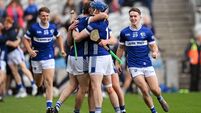
There’s quality coming around the corner in Limerick
He was a perfectionist as a player, one of the most stylish of the modern era and he has been just as obsessive in his quest to spread the gospel, always with the emphasis on coaching more than managing.
In essence, hurling all but dominates his life; it has done so for five decades. As far back as 1970, he helped raise Antrim’s standard (leading them to success in the All-Ireland intermediate championship), and in between coaching Cork on two occasions he led Clare to two Munster final appearances and three consecutive league finals (two of which they won with a team which included Ger Loughnane). In more recent times, of course, he brought Waterford out of the doldrums before being forced out last summer.
Now, he is at the helm in Limerick and facing up to the Déise in the first of the provincial semi-finals in Thurles tomorrow (4pm).
“I am always thinking of hurling. I could be out in the garden, or I could be driving the car. But, you are maybe thinking of training sessions, of developing different tactics, different ways and means of planning your training schedules. And thinking about the opposition obviously,” he explains.
Central to his approach is a powerful motivation to help players develop the skills which will enable them to fulfil their potential. However, he remains very competitive.
“I like to train them to try and be successful. The ultimate prize is success and it gives you a great thrill to win something — because you are measured on that long term. But I like to leave something after me, that I am after making a contribution. I don’t want to go in for a quick fix and I’m gone again.”
And, however disappointing the manner of his departure was, that’s how he looks back on his time with Waterford — pointing out that he does have outstanding memories of the seven years he spent with them.
“Thirty-nine years without a Munster championship was too long and I felt that had to be got rid of fairly fast. You could be managing forever and all of a sudden you win nothing. I am a man in a hurry too. If I was being a nice guy and doing all the right things, we probably wouldn’t have won (trophies). So, I had to get down to working fairly fast in developing the team to play a better type of hurling and to have more belief and so on.
“My ultimate aim was to win something for them. That was the first thing I wanted to do and that had to be done fairly fast.
“Sometimes when you want to win something you have to crack the whip a bit. You’re not always the nicest fellow in the world and I had to do that. We won three Munster championships and in great style. I like to bring that bit of style to a team too, which is important. To go on and win a National League against Kilkenny was great too, because Kilkenny are an outstanding team.
“These are all great memories, but passing memories. I’m a man that’s in the present too. I don’t want to be looking back too much.”
The challenge he saw facing him after taking over in Limerick was one of strengthening a team which was clearly hurting after the hammering they got from Kilkenny in the 2007 All-Ireland final and which under-performed last season.
“I see a lot of young talent coming up. I see great interest among the people and they know a lot about hurling in Limerick. I have a nice squad of players and I have good people around me. My intention would be that we develop and that the team would get more efficient in all areas to be able to compete and hopefully that we can win something.”
The management felt it necessary to introduce a lot of new players to the squad, some of them current U21s, with no experience at this level. And to make room for them, some established players were excluded. He says they were given chances early on, but going forward he didn’t feel they had “the right quality” to be good inter-county hurlers.
The league was quite satisfactory from the perspective that they only lost by a point to Kilkenny and Cork and by two to Galway. Its real benefit was that it facilitated the process in getting everything to gel.
“It’s a two-tier thing,” he says. “First of all you are trying to win games in the league and secondly you are trying to build a team and I think you have to build for the future. We have brought in a lot of young players who are learning their trade and getting to know what inter-county activity is all about. You are trying to give them experience in some games, League or challenge and see then if they are prospects coming forward for the championship.
“That’s the main theme at the moment — to try and get a good formation and a good panel of players.
“I see some good talent coming through, but it might take another year to fulfil their ambitions. Having said that, I am pleased with the progress and I can see them going in the right direction.”
He’s also pleased that is getting the type of commitment he sought from the players at the outset, bearing in mind the rumours that had been circulating last summer about players drinking before important games. “Like any manager coming in, you set out your stall. You have guidelines to give to your players and the people with you. It’s about people working together.
“I can’t watch players 24 hours a day but I have to give them good advice about what’s best for them for preparation for big games. And that’s important. I’m a great believer in getting the atmosphere and the environment right. In creating that, you will have better harmony and more commitment because this is a job that has to be done together. I heard bad reports about Limerick but, so far, I have a good bunch of players down there all interested in getting better and trying to win something.”


CONNECT WITH US TODAY



Be the first to know the latest news and updates