Business of Sport: ‘Three’ think it’s all over… but Chelsea sponsorship blues set to linger
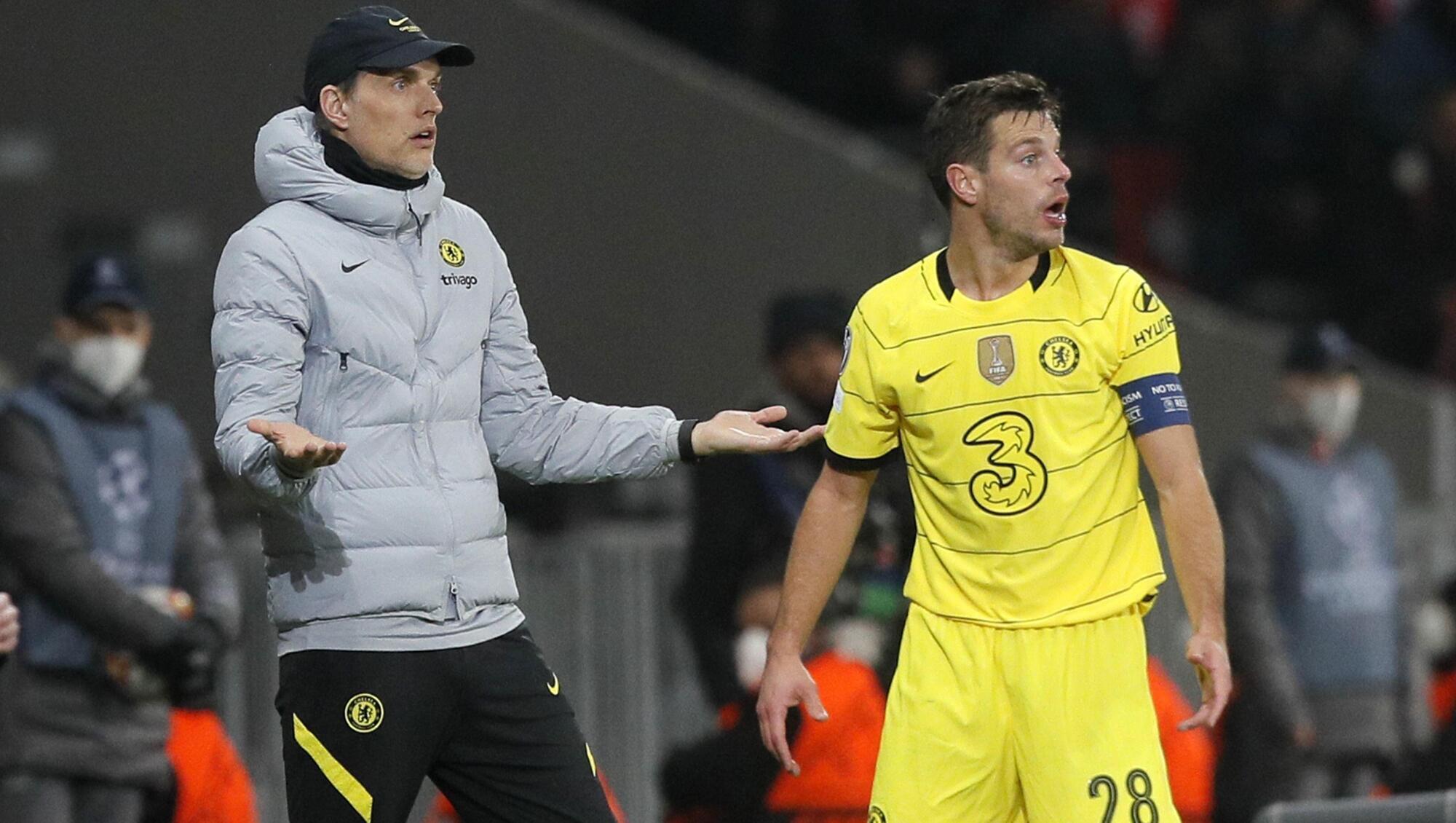
Chelsea's Cesar Azpilicueta, right, and Chelsea's head coach Thomas Tuchel react during the Champions League, second leg, round of 16, soccer match between Lille and Chelsea at the Stade Pierre Mauroy stadium in Villeneuve d'Ascq, northern France, Wednesday, March 16, 2022. (AP Photo/Michel Spingler)
‘THREE’ mobile’s €142m separation from Chelsea FC is a landmark moment in how sports sponsorship break-ups can go horribly wrong.
A basic PR error amid a failure of rudimentary due diligence has turned what should have been a moral open goal into a disastrous seven days for the firm.
Of course, if Robert Finnegan - Three’s Irish CEO of its UK&I business - had his way, the company would probably never have taken on Chelsea in the first place.
That €47m-a-year deal with the Board at Stamford Bridge was done before the Waterford man walked through the door at the company’s Reading HQ, exactly two years ago.
For many observers the partnership made little sense based on the exorbitant costs – around the same money would have bought shirt sponsorship at Liverpool at the time – a different brand, entirely.
The first year could not have gone better for ‘Three’ from a branding perspective, with Chelsea landing an unlikely Champions League title, then European Super Cup and onto a World Club title.
However, an error-strewn week for the company’s sponsorship, marketing and communications teams has landed the brand in grave difficulty, and all because of going too hard and too fast on a statement.
Announcing it was correctly suspending its relationship with Chelsea should have been enough but then demanding the immediate “removal of our brand from shirts” was an own goal.
Logo-free kits are explicitly barred in commercial football contracts, where only shirts with branding must be produced – outside of international football tournaments.
Three’s sponsorship team should have advised Robert Finnegan that the club’s entire season stock would have been planned and produced by Nike, complete with company logos.
Stock supplies for football shirts has been hugely challenged in recent years and even Nike will struggle to get new shirts produced and shipped within days, as we saw v Newcastle last Sunday.
You could also question why ‘Three’ didn’t come out in the first place and announce it was terminating its contract with Chelsea with immediate effect, and why all of the hesitancy and suspense?
This could well be down to money paid upfront by Three – Premier League clubs commercial contracts demand payments in advance – and the slim hopes that the company holds in getting some of that money back.
The suspension won’t be covered by ‘force majeure’ – or Act of God contract clauses – and repayment from such activations are never an option.
‘Three’ will know that if monies are due – and this is the big legal test – they will unlikely see any of it now that the club is no longer free to do business by UK Government order.
Any new owner won’t want to know about legacy debts either, particularly from a club which the Johnson administration has ruled has links to Vladimir Putin.
A ‘Three’ source told The Pitch “the company continues to monitor the situation closely” – as will millions of others.
Considerable debate followed RTÉ’s decision not to broadcast Shamrock Rovers vs Bohemians last Friday, to instead focus on Wales v France in the Guinness Six Nations Championship.
However, there should be no debate when it comes to sports broadcasting, where only one size matters. On Feb 25, a match involving Shamrock Rovers – this time away to Derry City - pulled in an average audience of 21,000 viewers.
The reason - apart from traditionally small audiences engaging with SSE Airtricity League games in the first place - was due to an U20 Six Nations rugby match between Ireland and Italy, which was broadcast on Virgin Media and which was watched by 140k viewers.
The market share of audience who chose to tune into the champions of Irish football away to Derry was just 2%, a number so low it won’t even register with commercial interests.
Sparking much of the debate last Friday was a question from broadcaster Ronan Mullen, who reasonably asked how a “non-Irish Six Nations game can be televised at the expense of Rovers vs Bohs”.
Mullen stated that for him “the viewing figures argument doesn’t wash” and the national interest should always trump “TV by numbers”.
Does Mullen have a point? Should the nation be provided with one of the more exciting League of Ireland games, featuring the champions and their biggest rivals? Or is the national interest so disinterested that the (average) 300k viewers who tuned into the rugby are a far more valuable audience?
In the world of broadcasting, figures are the most significant numbers for any broadcaster. One of the most interesting responses amongst the flurry of interactions on Twitter came from Fergus McCormack, an RTÉ communications officer who pointed out that it was a contractual obligation for RTÉ to show the Friday night rugby ahead of the football.
“No Wales v France tonight (Friday) would mean no England v Ireland tomorrow. And I say that as someone who will be in Tallaght Stadium tonight,” he tweeted.
RTÉ pointed to comments by Head of Sport Declan McBennett who frankly discussed television audiences in the recent past on the LOI Central podcast.
"I met the League of Ireland clubs in the Aviva Stadium in late 2018," McBennett said. "I said to them, in broad terms, if your product is over 100,000 of an audience, then you're a flyer. If it's between 50k and 100,000, legitimate questions will be asked. And if it's below 50,000, then quite frankly, you're in the drop zone, because it's in a very, very competitive environment."
Over the weekend both rugby and football were ‘flyers’, with Wales v France experiencing peak engagement of 364k fans, while Kerry v Mayo in the Allianz National League was seen by a peak of 461k. England v Ireland on Saturday was watched by a peak audience of 1,008,000 viewers.
Of course another solution for all would be for the FAI not to pick the biggest football fixture of the year to run at the same time as a rare live Friday night Six Nations broadcast.
THE crowds are back in record numbers and revenues will exceed previous totals. But are punters staking as much money on Cheltenham this week as they did for last year’s event behind closed doors?
Irish-headquartered Flutter Ent. tell that it expects to see more than €237m invested by racegoers over the week, a figure which would be down on the €275m it pulled in last year.
While punting from the sofa during the pandemic was done without the distraction of bars and hospitality, it made for a bonanza year for betting companies in 2021.
Flutter’s Paddy Power, Betfair and Sky Bet brands may still yet exceed previous records, cautious forecasting is the name of the game for gambling companies, and you can expect the same from the other big beasts.
Coral, Bet365, William Hill and Ladbrokes, along with the rest of a growing field can expect to pull in anything between €500-700m once the Gold Cup is run, by around 3.50 Friday.
Another area expecting great things tomorrow is broadcast, and ITV Racing’s Ed Chamberlin told The Pitch he expects figures to be as high as 3m for the Gold Cup.
Chamberlin explained that ITV’s coverage wasn’t just important to the viewers at home, but to the up to 30 sponsors on site for the week.
“I would have thought that five races being broadcast every day is so very important and valuable to the Cheltenham Festival and for their sponsors,” said the presenter.
ITV is believed to pay out up to €10m per year for its racing coverage, and a key chunk of that is invested on Cheltenham.
Tens of millions of euros will be forked out by sponsors who invest into The Jockey Club, where they are looked after by its Director of Partnerships Carey Weeks.
Weeks believes that commercial partners enjoy unique visibility through packed enclosures with fans paying from €47 to €130, for the privilege.
Among the key sponsors paying big are high-end names including Boodles, Ballymore and Bentley, to be part of the racing spectacular.
Racegoers in the general enclosure areas have forked out up to €20m for their week’s access to racing’s greatest festival, where added spend in the bars and restaurants is expected to exceed €10m.
The value of the Cheltenham Festival to the immediate area has been worked out at €120m in tourism impacts, – however, that study was conducted six years ago.