Godfather carries hopes of a nation
In its halcyon heyday, this corner of chaos carved out of the desert was home to a whole other kind of mob, one now confined to Hollywood’s halls of memory.
But yesterday, Las Vegas was again reverberating to the beat of the godfather.
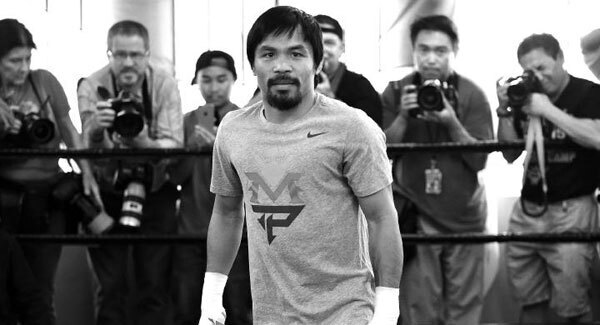
Before Floyd Mayweather and his moneyed entourage rolled through the MGM Grand in mid-afternoon, Manny Pacquiao set fight week aflame with a public rally that went a long way to showing just where public sentiment lies ahead of the biggest bout for a generation.
From early morning, hordes clogged up the Mandalay Bay resort to officially welcome Pacquiao to town. He’d actually arrived the night before, as close as one can to going under the radar in this of all towns and this of all weeks.
The Fight of the Century may be looming but Pacquiao was like he always is. All smiles, all jokes, all happiness, all hope.
This long-overdue welterweight showdown will be worth over half a billion dollars by the time he is joined in the ring on Saturday night by an opponent who has never tasted defeat in 19 years and 47 fights as a pro.
Such numbers should be cause for intimidation, trepidation even. But this is a man, 5’6” of frame, who, at last count, shoulders the hopes and dreams of 98,390,000 others. And he shoulders them well.
He may be Pacman to most of the world, but in his homeland, Pacquiao is the ‘Pambansang Ninong’. It translates to ‘national godfather’ and in the Philippines, a country where family bonds are tighter and given more import than even religion, it’s a title that goes at least some of the way to conveying just how central to daily life he is.
Pacquiao’s Filipino omnipresence — sportsman, elected official, actor, musician, business owner and plenty in between — has to be seen to be believed.
I spent time in the Philippines during a period of intense crisis for both him and his homeland.
Typhoon Haiyan, the strongest in global history, had slammed through the country’s islands, wiping towns from the map, killing upwards of 8,000 and crippling the national conscience.
The source of joy, even in such stricken times, was the same source as always. And yet it couldn’t have been described as expected. It was November 24, 2013. Pacquiao was making his return to the ring after an 11-month absence on the back of a soul-shuddering knockout loss to Juan Manuel Marquez had dealt him back-to-back defeats for the first time in his life.
In his capacity as congressman, Pacquiao was desperate to interrupt his preparations for the fight with Brandon Rios to visit the affected areas. But he knew where his efforts would be better put to use and stayed in camp. Filipinos don’t watch their favourite son fight like the rest of us. While the rest of the world has oohed and aahed as he beat all comers and all historic precedent to become world champion at eight different weights, his countrymen watch on as though the whole thing was slapstick comedy.
Each evasive duck and weave is met with hysterical laughter, each wicked left hook he landed on a helpless Rios this night provoked a humorous whoop. In its time of tragedy, Pacquiao had given his country happiness as much as hope.
“This isn’t about my comeback,” he said in the ring afterwards. “My victory is a symbol of my people’s comeback from a disaster, a national tragedy.”
That personal comeback has led him and his huge entourage back here to Las Vegas and the biggest prizefight in a lifetime. For the boy born into a bamboo hut on Mindanao Island, raised in General Santos’s City of Dust, schooled in the fight game amid the mayhem of Manila, Saturday and Mayweather is as big time as it gets.
“I could never have guessed what he would [become],” said Ronnie Nathanielz, the voice of boxing in the Philippines, of Pacquiao’s journey. “This country was down in the pits. No respect. No recognition. No nothing. He gave it back to us. Through his fists. And through his charisma.”
Pacquiao’s autobiography Pacman: My Story of Hope, Resilience and Never-Say-Die Determination is hardly remembered as one of sport’s great tomes. Written five years ago, it is merely an abridged version of his extraordinary life story.
Where it does provide particularly worthy insight however, is into those early days when Pacquiao had committed everything to the hope that boxing could be his, and his family’s, way out of abject poverty. Having moved to Manilla in his early teens, he recounts how he juggled training with three and sometimes four jobs, gardener, kitchen hand, tailor, rust-scraper at a mental yard, to make sure he could send money back to his mother in General Santos City.
“I slept in the streets. I ate once a day. Sometimes I just drank water,” Pacquiao has said. “That was my life before. So I understand the needs of people who need help.”
While the rust-scraping days were well behind Pacquiao by the time he made the move stateside, he was again mirroring a national rite of passage. Almost 10% of the Filipino population move overseas for work. They too are heralded as heroes, sending upwards of $20bn (€18.2bn) home to relatives annually. This remittance accounts for over 10% of their country’s economy. Pacquiao too funnels his own millions back to his homeland, even if some of his entourage have been accused of not making the best use of his never-ending generosity.
At every turn Pacquiao is not just a man of the people... he is the people. Distilling down a country of almost 100m people and 7,107 islands into one single being is obviously an impossible task. But for the Philippines, Pacquiao would undoubtedly be that being — the economic migrant, the selfless donor to those back home, the religious devotee who struggled with vices and temptations, the believer striving for personal, political and social improvement while at the same time struggling to manage the bloated band of quick-buck hangers-on. The hope. The happiness. All of it.
He helps his country even when he doesn’t intend to. On Saturday, the traffic jams that choke Manilla will clear as fight time approaches. The separatist skirmishes in the south of the country will come to a ceasefire. All eyes will fix on Las Vegas.
In the parlance of modern football Pacquiao is not quite captain, leader, legend. A more fitting epithet might be fighter, reformer, and above all else, godfather. His mob anxiously await his next move.
CONNECT WITH US TODAY



Be the first to know the latest news and updates