‘If my optimism dies, so do I’
Back in his early days in Ireland, Zaur Antia needed to get to DCU but with no more than a few words of English scraped and scrounged together, he thought it best to call a taxi rather than risk navigating his own way across the city. It all seemed to be going well as he sat in the back watching the strange buildings flashing by the window but then they arrived at some surrounds that looked like anything other than a university. Staring out at a bunch of animals, the driver turned to him and said they were there. All the Georgian native could do was repeat in his harsh accent the letters “D-C-U, D-C-U” as he sat in front of the zoo. These days he laughs about it but they were tough times when he first came here.
“I had difficulty with the language, with a new country, it was all hard. Family is most important but mine weren’t here. Every one month and a half I’d say, ‘Now I go, now I go’.”
But now, not far from a decade on, he is still pottering around the gym on the South Circular Road. All the others that came back from London have taken time off but in his awkward, self-taught English, he says his boxing coach back home “poisoned” him when he started out at 10 and he’s been obsessed ever since. It’s why even on his 50th birthday, he’s making sure no bad habits are being picked up by the next generation of Irish fighters that are creating the swish of leather on heavy bag that echoes around the place.
“I knew I had settled when I could help others,” he continues.
“The boxers here, their warmth made me stay. And my son, when he came, he had difficult times too. He asked, ‘Why do people smile at me? And why they do this [wink]? What do they want?’ I told him, ‘Son, you are walking very serious; they think you are not happy, they want to make you happy. They are telling you to enjoy life’. Slowly he became better and began to smile. Like me.”
Most immigrants’ stories are never heard because there’s no one there to listen. In the beginning, for Antia there was no one there to understand. Kenneth Egan said in the early days of the high performance programme he was like a caveman going around the place grunting while now, with so much controversy regarding contracts, the IABA weren’t so sure about us even talking.
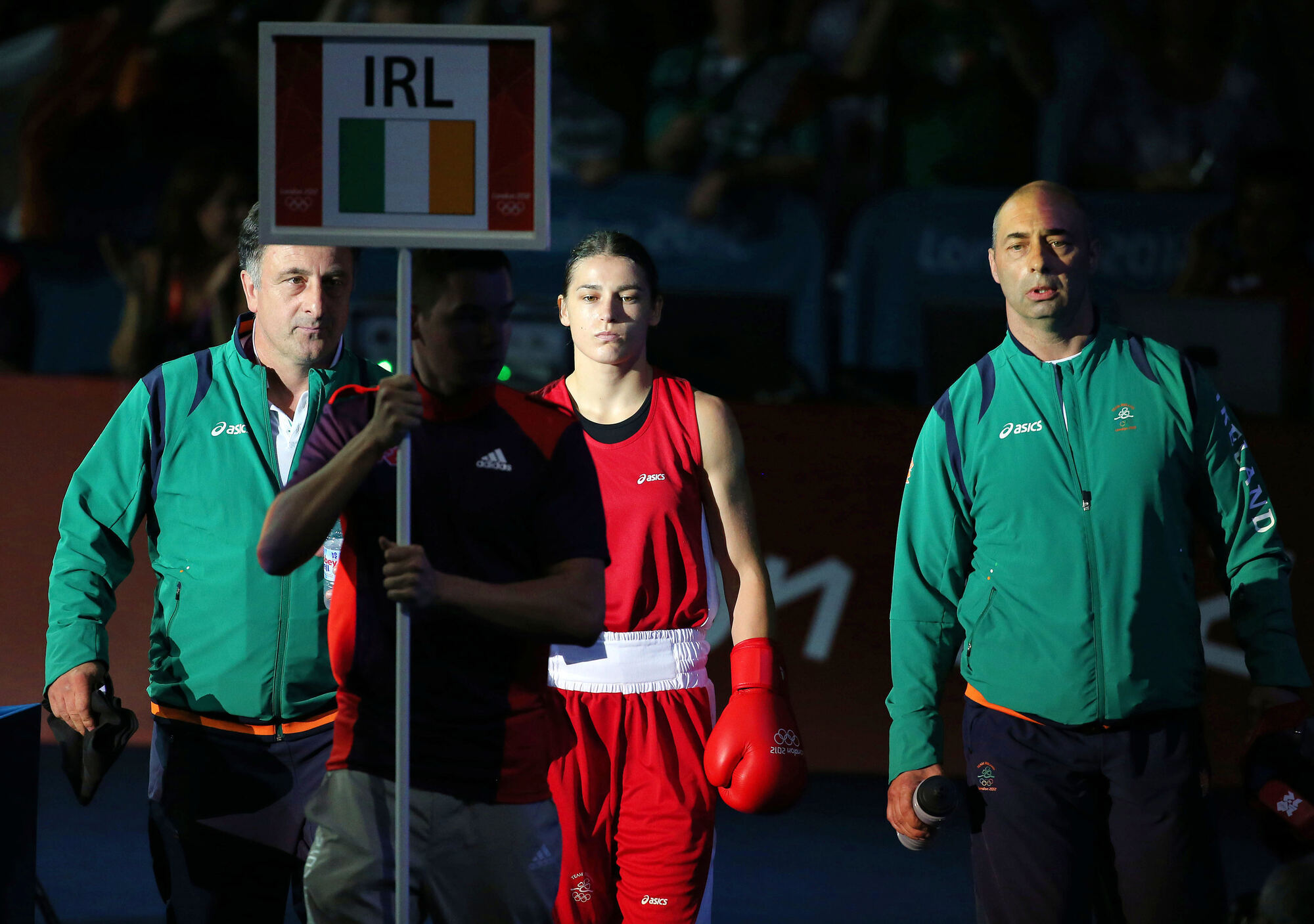
But it’s his past and not their future that makes Antia so fascinating. Across the last month he’s been popping up in blue and red corners at the Olympics beside Billy Walsh — his face with that distinct eastern sharpness, his words with that distinct eastern tone — yet so little is known about one of the men most responsible for the revolution in boxing here.
The son of a crane driver from the tough naval port of Poti on the Black Sea is now one of the most highly-regarded and highly sought-after technical coaches in the world but for many here he’s lost in the medal celebrations despite having been responsible for them. We take him for granted to the extent that for most of his time in Ireland, Antia’s been asking his boxers to pass on any old phones and laptops and DVDs they don’t need any more just so he can get by.
Given all that, the least we can do is recognise him and his story.
“When I was young my uncles were bringing me to different countries wrestling. Georgia is very traditional wrestling country. I was never beaten.
“I always wrestle boys older than me but in my town wrestling was not so popular and my neighbours were in boxing and that’s why I go there. And I found my place. My coach teach me everything. Boxing. Life. He was like a father. He said about me, ‘This is the boy who has no fear; he has no fear at all’.”
It was probably better that way given what would follow after the break-up of the Soviet Union but while it was still together it presented its own problems. A six-time Georgian champion, that wasn’t enough to get Antia much further as the next step was winning the Caucuses title before even getting a shot at a Soviet crown. He has one bronze medal from the nationals to show for it all, but third wasn’t good enough for the world stage.
Instead he correctly satisfied himself with the knowledge that that championship was every bit as tough as even the Olympics and, by 1981, his skills were recognised as he was named a master of boxing.
But being in the Soviet Union had advantages too. Even his two-year conscription to the Cold War Red Army had an upside for the most part.
“For the first five months we were in the mountains near Turkey. Army is always hard, but especially at that time with what was happening. We were up at five o’clock, they’d come into the bedroom, light a match and before it went out everyone had to be dressed and ready to go. They said that will make us strong and agile and everything. There were 50 people there. ‘Wake up,’ they’d shout and if 49 were ready and one not, you had to take off your clothes and do it again. After that we were marching in the snow, training hard. But after five months, they brought the top athletes from Caucuses to a special sport group. I was free again.
“That sport group was great and Soviet Union took sport very serious and were very advanced. In capital, in Tblisi, there was a very big institute of sport. And in 1984 I became a student. Very huge, beautiful building and education was very high. Psychology, anatomy, physiology — everything — sports science and sports medicine. They made sure you understand sport. The facilities were very good too and when I finish my boxing career I decide to train boxers, make Olympic champions. What I couldn’t achieve, I wanted others to achieve.”
But in Georgia, he never achieved the greatest heights if only because of politics. On April 9, 1991, before the break-up of the Soviet Union, Georgia took the step of declaring its own independence. Antia was at a camp for second, third and fourth teams at an Olympic training centre in Podolsk, near Moscow, when the first team arrived back from a tournament in Switzerland.
“The head coach tells me, ‘Zaur, you don’t know what happened? Georgia refused to be part of the Soviet Union. But you can stay here, we will give you a contract and give your boys contracts’.
“I tell you something, Russians and Georgians were always friend. That other stuff, it’s just politics. The people like each other, they have big respect as well. But we are a proud country, and I told him these boxers were from my country.”
So he returned to his country as it tore itself limb from limb. There was civil conflict and supplies from Russia were halted. Bread lines grew and Antia had to pull in favours from local restaurants just to feed his fighters. They worked out in a gym that had its electricity cut while bullets flew about outside. They weren’t allowed to tournaments in Europe through Russia so instead had to sneak across Turkish borders.
“There is no barrier for the fanatic and I am boxing fanatic. I am optimist. If my optimism dies, so do I.”
He says that’s the Georgian way and even these days he talks of Dinamo Tblisi winning a Cup Winners’ Cup in 1981, of the national women’s chess team dominating, of the red and white wine from home he’ll have tonight with dinner and of his country being the home of hospitality. It makes you wonder why he came here and how he stayed here but so much was chance and besides, there are no shortcuts to any place worth going.
“I was head coach of Georgian cadet team but Dan O’Connell [a Cork referee], he was friends with my best friend [a Georgian referee] and he told me about Irish coach job. I always wanted to prove and challenge myself. They invite me, so I came and they like.”
At the beginning though, that sentiment was one way.
“I knew Irish history and my country has a similar history. Anyone who had that history are tough people. I watched at tournaments. Irish weren’t skilful but they had big heart and big character. I had demonstrations at the start to get job and I started to train them and they did not know basic skills. The most basic. They couldn’t walk while punching. They couldn’t do basic head movements. So my demonstration was new for them.
“Very quickly they started learning and adapting to new methods. But before there was the problem, you train them for six or seven months and then they are gone. That had to change. We had conversation with Gary Keegan. If you train boy and they don’t stay, you won’t have team.”
The other conversation they had was about which style to follow. Antia said the Cuban way wouldn’t work as they are masters of every method. He suggested the Russian way, which meant perfecting what a boxer already knew. In Cuba, if you are a long-range boxer, you still learn other styles. But in Russia, you just work on long-range boxing. It’s that which got the Irish team so far and kept Antia hanging on. In the evenings he played chess with friends, played classical music on the piano and whiled away time until his family finally joined him. But the strings of Russia and Georgia have always been intertwined in his life and even after they all moved to Bray, that never changed.
While Russia accepting Irish boxers to their camps, because of Antia, helped them all go to the Beijing Olympics with medal hopes, the day after he and the Irish team left Vladivostok for the Games, Russia invaded part of his homeland and attacked the naval base in his town.
“My wife and son were there. My town was bombed. First they hit these communication places so there was no phone, no internet. This was difficult, I didn’t know where my family were, how they were.
“But what could I do, you have to be strong and control yourself. I told no one in Beijing. What matter if you tell the boxers, who can help you? Nobody helps you and you destroy them too.
“But boxers, I was busy with them and it helped me forget. But after the gym, when training was finished, again I felt this bad energy. Then I was all the time on internet, trying to catch my friends. ‘How is situation, where are they, please can you find something?’
“Then I find them, they were in the mountains with my wife’s sister. They were safe but my friends had problems.
“When they bombed, 16 people dead that time in my town, my boxer was dead, I was very close to his family and that was a big tragedy.”
Being free from such shackles made this Olympics all the more enjoyable.
“After last Olympics I had many, many offers to go to other country as head coach. But I didn’t want. I had settled here and I know there are a lot of good young boxers we could win with in London. We did.
“When Eric Donovan heard about me getting other job last time, his face, he didn’t want me to go and I told him I am going nowhere. Coaching work, you have to love your business and love your boxers. You have to think of them like your own child and that’s what happened here. Now look what we did in Olympics. And now look what we can do at next Olympics.”
True story, even if it’s scarcely believable.