Tommy Martin: Rovers' Euro exit bad news but there's better ways to measure health of league
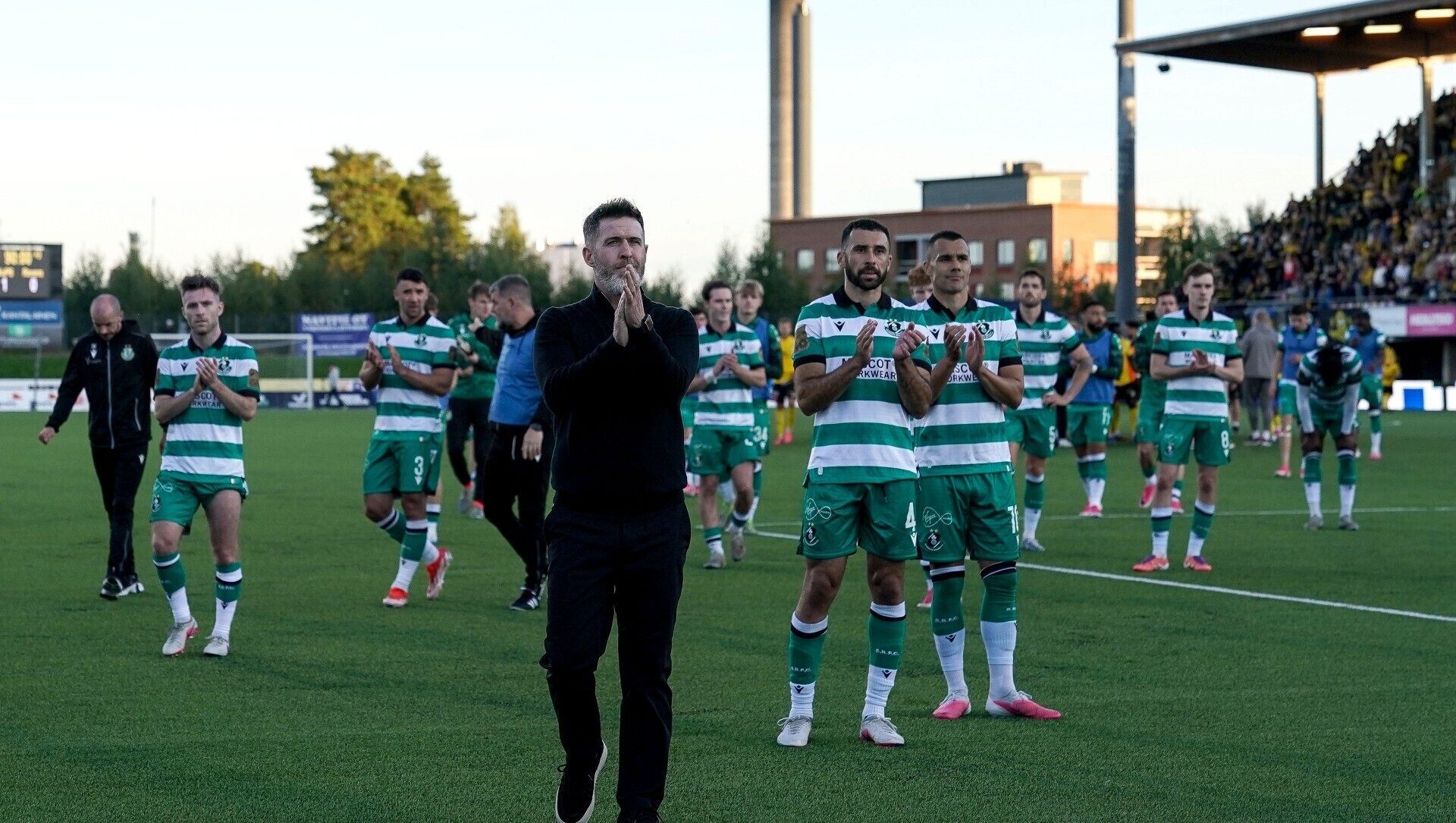
Shamrock Rovers manager Stephen Bradley applauds supporters after the match. Pic: INPHO/Mika Kylmaniemi

Not a great week for the greatest league in the world? Depends how you look at it.
If you think Shamrock Rovers’ exit from European competition at the hands of over-active caps lock merchants KuPS is bad for the League of Ireland because of the loss of financial revenue and the attendant reflected ignominy of being the highest ranked European league not to have a team in league phase UEFA competition, then yeah, not great.
If you, however, subscribe to the view most memorably expressed by a Bohemians FC supporter banner which carried the message “F*CK THE COEFFICIENT”, then you are, with apologies to the Tallaght-based outfit, cock-a-hoop.
Far from the genteel surroundings of UEFA league phase draw ceremonies, in the bearpit of LOI rivalry, Rovers being dumped out of Europe is cause for celebration, not consternation.
The Hoops may have crashed out having lost in three different competitions to three teams from lower ranked nations, exhibiting an entirely out-of-character level of defensive slapdashery along the way, but if you are a supporter of one of their local rivals, you are probably not in the least concerned about what this says about the wellbeing of Ireland’s domestic league.
In fact, if asked what the demise of Stephen Bradley’s domestic kingpins says about Ireland’s domestic league, you might respond that it’s the best thing to happen to Ireland’s domestic league since Damien Duff came in through the saloon doors at Tolka Park shouting about burning down the FAI and all that.
You’d say that Rovers being denied a further €2million minimum in UEFA pocket money is no bad thing given that they have won five of the last six domestic titles and appear likely to canter toward another one this term, for all the evident shortcomings of their European campaign.
In fact, you might go further and say that Rovers’ difficulty can be others’ opportunity even in what remains of this campaign. At the time of writing, St Patrick’s Athletic and Bohemians are idling somewhere in the middle distance behind Rovers at the top end of the table, like cops on a stakeout who don’t want to arrest the perp until they’ve finished these here doughnuts.
But if Rovers are reeling, perhaps a late season stumble might allow a belated title race to break out; which, for all the prestige and kudos that taking part in European league phase competition brings, is what tends to move the needle in terms of general public interest.
And if you said all those things, you’d probably be accused of narrow-minded self-interest and the same Afghan warlord tribal mentality that has always held Irish football back. While the money from UEFA competition does indeed jingle in the Rovers transfer warchest, it is also much-needed revenue entering the Irish soccer ecosystem.
Sure, Rovers will use that to poach one of your star players, scoop up emerging teenage talents or attract aging Republic of Ireland warhorses home for a domestic swansong. But they might also invest in academy structures which will develop players who will spill over into rival squads by process of natural diffusion. And the UEFA dough will filter out in increased transfer fees, like the five-figure sum Rovers recently paid Sligo for Will Fitzgerald, which are the lifeblood of any functioning football industry.
And Rovers picking up points – and cash - in Europe will benefit you in the long run, in theory making future European draws for your team easier, thanks to the benefits to your beloved coefficient.
These are valid and robust arguments to have in LOI debating chambers up and down the land and online. But what Rovers’ exit shouldn’t be viewed as is some sort of wider judgement on the League of Ireland and all who sail in her, easy and all as it would be to do so.
I mean, it is a bad look for the league. The introduction of the Conference League was the great liberation moment for the small leagues of Europe, allowing erstwhile minnows everywhere the prospect of marching out under UEFA livery to the jaunty strains of specially composed anthem, pocketing a tidy sum of TV cash in the process.
Rovers have filled their boots, reaching the group stage/league phase in three of the competitions five years of existence, to the point where, with a favourable seeding and stacks of European experience in the bag, everyone just sort of expected them to be there again this time. In fact, on the conclusion of their campaign last season, their manager openly expressed the ambition of pushing up a tier into the Europa League.
Latvia, Andorra, Lithuania, Albania, Gibraltar and Georgia – all lower than Ireland in the UEFA rankings, all about to get gripped with Conference League fever. Does that make Ireland the minnow of the minnows? The small fish the other small fish eat for breakfast? And what does it say about the rest of our lot that this Rovers team, dumped out the European competition garbage chute, are top of the pile at home?
For Irish football the state of crisis is so natural that even the slightest reversal can lead to soothing release that comes with smashing the panic button. But just because Europe didn’t go well in 2026/27 doesn’t mean the League of Ireland is crap, no more than last season’s feat of having two clubs in European competition proper put it up among the great beasts of the global game.
Shamrock Rovers have had a shocker, by their own standards. In the form they showed in last season’s qualifiers, they’d have made at least the Europa League.
They’ve been hit by injuries to key players; their key defensive trio have aged and Pico Lopes look like the summer’s exertions have caught up with him; they are a team in transition - some of their signings haven’t worked out and the plan to bring through young players to succeed the veterans has had mixed results; they have been on the road without a proper break since the start of 2024, thanks to their European exploits. That catches up with you.
And guess what? Sometimes teams go off the boil. Sometimes even great clubs struggle to maintain success or lose the magic formula for a spell or maybe altogether. Let me introduce you to a little outfit called Manchester United. They’ve been struggling to relocate the magic formula as a club since 2013.
The point is that it’s hard to keep it going. There are no guarantees. Guarantees are for Premier League clubs, with their £100m prize money cash pile before they kick a ball. At the League of Ireland’s level of the game, every country has upwardly mobile teams with ambition who’ll knock you off if you’re not at it.
As for what’s below Rovers, sure, we’d love a title race. But Bohemians and Shelbourne acquitted themselves well against much stronger outfits in Midtjylland and Ajax. Even Derry, a trainwreck off the field, put up a decent show in their European ties.
Really, the health of the league can’t be measured in the annual referendum of European results. It’s in the thousands of tiny actions being taken to improve things incrementally at all levels of the game. The investment in youth academies; the improvement in pitches and facilities and stadia with big projects about to get started around the country; increased exposure for the women’s game; better commercial and media engagement; the creation of a proper football pyramid with the introduction of the FAI National League. And so on.
These are the kind of things that generally pay off long term. Just like attendances, results in Europe have plateaued this season, but the overall trend is upwards. Really, you should look at these things over, say, a five-year period and make your judgment. Which, thankfully, is exactly what your old friend, the UEFA coefficient, likes to do.