Tommy Martin: Man City have exposed English football’s crisis of identity — but they are hardly alone
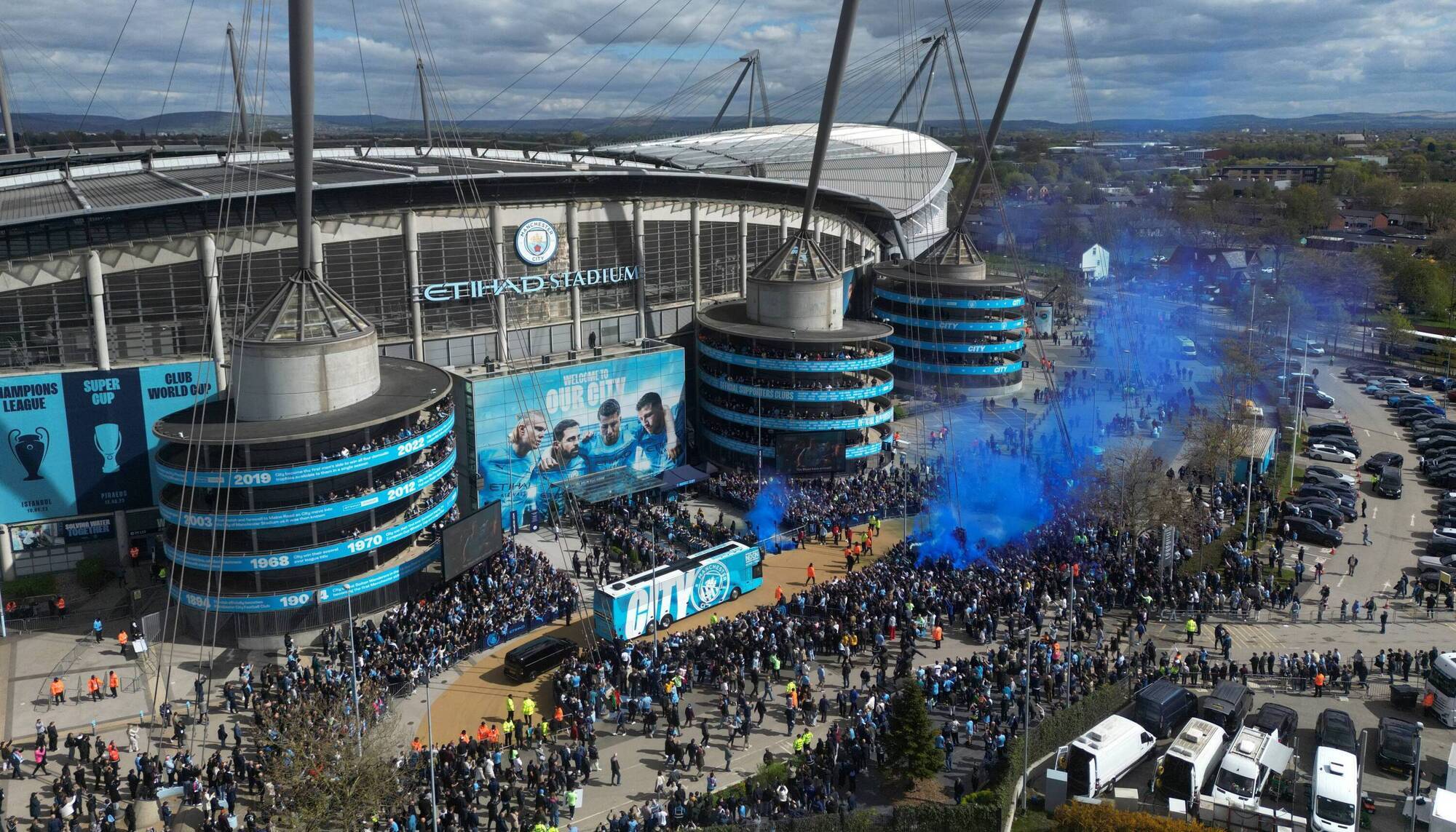
Manchester City face Liverpool this weekend. Pic: Michael Regan/Getty Images
Count your blessings, Irish sports fans, that you’ve had the easy-going distraction of the Ireland v Israel games over the past few weeks.
Our friends in the UK have had no such luck. They are ticking over into two weeks of solid Manchester City guilty verdict reaction without even the light relief of an Oireachtas hearing to leaven the mood.
Not that you have missed much if you were wrapped up in the Israel business. City have been found guilty on nearly all those financial charges people have been talking about for years and now everyone is wondering what should be done to them. That’s basically been it, but for two weeks.
At least the real, hot-blooded flesh of players and managers is about to enter the fray. Until now, the story has been played out by a cast of journos, pundits and lawyers offering varying degrees of high dudgeon on City’s antics. Therefore, there is genuine excitement that the big fixture of the Premier League’s return after the extended international break is a visit to Liverpool for Enzo Maresca’s boys, a karmic quirk of the fixture list that seems almost too perfect to be coincidental.
Read More
Liverpool are the club, of course, who put it up to City and their cheatin’ ways, most notably in the 2013-14 season during which a single slip crystallised the tragic hero status of their iconic former captain, Steven Gerrard. The Kop dispensing vitriolic vengeance on Stevie G’s behalf on Sunday can be seen as the first lashings of whatever justice is coming City’s way.
Naturally, the story is in something of a holding pattern while we wait for the outcome of City’s appeal and for the actual punishment to be handed out. In the meantime, the debate has centred on two things: to what extent City’s crimes tarnish their own achievements and the entire legacy of the past 15 years of Premier League football; and how severe those punishments should be.
The relative vacuum of the international break has allowed a cacophony of voices to vent and the impression has been of a cathartic reckoning among the great and good of the Premier League’s recent history.
Gary Neville donned the statesman garb of his anti-Super League crusade to chair a episode shot through with the forensic gravitas of state tribunal, while Ian Wright, Roy Keane and Jamie Carragher wept for the souls of all the Barclaysmen who died in vain.
Roy had already claimed the City players of the era in question should
throw all their medals in the bin, while Wayne Rooney said that City should be put “in the lowest league they can go in” as punishment for their crimes. West Didsbury & Chorlton AFC Under 8s are said to welcome the challenge.
Others more favourable to the City cause have suggested that football is not about financial rules but rather the friends you make along the way; in other words, we will always have Aguerooooo! In this camp is former manager Pep Guardiola. “I want every single City fan across the world to know I am here, more than ever,” he cooed on his Instagram page, like a lovelorn boyfriend and not the major beneficiary of a club hierarchy that “systematically broke Premier League rules for more than a decade.”
Another argument from the City side is that, while they have been found guilty of flagrantly breaking the rules using what the independent commission described as “sham” contracts, the rules themselves are sham and therefore deserve to be broken. In this sense they are like a husband who has been caught in bed with his mistress, but who decides this is the correct moment to launch a considered critique about the institution of marriage.
As time has gone on and this pregnant period awaiting the punishment continues, the implications of all this have seeped into the conversation. There is the sense of the cracking of an edifice, the wiping of history, the questioning of everything. If we are the stories we tell ourselves, English football has been asking, what if those stories were a sham? Are we a sham?
Naturally this has led to anger. Unexpectedly, prime minister Andy Burnham has copped his share, thanks to a misjudged comment on the case in which said he was “really concerned” if the independent commission’s verdict forced City’s Abu Dhabi ownership to sell up, considering the amount of investment they had pumped into the city of which he was formerly mayor.
Not only did this comment carry the whiff of political interference but it casts Britain in the unflattering role of economic supplicant, dependent on benevolent but capricious foreign powers for its livelihood. Never a good look for a PM, even if it is accurate.
Burnham’s walk-on role speaks to a greater unease that the City judgement has revealed. The Premier League has been Britain’s greatest cultural export since the Beatles, but its success has been achieved by embracing the sort of unfettered, unregulated globalism that has inspired a solid decade of political discontent in the UK.
It has been striking that much of the anger towards City has positioned their rivals as law-abiding, rule-adhering, old-fashioned fair play merchants in the grand British traditions. The former player Stan Collymore expressed this view in an X response to the journalist Guillem Balague, who had argued that City might have felt they were tweaking the regulations in the manner of an inventive F1 team.
Collymore’s response was that City’s actions were symptomatic of a mindset, imported post-2000 into the hitherto sportsmanlike culture of English football, where cheating was tolerated and expected. Even when taking corners, “we used to put the ball in the hole, solidly within the lines, as the laws meant,” where now the ball is flagrantly placed outside the arc. “The standards in England are now tainted,” Collymore argued, “because habits and cultural norms elsewhere have tainted an almost unimpeachable sport in this country.”
Never one to make a measured contribution to a debate, the veteran manager Ian Holloway summed up the feeling thus: "How dare you ruin what's part of our country, our DNA in this country, without a shadow of a doubt. Honestly, every one of us, mining villages... why it all started, who knows, but it's all about a team and believing that you can be fairly better than someone else.
"And they've gone and ruined it, right at the top of the game. Absolute disgrace."
It’s clear that City, by the scale of their cheating and the harsh wording of the judgement against them, have served as a wake-up call about something precious that was, at some point, sold off to the highest bidder. The notion that City’s powerbrokers are in some way outliers among the cast of solid citizens that make up the Premier League ownership club is one of the more ludicrous inventions of the last fortnight. After all, several years before Abu Dhabi came to town, the league had been turbocharged by the arrival of Roman Abramovich at Chelsea, a man whose billions derived from the stolen mineral wealth of the Russian people and his ties with that nation’s corrupt ruler.
The anger toward City makes little sense on its own. The cheating was always blatantly obvious, the club’s defence clearly belligerent and spurious and yet appreciation for their successes remained largely fawning throughout. All this is about something bigger.
In this two weeks of The City case therefore must be seen as just another chapter in the deep and ongoing sense of loss that has become the great modern British neurosis, one that has afflicted their politics, their industries, their communities and cultural institutions and now the playing fields. You know, they used to “put the ball in the hole, solidly within the lines, as the laws meant.” Will any punishment be enough?