Jack Anderson: Sydney Swans scandal puts AFL culture under scrutiny again
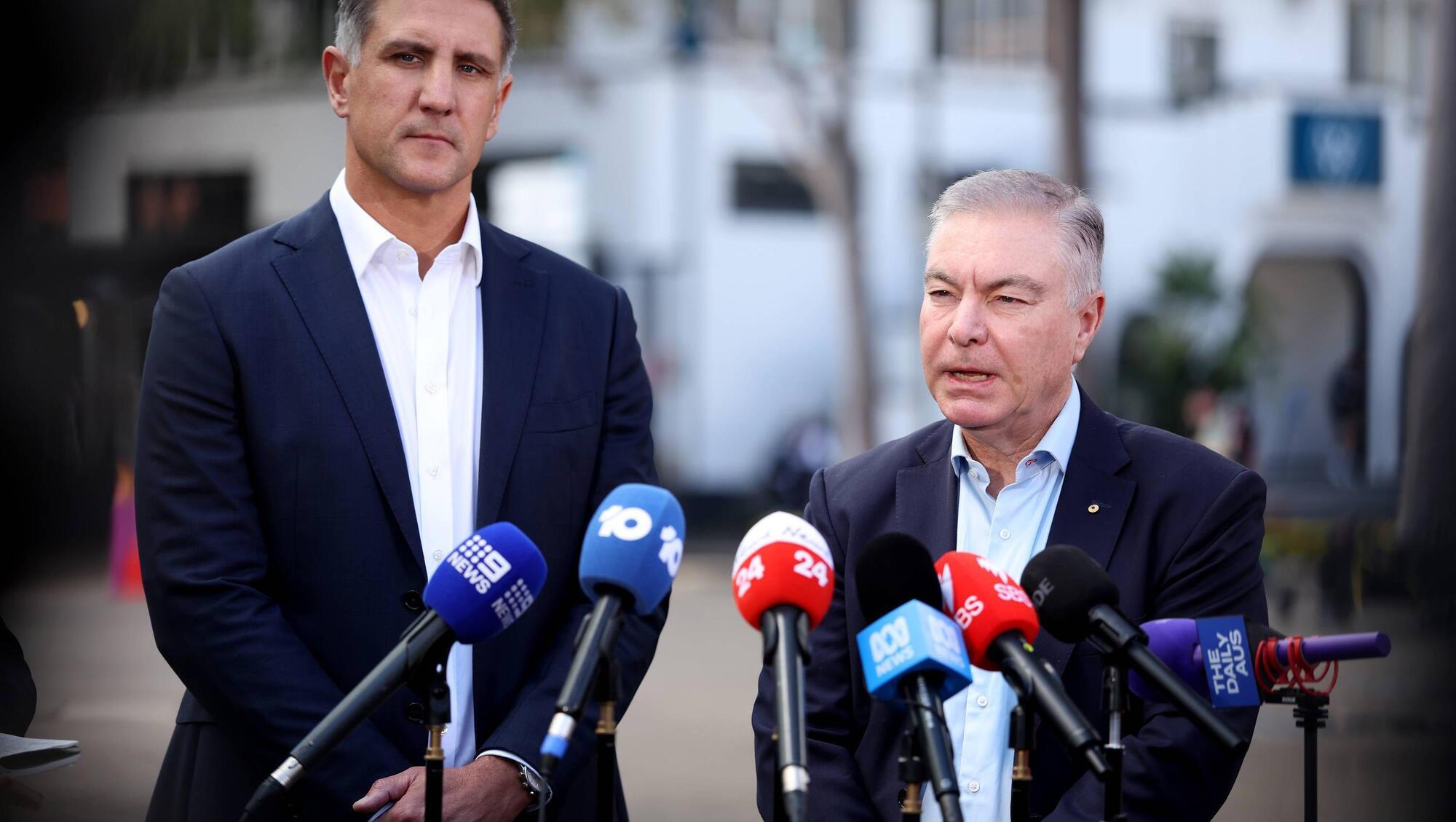
Sydney Swans chairman Andrew Pridham (R) and CEO Matthew Pavlich speak to the media. Pic: Mark Metcalfe/Getty Images
The AFL men’s competition has reached its final stages. Traditionally, the top eight made the playoffs but this year 10 of the 18-team competition were given the chance to play “finals footy”, keeping most teams interested till the end. The higher up you finish during the league stage, the more likely you are to get a home venue and a second chance in finals; the lower, and it’s a knockout, away game.
The top 10 has really worked this year as a fast-finishing Carlton (one of the traditional powerhouses of the AFL) just made it but now enter finals with momentum. In hurling terms, Carlton are Cork. They haven’t won a title for decades but any sniff of a run and a team to follow and in the crowds will swagger and roar in their thousands. It’s electrifying for the AFL to have Carlton in full flow (as it is for hurling to have Cork) but as of late, success has not flowed for either, despite talented squads. As the Philadelphia Inquirer once said of a skilful but flawed local baseballer, “Not since E.T. have we seen someone with such otherworldly attributes struggle this hard to get home.”
Carlton are based in Melbourne, the heartland of the AFL. For the past three decades, the AFL has tried hard and invested heavily in making the game a truly national one. It’s partly worked. There’s even a Tasmanian team in the pipeline (they will wear green, play in the wet and in a reversal of centuries of history expect them to come north looking for our talent, rather than us being deported south).
Brisbane (Queensland) are the defending AFL premiers. Freemantle (Western Australia) finished top of the league ladder this year, followed by the Sydney Swans. Sydney as the biggest city in Australia (and traditionally rugby (league) territory) has long been a target for expansion by the AFL. The Swans franchise (originally South Melbourne) moved in the early 1980s and a second Sydney team (the Giants or GWS) was established 15 years ago. GWS feature the most unheralded Irishman playing in the AFL, Derry’s Callum Brown.
Since moving, the Swans have won two AFL Premiership in 2005 (with Tadhg Kennelly) and 2012. They have lost four finals since (2014, 2016, 2022, 2024), the latter two defeats were heavy and humiliating. Having changed coach recently, the Swans comfortably finished the regular season in second, guaranteeing them home advantage in finals, and all the commercial benefits that comes from that.
On 16 August, they played their penultimate game of the season in Melbourne against a callow Essendon. It was a Sunday afternoon stroll for Sydney. The game’s aftermath was wrapped up around 7pm and normally the team would have flown back straight away to Sydney, a short 60-minute hop. But a curfew at Sydney airport means it has restricted night flights. The Swans team and staff made the decision to stay at an adjacent hotel.
Despite having one more league match to play the following weekend, and a final series shortly thereafter (and remember that most of the team would have been part of the squad that were humiliated in the Grand Finals of 2022 and 2024), they went out on the town.
Footy players can’t hide in Melbourne; they might as well where Hi-Viz jackets and the irony is that the Swans players would likely be better known in footy-mad Melbourne than in their hometown. The Swans coach and his staff were first to arrive back at around midnight. Some players made it to the hotel around 2am, some as late as 4am. A group of 5 players, including vice-captain Issac Heaney, one of the best and well-known players in the competition, then allegedly hired women to perform private dances for the group.
It has since been alleged that there were also men other than the players in the hotel room and that there was illicit drug use. What is certain is that by 7am or so, a commotion had broken out in the hotel foyer when at least one of the women claimed that she had been sexually assaulted. The police arrived soon after.
Melbourne may have a population equivalent to the Republic, but it is as intimate as Ireland when it comes to news of this nature. A media firestorm started and it has yet to be quenched.
The immediate concern was for the safety and well-being of the three complainants. The investigation is now with the Victoria Police Sexual Crimes Squad. It is ongoing and statements have been taken from various members of the Swans support staff but not yet from the players. There is no indication of when, if at all, criminal charges might follow.
Given the police involvement, the AFL backed off from any internal investigation. Innocent until proven guilty is the criminal law’s most powerful maxim but criminal law is only one standard by which the players must abide. Public expectation and contractual obligations are others. The Sydney Swans stood down the five players for the rest of season. The Swans hierarchy used misconduct terms in the players’ contracts as the legal mechanism to do so. The AFL, in as much as it sought to intervene, suspended those involved from attending the end of year All-Australian (All-Star) nominations but that is the least of the players’ problems.
Who knows what their playing future will be if they are actually charged. And even if they are not charged, the three women have already announced via their lawyers that they will be seeking compensation for pain and suffering, psychological injury, and economic loss. Simultaneously, sponsors, both personal to the players and corporate “partners” of the club, have suspended existing commercial arrangements.
A rift has been reported in the playing cohort with some of the older players who have played in three losing Grand finals still apoplectic at their teammates’ behaviour. If they return, the five may have to find another club, though in the hardnosed business of professional sport, you’d suspect that there will always be a “market”.
The last league game (last Sunday) for the Swans’ men’s team was supposed to be a tune up for finals but was also scheduled as a double header with the Swans’ AFLW team. All week the AFLW team (and their coach, Tipperary’s Colin O’Riordan) were placed in the invidious position of having to answer questions about the integrity of the men’s team, who despite having caused the whole affair, hid behind carefully curated press statements. Sydney Swan fans, male and female, were left livid and empty.
Wider questions are being asked about the AFL’s culture – within the Swans’ men’s playing group and the attitudes beyond the platitudes to women in the sport generally. Over the next few weeks, as the AFL finals play out, criminal charges may follow, civil cases may lead to compensation, but all of those legal questions will be predicated on what happened, the more important question is why it happened. And in this some insight might be gained from revisiting one of the best sports books of recent years, a 2014 award winning publication on the AFL by Anna Krien, called Night Games: Sex, Power and a Journey into the Dark Heart of Sport. It’s about a player facing and being acquitted of sexual assault charges after an AFL Grand Final.
A quote from Krien’s book on a case from the past, captures what may lie ahead in the Swans’ story: “What does a young footballer do to cut loose? At night, some play what they think of as pranks, or games. Night games with women. Sometimes these involve consensual sex, but sometimes they don’t, and sometimes they fall into a grey area.”