Letter from France: The cities never stop with rugby often left on the périphérique
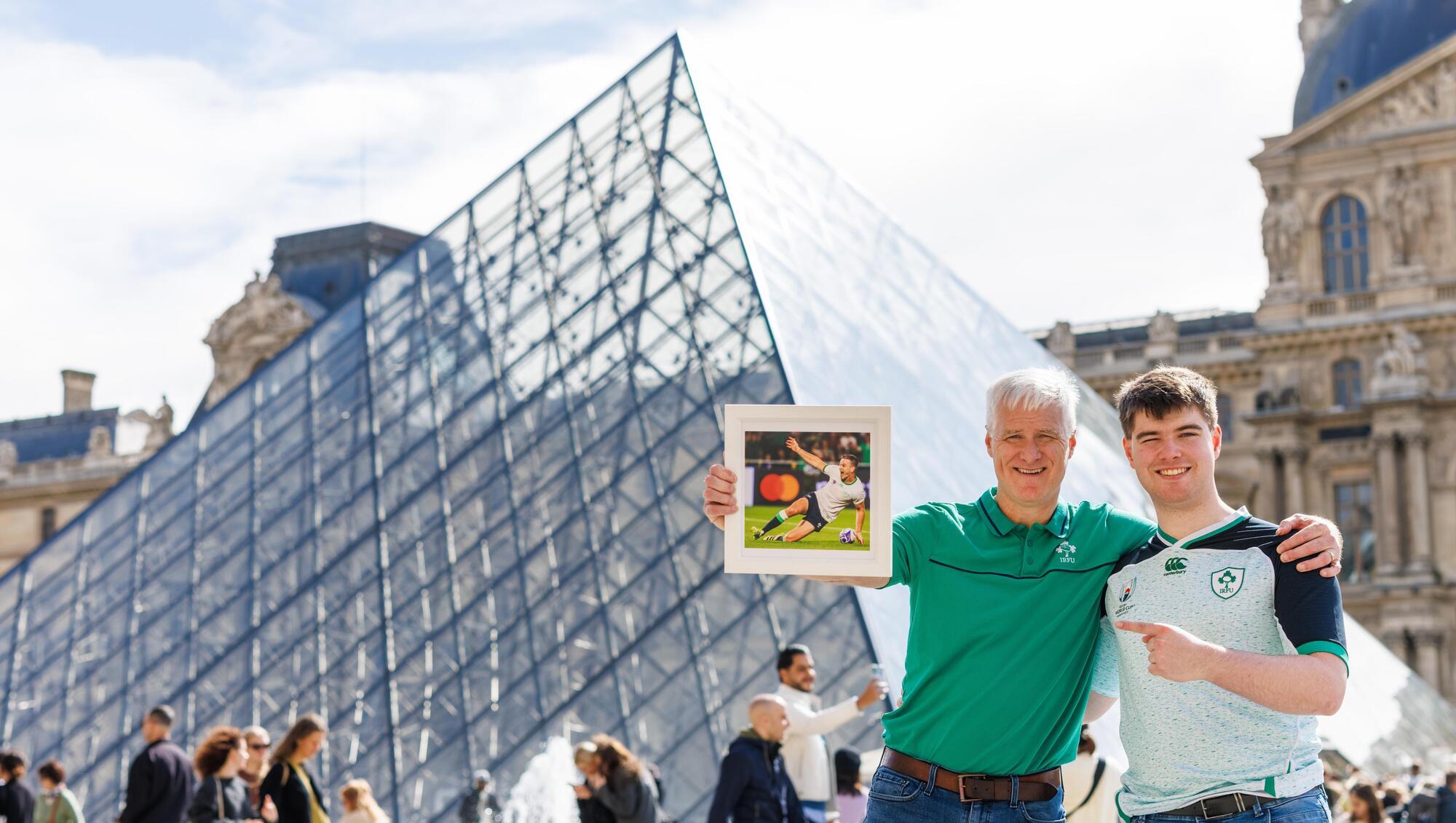
HANG IT HERE: Ireland Rugby Fans In Paris Ahead of the 2023 Rugby World Cup Game Versus South Africa, The Louvre, Paris, France 22/9/2023
Letter from France? Ach, apologies for the vagueness but a week spent traversing this eternally fascinating country rules out anything more exact. ‘On the Road’ might have been a more accurate header but Keruouac got there first.
His Beat-era classic achieves the impossible by spanning sea to shining sea, from San Francisco to New York City, and any number of points in between. Somehow it manages to funnel a melting pot of Americana inside the one cover.

There is a point in that cult body of work where Sal Paradise, the narrator, Dean Moriarty, his free-spirited companion, and Stan Shepherd take a beat-up ’37 Ford Sedan across Texas to Loredo before crossing the border into Mexico.
Our week has been more a case of planes, trains, automobiles and an average of 12,000 steps a day and we’ve witnessed a massacre – South Africa-Romania – in Bordeaux, done some detective work to find the Scots in Nice and eavesdropped on the French in Marseille.
There has been no poetry or jazz on this scoot around France but plenty of words committed to a Dell laptop, a couple of podcasts and the odd beer thrown in to an itinerary that reads Bordeaux-Marseille-Toulon-Nice-Toulon-Marseille-Paris-Nice.
Similarities and differences jump off this country’s pages.
Bordeaux is majestic in its architectural beauty, Marseille a riot of nervous energy and so, so many people. Toulon is a hidden gem with its inviting central core of plazas and cobblestoned streets, Nice exudes chic and insouciance.
The capital is a world and an attitude all unto itself.
The temptation is to say that all roads inevitably lead to Paris at this World Cup but then the organisers struggled for so long to find acceptable lodgings for the teams in the capital that some have been housed miles beyond the périphérique.
The concept of égalité seems to have been lost as far as Ireland and South Africa are concerned with Andy Farrell’s collective housed east of the city and in an area surrounded by an aesthetic that one colleague has compared to Slough.
If the hotel itself is adequate then the drab surroundings have inevitably invited comparisons to Ireland’s billeting in an industrial estate in Bordeaux in 2007. The Boks, at least, find themselves in a spa surrounded by the greenery of a golf course and a forest.
Neither is perfect, to be fair. Rare time off is compromised by the logistic slog of making it anywhere new and interesting, although the weather this past few days has been wet enough and miserable enough to deter even the most intrepid among them.
For all its beauty, its wide boulevards and its cultured confidence, Paris can look as sad and as down-at-heel as anywhere else when the heavens open, and all the more so in some of the less salubrious areas around the Gare du Nord.
Rutted and cracked pavements, endless detritus and a heart-breaking roll call of people down on their luck conjures memories of New York City in the 70s as we’ve absorbed them through movies like Taxi Driver and Serpico.
Three days we’ve spent in this corner of the city and four times already we’ve passed the same man wandering around the same streets with the same unkempt clothes and with the same vacant stare. It can’t help but break a heart.
But this is still Paris and it seems as if there is a café on every corner that isn’t just a purveyor of food and drink so much as the cornerstone of a neighbourhood. Somehow, amid a city of millions, human connections remain and renew.
The Nord Nord bar sits adjacent to La Vieille Pie on the intersection of rue Piquet and rue Pajol in the La Chapelle neighbourhood of the 18th arrondissement. The area is a hive of activity as pedestrians, scooters, cyclists and car drivers navigate the madness without incident.
A half-hour spent there nursing a beer on Wednesday night and a pattern emerges. Customers come and customers go but time and again they greet or leave people on adjacent seats with a kiss and a smile. The staff too. No table appears to be an island.
These scenes are, in effect, timeless. A bridge to centuries gone by when La Chapelle was a commune outside the city before, in the 1860s, the urban sprawl reached beyond the walls of the old Ferme générale that had stood since medieval times.
What you don’t see all that often is evidence of a World Cup.
The mind goes back to the 2012 Heineken Cup final when Leinster and Ulster were involved and London swallowed them up like a woods would an acorn. Paris is of a similar size. It carries this competition, for the most part, like an elephant would a flea.
The games themselves provide a brief spike in visibility but this tournament is only one among any number of events that, together, will necessitate the use of 30,000 police officers, anti-riot squads included, over the week’s span.
King Charles III has visited the capital already and moved on to Bordeaux, Pope Francis I holds mass today at Marseille’s Stade Velodrome, and Paris Saint Germain host Olympique Marseille in Ligue 1 tomorrow night.
Amid all this are the planned demonstrations against police violence and racism that have been called today for so many of the main cities: protests that have their origin in the shooting dead of a 17-year old driver by police on the outskirts of Paris last June.
Rugby comes and goes, the cities never stop.