Enda McEvoy: New heroes should stir lost interest in athletics
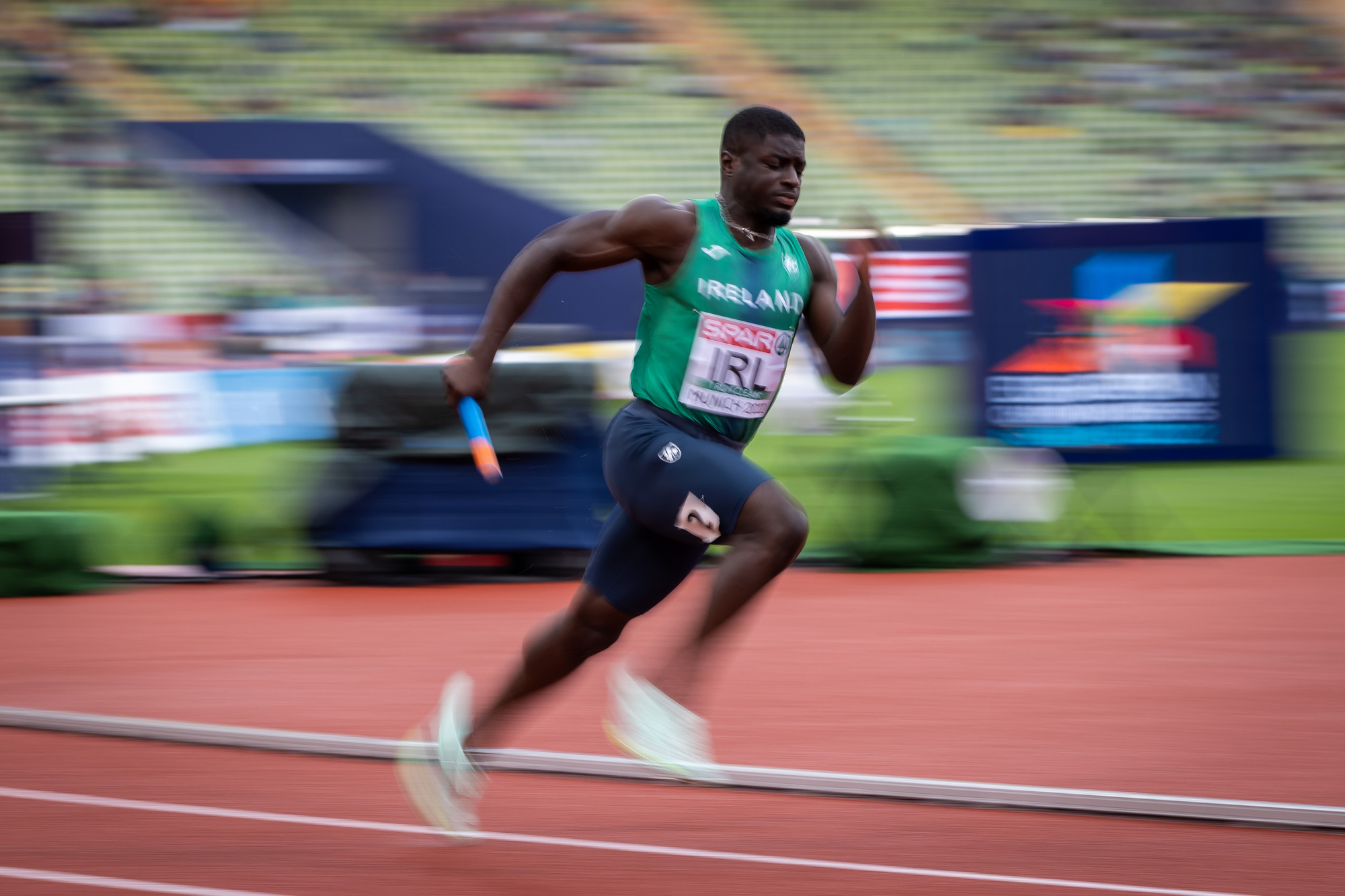
NEW HERO: Ireland’s Israel Olatunde gets the Mens 4x400m team off to a fast start yesterday. Pic: INPHO/Morgan Treacy
And so in the dog days of late summer, amid heat and drought and fires in cornfields and biblical rain, he came to us in our hour of crisis. The saviour Ireland didn’t know it needed.
Israel Olatunde. You hadn’t heard of him until four days ago. Don’t be ashamed to admit it. Neither had I.

We’d never heard of him and now we know everything about him and suddenly we’re all Olatunde experts and we have his path to Olympic glory mapped out.
If he’s this good at 20, what’ll he be like at 25? As a fast finisher who’s better over the second 50 metres, what might he be like if and when he tries the 200m? With all that fast-twitch muscle fibre, will his hamstrings hold up?
How will he cope with a return to normality in UCD, and is UCD as full of temptations to impressionable youth as the trendy novelists assure us that Trinity is? And when he goes home for the weekend, might he not be led astray in the fleshpots of Dundalk? Come to that, are there fleshpots in Dundalk and if so where?
One good reason for believing that the sky could be the limit is that the nation’s new idol has already shown himself to be a big-game player. Prior to his semi-final on Tuesday the lads on RTÉ made the point that Olatunde had won his heat in a personal best. In other words, he had come to his first major championships and performed.
It is a rare achievement for a young Irish athlete. Too many young Irish athletes go to their first – or second or third - major championships and fail to perform. They let their nerves get the better of them. They play the occasion instead of playing the match. They prove unable to control the controllables. The usual jazz.
Olatunde did none of these things. He went to Germany and, far from being overawed by the occasion, he rose to it. He raced three times and he ran the same terrific race on each occasion (10.17, 10.20, 10.16).
This may sound simple or straightforward. It is far from it. And while it may be inevitable for, or at any rate expected from, an athlete at the top of his game, it is nothing of the sort for a novice. Then again, maybe you saw him being introduced before the final. Not a bother on him.
That the Dundalk man’s gaiscí took place in the venue they did will give some of us of advancing age a reason to regard the word Munich slightly more kindly in an athletics context. They may even stir a renewed interest in the sport.
It is not being wildly presumptuous to surmise that a number of older readers finished with top-level athletics, if not with the Olympics altogether, after Seoul in 1988. The men’s 100m final was less a race, more a mobile pharmacy on 16 legs, so much so that a book written about it was titled .
You’ll remember that Ben Johnson was stripped of the gold. You may not remember that no fewer than five of the other seven finalists would somewhere along the line either test positive for drugs or be involved with performance-enhancing substances. Among them were Carl Lewis, who was awarded the gold, and Linford Christie, raised to silver.
The needles and the damage done. Desai Williams, who finished sixth, died of a heart attack last April.
Also no longer with us from Seoul is Flo Jo. Florence Griffith Joyner showed a striking improvement in her form and times in the months leading up to the Olympics. She went on to win gold in the 100m and 200m, with the world records she set along the way still standing 34 years later. Flo Jo didn’t live to see her 39th birthday.
We can, and do, tut and tsk about the manner in which the Premier League doubles as a theatre of the frequently absurd and fantastically overheated, as evidenced by events in west London last weekend. The shenanigans at Stamford Bridge: glorious knockabout pantomime. The unstoppable slow puncture of Manchester United, although credit to them for managing to hold Brentford scoreless for the last 55 minutes.
Yet the only items they’re dosed up on across the water are machismo and self-importance. What some international athletes are dosed up on one shudders to think. The easiest course of action these many years has been to not think at all. To simply disengage instead.
Among Olatunde’s opponents last week, incidentally, were the Turkish duo Jak Ali Harvey, né Jacques Montgomery Harvey in Hanover Parish, Jamaica, and Emre Zafer Barnes, better known to his old buddies as Winston Barnes of Spanish Town, Jamaica. Much less objectionable than juicing, obviously, but not a hugely edifying sight either.
Around the same time as our young hero was reaching his final, the Dublin-born Michael Obafemi, aged 22, was scoring a blindingly brilliant goal for Swansea City against Millwall. The following evening Rhasidat Adeleke, who’s 19 and from Tallaght, finished fifth in the women’s 400m in a new national record. Young, black, gifted and Irish.
From a sociological point of view there is much to unpack. Olatunde and Adeleke represent themselves, their hometowns, Irish athletics, the Nigerian Irish community and a changing nation all at the same time. No dichotomies exist therein. The op-ed columnists – and there are few more toe-curling sights in journalism than op-ed columnists feigning an interest in sport - will have a ball furrowing their brows and extracting meaning from it all.
As for us mere mortals, prodigal athletics fans or otherwise, we’ll get on with the business of watching out for Olatunde and Adeleke. Could be the start of two beautiful friendships.
Jonny Dwyer, 36 years young, cocked his rifle and hit the sideline cut of a lifetime from 55 metres, all power and fade and accuracy, to land the clinching point. Ferns St Aidan’s were Wexford hurling champions at last. Life there will never be the same again.
On Sunday evening, back in triumph after the match, they brought the cup to the cemetery to impart the good news to the faithful departed and to say thanks. Among the graves visited were those of former chairman Jack Byrne, buried the day before; Tom Guinan, a local legend who died in June; and Seamie Murphy, who on returning from New York in 1981 transformed the club’s under-age structure.
On Sunday night they danced at the crossroads, or at any rate in the moonlight.
On Monday and Tuesday they danced some more. At teatime on the Tuesday they were still tweeting footage of the celebrations, now in their 48th hour.
On Wednesday the defeated St Martin’s team arrived in Ferns by bus. Victors and vanquished shared a convivial night together, upholding a long and valued Wexford tradition. An arduous week, yes, but they’d been waiting for it for 135 years.
The sight of a GAA club capturing their first county senior title – Ferns St Aidan’s had lost five finals dating back to 1939 - is one of the wonderful myriad little pieces in the mosaic of Irish life. Change the names and the faces and it could be a club in any county. It is part of what makes the GAA the GAA.
Passage secured to the 2024 Olympics in Paris. Now we know who’ll bring the horse to France. (Gag courtesy of Mary Drennan. Credit where it’s due.)
Beat Poland 3-0 in their opening Euro qualifier. That’s how to make a good first impression.
Can’t be pleasant having one’s tresses tugged but there’s a solution and it’s not complicated. What would Chopper Harris have said about the Spaniard’s barnet? Nothing complimentary.
Threw a headbutt on his Anfield debut. That’s not how to make a good first impression.