Michael Moynihan: Reality bites the Gaelic football economy
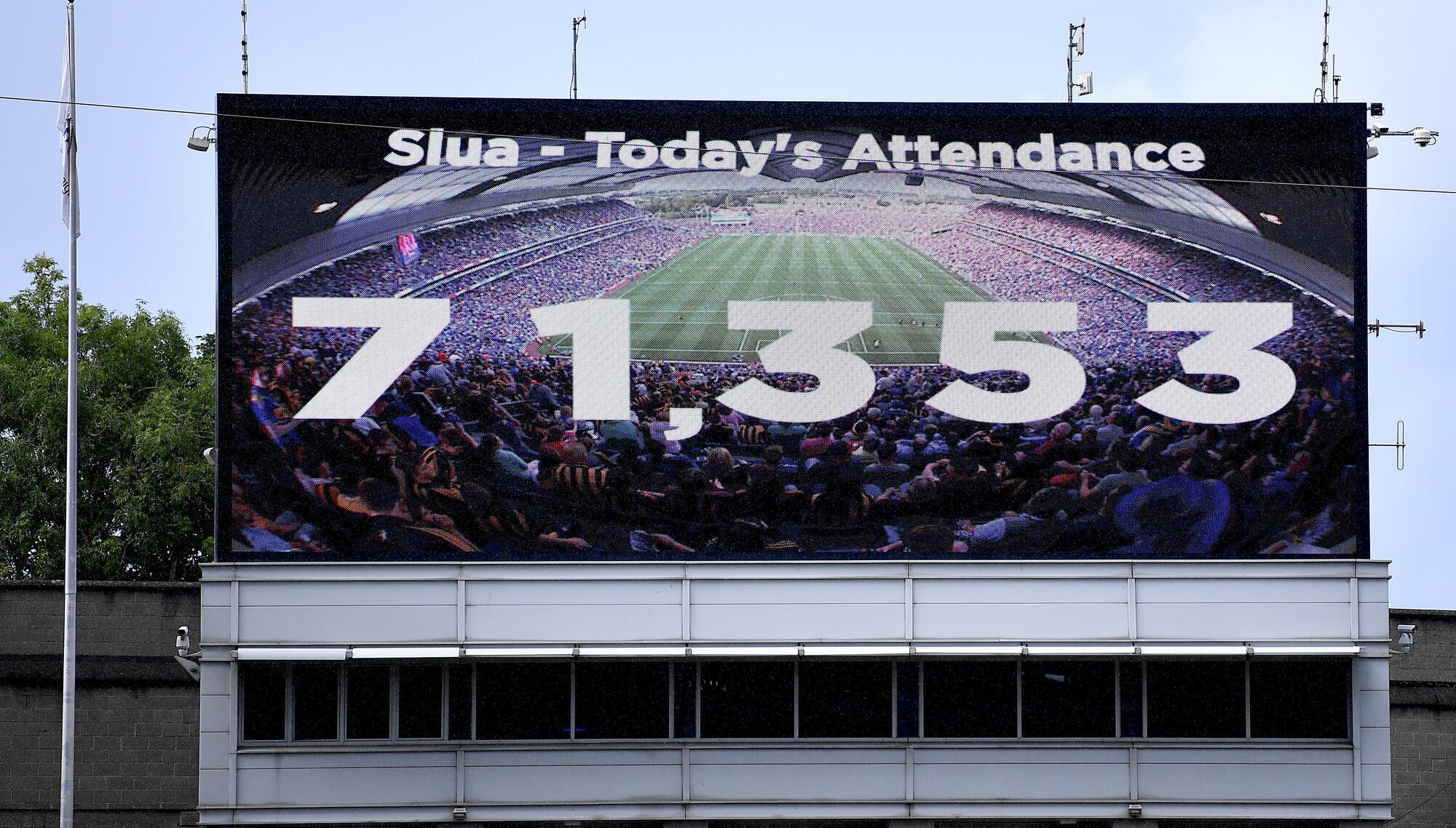
NOT QUITE A SELL OUT: A general view of a big screen showing the attendance at the GAA Football All-Ireland Senior Championship Quarter-Final match between Kerry and Mayo at Croke Park, Dublin. Pic: Piaras Ó Mídheach/Sportsfile
The long, long arm of Gaelic football reached out and across the entire country again over the weekend.
You probably caught some of the action at various points, whether it was Dublin v Cork or Kerry v Mayo - the feast of football splashed across Saturday and Sunday to the delight of whoever was shouting for the teams which won.
What’s interesting to me, though, is to see how Gaelic football reflected some of our current obsessions over the weekend.
For instance, the simmering unhappiness with hotel prices in the capital came to a boil when linked to the All-Ireland quarter-finals in Croke Park. This wasn’t surprising when the line-ups were confirmed - Cork, Kerry, Clare, Galway and Mayo in particular seem specifically designed to be as far as the capital as possible.
For those supporters the prospect of overnighting in the capital wasn’t an indulgence. The idea of driving from Castletownbere, Dingle, Doonbeg, Galway or Achill to a game in Dublin and then pointing the car back down the road at the final whistle isn’t an attractive one at the best of times; on Saturday afternoon the notion of starting the return leg at around half five if you were from Clare, or maybe eight o’clock for Cork supporters, was even less appealing.
However, there’s no doubt that the skyrocketing hotel prices in Dublin had people swallowing hard last week when making their plans. My own guess is that a good few distant cousins, old classmates and former workmates got phone calls inquiring about the possibility of vacant couches as last week rolled on.
That was before the cost of travel itself was considered. Anyone keeping a car on the road will be accustomed to an involuntary sharp intake of breath when approaching service stations - as soon as the bulbs announcing the fuel prices can be read the reaction is immediate and consistent. Filling a tank for the long road to Dublin 3, and then refilling it afterwards, is a real commitment.
Those are current issues. With any luck the high price of fuel will not last forever - any specialists in global economics are free to take issue with my bold prediction - while the hotel room costs will surely yield to gravity, if nothing else, eventually.
There’s also another universe where the spread of counties in the last eight isn’t quite as broad. Where the supporters of the teams involved aren’t facing nine- or ten-hour round trips.
(Though a glance at the history books suggests that quite a few of the western counties involved this year tend to figure at the sharp end of the championship time and again, of course.) The striking thing about these issues and this weekend is the intersection of economic issues with Gaelic football in particular. It’s not confined to the recent headline challenges, either (what are the historic reasons for football being a dominant sport in the west of so many counties, for instance?)
You could go back through the decades and see this borne out everywhere Gaelic football is played. Readers who are old enough may recall a perennial feature of media coverage of the eighties and the entire country’s travails with emigration: the remote GAA club which either couldn’t field a team because so many players had left or which was forced to press-gang the middle-aged in order to fulfil fixtures.
This was neatly paralleled a couple of decades later by the focus on GAA clubs being formed far from the traditional destinations like Boston and London: competitions being run in Europe and Asia bore witness to a different kind of emigrant finding a different path.
Gaelic football has always been the prism through which the issues of the day can be viewed. This weekend was just another example.
When you get a name for being interested in particular matters it can be hard to shake it.
I am not saying I’m obsessed with what athletes eat, for instance, but a couple of pals of mine faithfully relay any and all nuggets in that regard, no pun intended.
Then there’s the department of physical quirks.
This is a broad church, which includes oddities like Peter Shilton hanging from the banisters as a child to stretch his arms as well as proof of baseball player Reggie Jackson’s arm strength (he could throw a basketball sixty yards, apparently).
Now I have another little gem. Rereading a Roger Angell book recently I stumbled across an aside about baseball pitchers and their hands.
The ability to throw a baseball at speeds of almost one hundred miles per hour is based on the pitcher’s strength and flexibility, among other qualities, but hand size helps: a pitcher whose fingers can be spread all over the ball has better control and can deliver the ball exactly where he wishes.
Angell referred in passing to a habit of some pitchers who wanted to increase their hand size: they’d sleep with their pitching hand tied around a ball in hopes of adding an extra inch or two to their grip.
More of these, please. You know where I am.
Wimbledon begins shortly - one of those sports events which instantly dates you as soon as you identify your key game.
A fan of Borg versus McEnroe, or the early clashes between Evert and Navratilova? You must be rising sixty. Reminisce about Becker’s first title? Then you’re probably a few years younger. If that Nadal-Federer classic from 2008 is your touchstone then you’re a good few years younger.
I’m not a big tennis follower myself, but I did note something during the week which resonated - comments from the representatives of Briton Emma Raducanu, winner of last year’s US Open to the effect that she was focusing on tennis and had turned down millions in endorsements.
The endorsements that Raducanu has taken up include some pretty classy brands, the likes of Porsche, Tiffany and Co, Evian and Dior.
To be fair she also works with British Airways and Vodafone, which are huge companies, but there’s a cachet to those first four names that seems on point with Wimbledon - the strawberries, the hushed crowds, the sense of occasion. More power to her.
I know people are getting enough entertainment - a loose term - from the turmoil in the world at present, and maybe the appetite for an apocalyptic tale of survivors struggling with an angry planet is not as high as it was, but bear with me.
Aurora by David Koepp is probably best consumed while you stretch out on a beach with a cold drink close at hand. At least that way you can slip your toes deeper into the hand as the book’s characters struggle with a world without electricity. If the name David Koepp sounds vaguely familiar, congrats on paying attention to the credits at the end of movies: he wrote the screenplays when Carlito’s Way and Jurassic Park were made into films.