Larry Ryan: Succession plans - how can sport compete with good telly?
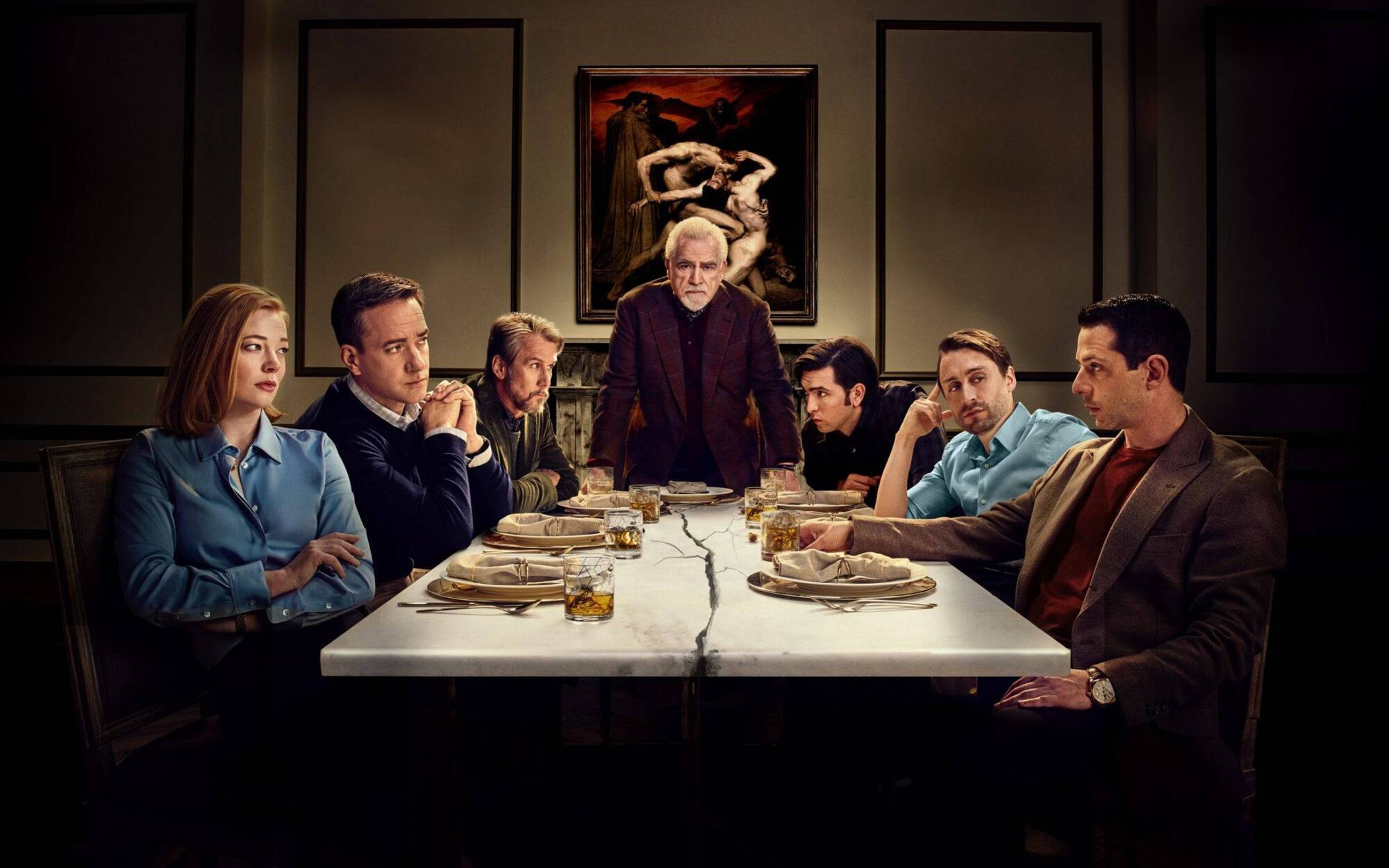
Succession promotional image via HBO

The good times roll again. Don’t you detect the same giddy vibe among us that might be out there in the days before, say, a World Cup?
A high level of satisfaction, a deep sense of contentment at the days and weeks in store.
Some planning being done to clear the decks of everyday inconvenience in order to maximise this guaranteed enjoyment.
It’s down, there’s no doubt, to returning to the box on Monday morning.
This magnificent series, ‘loosely inspired’ by the Murdoch clan, is back for season three to unite us all in fascinated revulsion at its terrible people.
Indeed the most compelling sporting ‘content’ of the coming weeks might well come if it resurrects the subplot where Roman Roy mistakenly purchased Hearts as an 80th birthday present for his father, a lifelong Hibs man.
And then, as if we hadn’t enough malevolence to revel in, returns (for season 11) the following week — as if they were putting on the Euros back to back with the World Cup.
And yet it’s a little different too. For contrary to what we’re told at moments of great sporting excitement, it seems that you can write the script.
I only mention this feelgood factor rising around us because it’s hard to identify anything similar coming down the tracks in the sporting world.
Sure, we’ll all have our own plans. Many among us have cleared their calendars for the Tipp hurling quarter-finals this weekend. Or even the bit of football in Cork. For some, the women’s soccer team will now take the spotlight from the men.
We’ll all be back in the Premier League and Champions League trenches. There’s finally a bit of basketball and there’s folk keeping an eye on the gridiron.
But as Larry David puts it in the trailer: “I hate people individually, but I love mankind.”
Is there anything really out there for mankind for the foreseeable, capturing the old public imagination?
They are trying their level best with the United Rugby Championship, God love them, but it’s not really happening, is it?
There’s Gaelic football structures to debate, I suppose, but you know…
Our best bet, for the time being, looks to be Newcastle — a saga that should make events at the Waystar Royco corporation look wholesome. But even then we have to wait for the transfer window for the juicy stuff to get going, for the plot to thicken.
Thankfully, Arsene Wenger is out there, thinking as usual. Whether you trust him or not, Arsene always sees it early and he sees the people getting restless.
After all, will soon be last week’s global phenomenon.
“By analysing the perception of time in our modern society where everything is becoming quicker and quicker, the demand for major events is also greater,” says Arsene.
The way things are going, to cater for shrinking attention spans, Arsene knows you’d ideally need a World Cup every six weeks or so — to be binge-watched in 72 hours if you wanted. But for now he’ll settle for one every two years.
And you can see the man’s point. The streaming companies are falling over each other to drop ‘major releases’ week on week to stop punters forgetting to log back on.
This new world is built on excitement around something fresh. Can any sport really hope to survive on ancient release cycles?
Especially as there’s a danger that sport had ideas above its station all along, that it never quite gripped mankind as much as we thought.
Tanni Grey-Thompson, one of Britain’s great Paralympians, told the UK government this week that the numbers show the major sporting events — such as the London Olympics — have not had the promised ‘legacy’ effect on her nation’s fitness.
“Far too often the debate on elite sport, inspiration and population in activity have been conflated,” she said. It just creates “false hope”.
Could everything we thought we knew about sport be based on a lie?
Next they will tell us that autobiographies released for Christmas by sporting celebrities aren’t critical documents in helping others going through the same thing.
Long-term, could sport be the telly’s next victim, it having already seen off the movie, having beaten Hollywood?
“The movie business is over,” said Barry Diller recently, former chairman and CEO of Paramount Pictures and 20th Century Fox.
Diller fondly recalled the good old days where you could spend a year or two building excitement for your next big release. “That’s finished,” he told NPR. He’s gone back to working on plays.
There is surely some warning here for the GAA too.
As imperfect as the new championship structure options look to be, they might be even more wary of sticking with the same old, same old.
Of turning down the opportunity to sell something fresh.
Thankfully, of course, sport is not reliant on mankind for its survival. For it has fans.
It has been a year when fans made themselves heard. The Super League might have been one hot new format football needed, but it was jettisoned by a sense of horror and morality and fairness — even among fans who have since partied in the streets over Saudi investment.
“Sport is much different than entertainment,” David Levy, the former president of WarnerMedia’s Turner Broadcasting, told CNBC.
“With entertainment, every show is hit or miss, and you always have to market content. You never know what will succeed and what won’t. That’s why sports is the best content to invest in, and it will be no matter what the distribution model is.”
Mankind might have wanted to watch Messi, Mbappe, and Neymar take on Manchester City in the Champions League last month, but RTÉ knows its audience and showed Liverpool.
Even if Larry David promised weekly cameos in the new season of , there will always be enough Liverpool fans to keep that show on the road.