Premier League management about fine margins. Just ask Jose ...

“I think Jose is finding solutions now,” Fergie told us. “There was a period earlier in the season when he wasn’t getting the decisions and his emotions boiled over. You see him now — he is calm and in control.”
In turn, Jose let us know that Fergie has begun to take a more active role again in the affairs of Old Trafford, assuring us that “Sir Alex” is always welcome in “his house”.
No doubt, there are cynical people out there who will not be terribly surprised to learn that Mourinho has begun to “get the decisions” at a time when Fergie has loomed back into view.
Others may fondly recall the beautiful serenity in Fergie during those times when he too was “getting the decisions”.
And even as Mourinho maintains business as usual on most fronts — the jibes at other managers, the conspiracy theories about fixture congestion, the wars with his own players — it would be easy to imagine, in this new calmness over the refereeing, the relief of a man who had offloaded a key part of his brief to somebody a lot more qualified.
While mediocre managers, in times of great agitation, tend to console themselves with the aspiration that the decisions even themselves out over the season, Fergie always gave the impression he was aiming a little higher than that.
There is, in this campaign of fine margins, a great preoccupation near the top of the Premier League with getting the decisions.
And several great managers who don’t seem to have found the solutions.
While Antonio Conte might hail from a background where there is a reputation for taking quite a hands-on approach to getting the decisions, he currently has the luxury of leaving well enough alone on that front. And given the role of the tactical foul — and the spontaneous foul — in Tottenham’s gameplan, Mauricio Pochettino has also wisely decided that less is more from him in this arena.
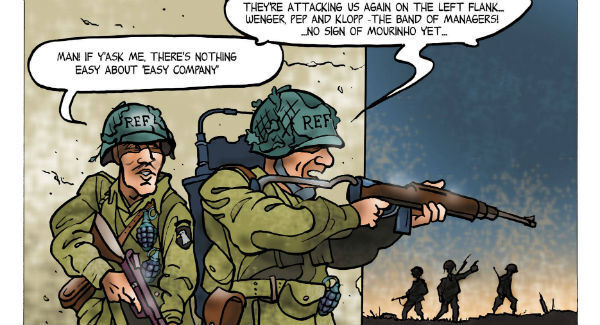
But Klopp, Wenger and Pep are working through the textbook. Searching for the solutions. Trying it all.
They are compiling dossiers of persecution and listing double standards, and resorting, as the need arises, to the ‘fuck’s sakes’ in the technical areas.
While Wenger boils over, Pep has gone the traditional bewildered diplomacy route; seeking a summit with refs chief Mike Riley.
While, after defeat by Southampton, Klopp even made a plaintive appeal for controvassy, claiming “nobody says anything” when decisions go against Liverpool.
All of these measures might have come straight from the Fergie armoury.
And yet, he managed to take a much more holistic approach to persuading the flag to stay down and the finger to point to the spot.
Just as Fergie served as football’s informal broadcasting commission, commonly offering interviewers a ‘well done’ at the end of proceedings he deemed to have gone satisfactorily; perhaps his greatest achievement was installing himself as unofficial referees assessor.
It was a responsibility he didn’t take lightly. “The most difficult challenge was how to address the problem of bad refereeing,” Fergie said, in his autobiography, of his approach to media.
And so he took a sustained vocal interest in refereeing standards, including the weight and fitness of referees. Particularly so after a period of ‘bad refereeing’, where the decisions may have been in danger of evening themselves out.
Paul Scholes offered some interesting perspective last year on the psychology of his old gaffer’s relationship with the whistleblowers.
“How would I describe the impression I got from some referees when it came to Sir Alex? I think some of them wanted to please him.
“I don’t mean that they did us favours. It was more that they were very keen not to make mistakes in our games. That when they came to Old Trafford they wanted to be on top of their game and get everything right.”
Scholesy contrasted that supervisory approach with Mourinho’s constant pleas that a vast international officiating conspiracy was dogging his every move.
“If he had hoped that they would be more likely to give his team the split decisions then it has not worked. They seem to be determined not to be seen to be influenced by him.”
In former ref Mike Halsey’s autobiography, there is some interesting testimony as to his keenness not to make a mistake on Fergie’s watch.
“I also got on the right side of Sir Alex Ferguson later that season when assigned to Arsenal v Manchester United in April. It was a match that would go a long way towards deciding the title and United’s draw helped them towards another championship.”
Halsey sent off Sol Campbell in the 2-2 draw, meaning he would miss the title run-in and the calamitous draw at Bolton, when we would see, maybe for the first time, what Harry Redknapp has called ‘the maniac’ in Arsene Wenger.
Halsey continued: “As I left, Sir Alex — my relationship with him still in its early stages — applauded me and shook my hand but naturally Arsenal did not see things the same way.
“Arsene Wenger’s assistant Pat Rice, who always seemed to detest referees, came to my dressing room to complain.”
Signs, early in his reign, that Wenger was never going to achieve mastery in this specialist area of manipulation.
Of course, Fergie employed stick as well as carrot, as he admitted when laughing off suggestions he influenced refs. “This is a guy who has the worst record of any manager in the history of English football, fined £100,000 (€117,000) by them, suspended so many times, that’s some influence, I must say.”
But the touchline theatrics that earned those censures also played a part in stirring up the anxiety another ex-ref Dermot Gallagher talked about when it came to denying United important decisions.
“Years and years ago one of the referees had a heart monitor on during a match at Old Trafford. They were assessing it and suddenly it jumped and went through the roof. They looked at the DVD and he’d just turned down a penalty in front of the Stretford End. The pressure is immense.”
Over the last three seasons, much of that legacy, like many other things, has been frittered away.
Earlier this season, and during the campaigns of Moyesy and LVG, when men tumbled in front of the Stratford End, it was the referees who became calm and in control.
But United may be finding solutions. But when push comes to shove, others still have lessons to learn.
Heroes & villains
Not just because his clinical dissection of Daniel Sturridge’s performance against Southampton was compelling punditry, rather because those types of excoriations from Carra and Neville have generally been reserved for John Foreigner.
If he has ridden a wave of emotion this far, he’ll splash in a wave of tennis fans’ tears if he somehow beats Nadal.
“We consider the threat to the integrity of NBA basketball presented by Mr Cuban’s misconduct to be real,” wrote NBA general counsel Lee Seham. In his communications with basketball officials, the Dallas Mavericks owner may well be showing a little too much interest in “getting the decisions”.
Ryan Mason’s head injury coverage lurched from hysterical ‘Fighting for his life’ headlines to bikini pics of the ‘Wag’ at his hospital bedside.