Ronan O'Gara on what makes the perfect 10 for the modern game
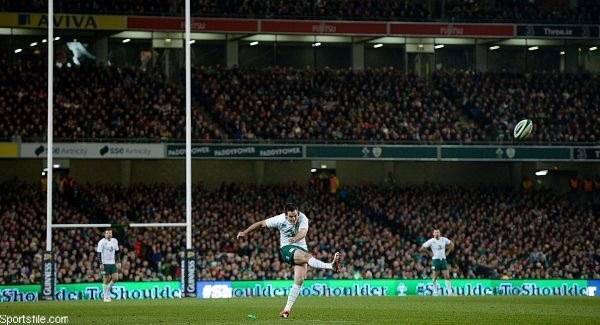
Few of us were fathers at the time, so you don’t pay as much attention as you should to these things. He was Mike Ford’s son at Ireland training. That’s all we knew.
And so when George Ford took the conductor’s baton at No 10 for England last weekend against Australia, it brought it all full circle. Him watching me, now me watching him.
And wondering about the mechanics of the no 10 role, the play-sheet for the out-half. Even the type of out-half modern day international rugby demands.
Owen Farrell is evidently no longer in control of his own destiny, never mind the English attack game. Playing for Saracens has stagnated Farrell, because they play such a pressure game.
An out-half these days must have the dexterity to play the full range of styles. Even though people were more than ready to pigeon-hole me as a pure kicking ten, I would like to think there were plenty of breaks and half-breaks to keep my game varied and the foes in front of me guessing.
You have to have those strings to your bow if you want to survive at international level.
Farrell isn’t a one-trick pony but being left out by Stuart Lancaster may be no bad thing either.
Now he has breathing space to look in the mirror and see how and where he has to improve to be a World Cup ten next autumn. It’s in his genes to battle like hell to get that jersey back because his father, Andy, was an exceptional player is both codes.
Camille Lopez will start at No 10 for Clermont Auvergne at Thomond Park tomorrow. He’s had his own sobering moments of late.
Built up as the kicking answer to France’s perennial search for a reliable out-half, a few missed efforts in the defeat at home to Argentina has stirred the debate again.
And the men with their hands on the ladle, inadvertently, were French coaches Philippe Saint-Andre and Patrice Lagisquet, telling anyone that they’ll all be fine once they can find a reliable kicker of international standard.
Over last 20 games, they crunched the numbers, oblivious to the stark fact that most French 10’s get a maximum of three or four games before they are shunted sideways.
Thanks for the vote of confidence lads, says Lopez.
Clermont seem to have finally decided who’s their best ten is but they retain options in Brock James and Mike Delany — each with a different set of game strengths.
The prototype modern ten has to be built like a labourer’s cottage, have a metronomic kicking game and have the strategies of a White House Situation Room. But a kicking game and a good tactical brain must always outweigh the power game of a ten.
The one place you have to be able to accommodate a less physical player is the brains at ten, to direct everything.
If he’s a physical meathead, what good is he to the team when there’s 14 others who can do that job when necessary — they’ll inject the power and pace, surely?
There should always be a place for a great brain in sport, irrespective of what game you’re talking about.
Don’t kid yourself, the opposition will always target the ten channel anyway; the next decision, depending on speed of ball, is either forwards around the corner or the ten directing operations flat along the gain-line, or seeking space in the wider channels.
Invariably the 12-13’s are better defenders, so the ten channel will be the weakest link — unless you’re Jonny Wilkinson. Johnny Sexton is a great defender but the opposition still go there frequently.
I’ve done plenty of analysis on this, wearing my coaching hat, and 70-80% of first phase strikes are up the 10-12 channel. If Sexton is there, they will vary it, admittedly. If I was there, they’d go there all day.
I’m not being a smart arse when I say that I worked like a dog on all aspects of the ten role — I knew I had to work on my defence, and it was continuous in its repetitive work on tackle technique.
In the latter years, it wasn’t as good as it needed to be, perhaps. But that’s the price you pay for being unable to stop Father Time. On the other side, I tried to compensate by ensuring the quality of my kicking game never waned. In fact, I think it got better every year.
Racing Metro are in the Liberty Stadium tomorrow. Toulon are at Leicester on Sunday evening. But from a theatrical point of view, the weekend’s biggest Champions Cup event will again be at Thomond Park.
I watched Clermont’s 27-19 defeat by Toulon in the battle of the big guns last wekeend in Nice. Tomorrow’s 15 should be very different. Nick Abendanon has really impressed since joining from Bath. Lopez should return. As will Wesley Fofana. Aurelien Rougerie remains very capable at this level, and Nalaga is extremely dangerous.
They remain second in the Top 14 and the worry for everyone else is they haven’t hit their stride yet. There’s more in the tank. They have such quality in their two squads. The massive slog of domestic action demands that they have buckets of options — invariably they are quality options.
But whether they have the psychological wherewithal to silence a rocking Thomond Park on one of those crisp winter Saturday evenings, I don’t think so. Munster will win tomorrow because they’ll rattle Clermont.
What you could never understand until you live and breathe it is the prioritisation given to the slugfest that is the Top 14 over Europe. Big French clubs cannot but be in the Top Six. In Ireland, we associated top level rugby with the Heineken Cup; over here top level rugby is the Top 14. That’s a critical difference.
Everyone moves to a quicker beat in Ireland the week of European competition. In France, players almost drop a notch, like it’s a down week from the stress and strain of domestic struggles. That worries me.
Clermont can win at Thomond Park. They’re experienced, and possess very ambitious international players who are still performing with pride and influence.
But quietly and efficiently, the baton in Munster is being nicely passed along through this european adventure. Now Anthony Foley’s starting 15 is serious, even if the centre remains an area of transition. The back three is exciting and solid, the half-backs are doing what they’re supposed to.
The back row of Stander at 8, Tommy O’Donnell at 7 and Peter O’Mahony means that Robin Copeland has to wait his turn. Gerard Van den Heever looks devastating with ball in hand, and will get the start tomorrow.
Last Friday night was a very important one for Duncan Williams as Munster pipped Ulster in front of what I thought was a staggering sight of empty terraces at both ends of Thomond Park. Or maybe that was just because I was watching from afar.
People have questioned how the back-up Munster scrum-half has even got a contract. It was nice for him to prove that’s he more than capable. He was the biggest schoolboy prospect when he came out of Christians, a great ball-poacher. He played like a wing-forward, which meant he got battered.
And amid the torn abductors, groins, eye socket injuries, the biggest damage was to his confidence. It’s the age-old problem. But that game last week will do wonders for Williams’ confidence. The knock-on effects are subtle but so important. You become more professional in the small things because you matter, and you know you matter.
So you go to bed a bit earlier, you get into the gym a bit sooner, you arrive at training ready to seize the day. You don’t trudge anymore, you strut. And you can’t carry that off without doing the business.