Homegrown approach boosts Germany and Spain

Just when the season seems to be warming up, into the chiller it goes again.
Perhaps we should see this as Uefa’s way of evening up the odds. The break is more of an issue for the leading clubs as they lose most of their squad for 10 days, with all the worries about possible knocks, or worse.
At the other end of the table, it provides club managers an opportunity to pull things back together on the training ground and gives time for injured players to recover.
Frustration is greater now because the enlargement of the competition means more of the qualifying games pits giants against minnows. Italy’s two games are at home to Azerbaijan and away to Malta. While some countries that used to be classified as minnows, such as Albania, Armenia and Iceland, have developed the ability to bite, this round of matches seems unbalanced.
On the plus side, unlike the Champions League we can assess the strength of countries after the World Cup, and which way they’re heading.
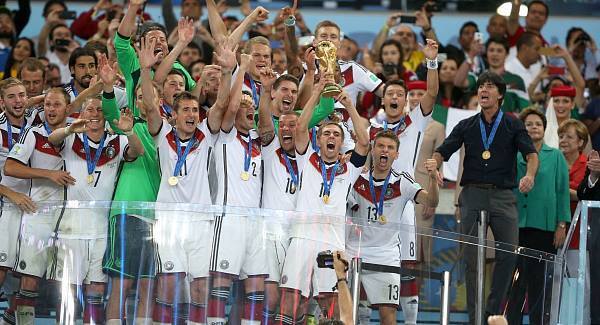
Are Germany as supreme as they seemed back in July? Was Spain’s eclipse temporary? Has Dutch football been reborn? Can Italy come through their crisis? Are England more than also-rans? Will Belgium now justify the hype? This week is all about homegrown players and the ways the different leagues are evolving creates problems for national managers. Virtually all of Belgium’s golden generation are playing abroad, most of the Dutch players as well. This means they’re competing at a higher level for their clubs, but it also means the team can lack character and coherence.
If you look at club sides in Europe’s top five leagues, there are quite different approaches. In England, France, Germany, Italy and Spain, the number of club-trained players at clubs looks very stable. The average is around 20%, according to the statistics kept by the CIES football observatory in Switzerland, and it has been more or less the same for the past five years.
Meanwhile the number of foreign players at the leading clubs — the top five in each league — has also stayed fairly stable: around half are expats, although the figure rose to 56% last season.
But compare the figures for each country, and the picture starts to look completely different.
Only 7% of players at the top five sides in Serie A are club-trained, and the percentage of foreigners has risen dramatically: from 51% in 2009 to 73% last season.
The top five in the Premier League have twice as many ‘homegrowns’ as there are in Italy, but the numbers are well down over five years.
Back in 2009-10 there were 22% club-trained in England, the latest figure is 13%.
In France the proportion of club-trained has gone up — to one in five — but the percentage of foreigners has also risen significantly. It was around a third at one stage but it was close to 50% last season, an obvious by-product of the flood of new money into the game.
Spain and Germany are different. The number of foreigners in La Liga has risen and fallen but compared to five years ago the numbers are about the same: it’s 43% for the top five clubs. And around a third of their players are club-trained.
The top Bundesliga clubs have also kept things fairly stable. Just over 40% of their players are from abroad, about a quarter of their players are club-trained.
You have to interpret all these statistics a bit. Club-trained refers to those who were at their club for at least three years between age 15 and 21 and have been used in league matches. So they may only have played a few matches for their club in any one season. Moreover, the top sides in both Germany and Spain have their B teams, which allow them more easily to retain youngsters within the club.
But the overall conclusion is the best clubs in Germany and Spain have maintained a stable approach to recruitment and retention compared to those elsewhere. You can see the results on the pitch as well as on paper.