Paul Rouse: How the GAA gave a depth of meaning to county boundaries
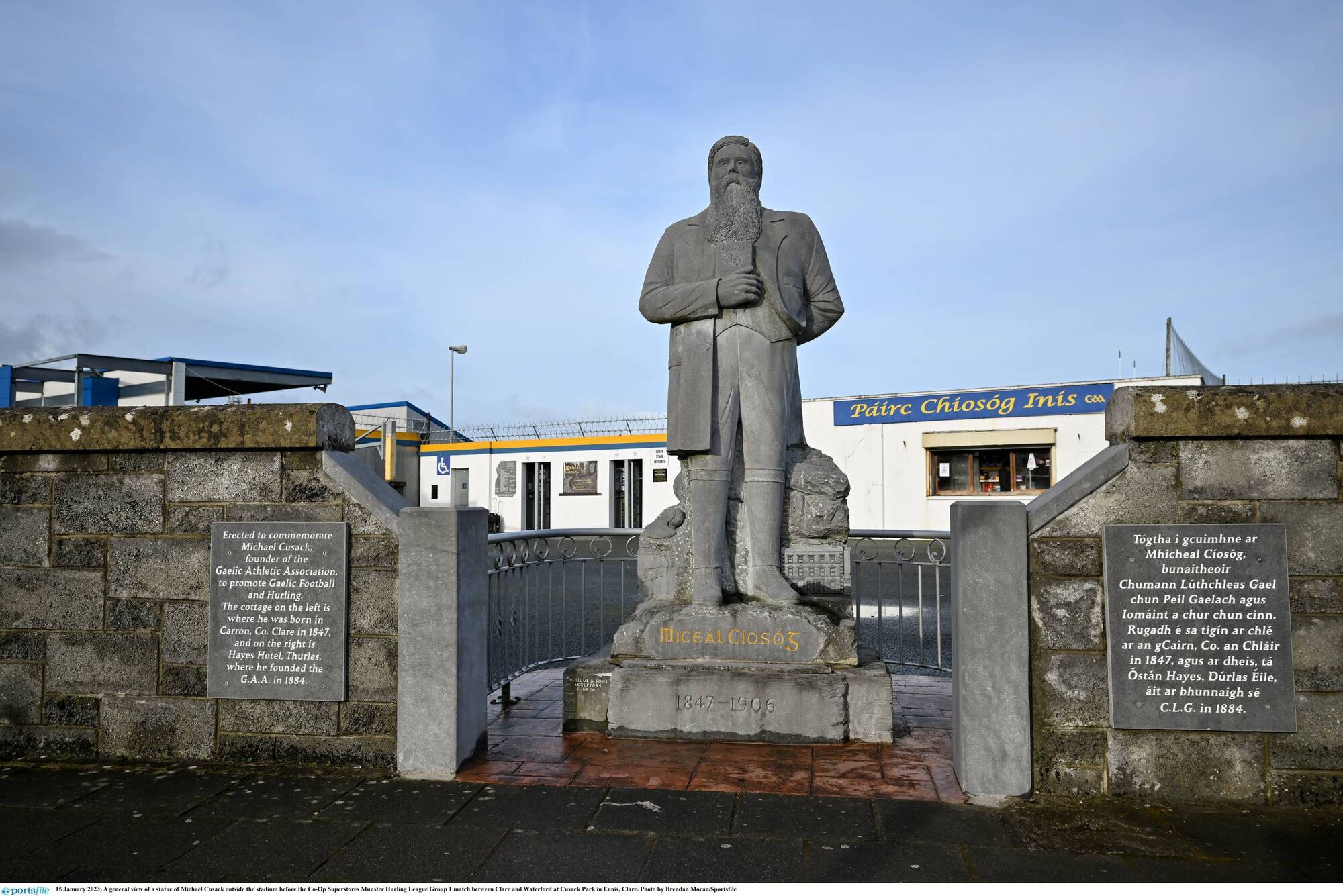
GROWING PAINS: By August 1887, Michael Cusack was describing the GAA’s rule on the relationship between parishes and clubs as a ‘fruitful source of annoyance. Pic: by Brendan Moran/Sportsfile
It is considered an article of faith within the GAA that lines drawn on maps are sacred in their meaning: county plays against county, parish plays against parish.
This idea of neat territorial divides fits perfectly into the modern world of sport – like all history though, it is far from neat when considered in detail.
At the third GAA meeting – held in Thurles on 17 January 1885 – Maurice Davin presented a set of rules that were unanimously adopted. These rules said nothing about counties as a structure of governance and laid down no territorial boundaries around the establishment of clubs or counties.
It was the Normans who had begun the evolution of the county system when they introduced an English system of shires and counties to the Irish landscape – boundaries (although many remained fluid for quite a time) were introduced and counties began to emerge. By 1200AD, counties such as Cork, Kerry, Louth, Tipperary and Waterford had come into being. The basic process continued until Wicklow became the last of 32 counties to be created in 1606.
For most Irish people, any deep sense of county identity, prior to the nineteenth century, was most likely relatively weak – indeed, there was nothing inevitable about the triumph of county loyalties.
Increasingly, though, during the 1800s the county functioned as an administrative unit for British colonisers. Bodies such as the Royal Irish Constabulary were organised around county units of organisation and the census was collected on a county basis.
The campaign for Catholic Emancipation, the Land League and other movements were organised by county and during the nineteenth century various history books were written which chronicled the history of various counties.
A further major shift in developing county affiliations took place between 1833 and 1846, when Ireland was mapped by the Ordnance Survey. While the process of mapping was met by suspicion and even violence in certain parts, the reality of the maps was simple and powerful: people now knew with certainty in which county they lived, where the boundaries of that county were, and where next door began.
This was further reinforced when the counties began to be used as the unit of local government from 1888.
But although modern sport demands clarity in terms of its rules of affiliation, as sports clubs and organisations were founded in the nineteenth century there were numerous influences and contexts.
It must be remembered that it had not been the intention of the men who established the GAA in 1884 to use the county structure of Ireland as a basis on which to develop their Association. Initially, it was simply decided to establish clubs across Ireland and these clubs were asked to affiliate to the central committee of the GAA.
The extraordinary and immediate growth in the number of GAA clubs between 1884 and 1886 left it impossible for the GAA to regulate matters entirely from central level. There was already a precedent within sporting organisations for responding to a rapid increase in the number of affiliated clubs. In England, the men who organized soccer, rugby and cricket used the English county structure as the basis for their own rapid spread.
A key factor in determining that the GAA should organise on county lines was the decision in November 1886 to establish All-Ireland hurling and football championships.
The rules upon which this championship were based identified the club as the primary unit of the GAA, but also clearly laid the basis on which the future primacy of the county was founded.
These rules stated that the All-Ireland Championship was open to all affiliated clubs of the GAA; that clubs in each county would first play off a championship between themselves on a knockout basis; and that then the winning club in each county would proceed to play off, again on a knockout basis, against the winning teams from the other counties until an All-Ireland champion emerged.
Critically, to facilitate the running of the championship it was decided that county committees (the forerunners of modern county boards) should be established in each county. It was to these county committees that so much power ultimately devolved within the GAA.
It was also now incumbent on clubs operating in border areas to choose one side or the other, to conform to the new organising structure that was now being constructed through affiliation.
But the hinterlands of quite a number of clubs left that a most challenging process. All across Ireland there were clubs based in parishes that straddled county boundaries.
And if there were difficulties in framing county boundaries, there were equally difficulties with the idea of parishes.
At its annual convention in November 1886 – the one that established the All-Ireland championships and set up the county unit of organisation – the GAA also stipulated that each of its clubs should be based on the boundaries of Catholic parishes.
But in Dublin the rule was never implemented. Instead, clubs in Dublin were formed around businesses (e.g., the Freeman’s Journal Hurling Club), around trades (the Grocers’ Assistants Gaelic Athletic Club), around institutions (Erin’s Hope was based in a teacher-training college), and around localities that were not defined by parish boundaries (such as Dunleary and Golden Ball, a small village in the foothills of the Dublin mountains).
Many clubs were based around groups of friends banding together; this gave them a transience which accounts for the extraordinary number of clubs in the history of Dublin GAA that bloomed and then died.
And in rural areas, too, there were numerous instances of a simple ignoring of the parish rules. By August 1887, Michael Cusack was describing the GAA’s rule on the relationship between parishes and clubs as a ‘fruitful source of annoyance. No one seems to know what constitutes a parish. Endless objections are lodged. Each club accuses the other of having men from outside parishes on its team. Strong measures will have to be taken regarding this parish rule … There is scarcely a match played between country teams in which disputes do not arise regarding their composition.’ Also, for all the rhetoric of parish honour and glory, many clubs were more than willing to poach the hurlers of other clubs in other areas if it helped them to win a match.
It was not just the pursuit of victory that brought people across boundaries; it was also a desire to play with friends and colleagues and to reflect the existing networks of family and commerce.
This point has been made by Tom Hunt, who wrote: “when territorial units formed the focus about which a club was organised, smaller units than the parish were more important. Rural society in the late nineteenth century functioned not on a parish basis but on the more informal alliances that evolved amongst members of the farming community. … The operation of these community networks provides the key to the understanding of the origins of many of the early GAA clubs. The townland lay at the centre of rural communities. A townland or contiguous townlands provided the nucleus from which some clubs emerged built around a clutch of sporting and athletic neighbours.”
Tom Hunt gave the example of The Suir View Rangers team that contested the Tipperary hurling championship between 1895-1898, with the majority of the club players living in two adjoining townlands, Bawnmore and Longfield.
Those townlands were in the parish of Boherlahan-Dualla and three teams form the parish – Ballydine, Boherlahan and Suir View – competed against each other in the 1897 Tipperary championship. The Suir View team grew from the activity that took place around a forge owned by the Morrissey family of Ballyroe.
A further example was Tubberadora, a club based in a townland then located in the Moycarkey parish. The team was based on five houses and in its short existence won the All-Ireland senior hurling titles of 1895, 1896 and 1898.
Such was their sense of themselves that they retired undefeated from competition after the 1898 All-Ireland Final on the premise that, like Alexander the Great, they had no known worlds left to conquer.
Central to its brief history was Tubberadora Mill, “the focal point of social and economic activity for the farmers of the Tubberadora hinterland.” The essential point is that the reality of the playing experience for many members of the GAA in the nineteenth century does not fit neatly into the claims of the supremacy of parish and county loyalties.
Ultimately, in the twentieth century, the increasing demand for precision in eligibility came to overwhelm older networks of sociability, but they did not always simply evaporate. Their legacy can still be seen in the enduring accommodations that emerged.
A fine example of the challenges involved can be seen on the borderlands between Offaly and Tipperary. The extent of this history can be seen in the fact that for its first four decades, Offaly was known as King’s County.
The first time the GAA was organised in the Moneygall and Dunkerrin area, it was based around the farm of Thomas Corcoran in the townland of Honeymount. It was on that farm that a team who became known as ‘The Honeymounts’ played their matches; the players who played in that field were drawn from the surrounding townlands, either side of the border between Tipperary and King’s County.
The farm was in Tipperary and Thomas Corcoran attended meetings of the North Tipperary Board of the GAA, but almost half of the players who listed as playing for the Honeymounts were drawn from the King’s County townlands of Caslteroan, Clashagad, Moneygall, Ballintemple and from the parish of Dunkerrin.
As if to emphasise the extent to which the border between the two counties was irrelevant can be seen through a 1889 match when ‘The Honeymounts’ played a combined team from Shinrone (King’s County) and Ballingarry (Tipperary) in a match that was commemorated in song.
County boundaries were irrelevant to the occasion.
What is of interest as well, of course, is that although ‘The Honeymounts’ were affiliated to the Tipperary GAA, were represented at meetings of the county committee and were corresponded with on an official basis.
But, at the same time, another team named ‘Dunkerrin, Monegall and Barna’ entered the first ever Offaly senior hurling championship in 1888. The semi-finals and final was played in Birr on 2 April 1888, the day after the first All-Ireland hurling final was played on the same field. In the semi-final, ‘Dunkerrin, Moneygall and Barna’ won by 1-3 to 0-0 over Frankford (Kilcormac), and in the final they defeated Roscomroe by 0-3 to 0-1.
So Moneygall has won county championships in two different counties (they won county senior hurling championshjps in Tipperary in the 1970s).
As if to emphasise where their allegiances lay, later that year, at the King’s County annual convention, Dunkerrin were one of the clubs represented.
Nonetheless, the reality of life in the border townlands of the area around Moneygall and Dunkerrin was that players continued to hurl on both sides of the county line for many decades to come. Exploring the legality of this arrangement would be quite the undertaking.
In all of this, it must be remembered that it was not just about the game.
What drew people most of all to the GAA in the years after its establishment was the love of play, whether that be as a competitor or as a spectator.
It was also a success because it offered people a day out with a difference – a unique cocktail of sport and drink and music and pageantry, which mixed the local with the national. I n the 1880s leading GAA figures such as Michael Cusack and Archbishop Thomas Croke repeatedly sought to praise GAA players and spectators for the manner in which they abstained from drink. There was more than a hint of wishful thinking to this.
Drink was sold on the sideline at some GAA events, drawing occasional complaint that it was overpriced; and pubs in the vicinity of pitches were thronged on matchdays.
The idea of ‘a day out’ was obviously one that crossed borders.
It wasn’t just the spectators who drank. When Roscomroe beat Frankford in that 1888 semi-final match in the King’s County championship, the players were so thrilled with the victory that they spent the afternoon drinking despite the fact that they were due to play ‘Dunkerrin, Monegall and Barna’ later in the day. In part, of course, this provided the ideal excuse for subsequent failure, as a famous local ballad in Roscomroe concluded: ‘’Twas the liquor that defeated us!’ A day out in King’s County was joined by a day out in Tipperary. In the 1880s, the local curate in Dunkerrin, Fr. John Maguire, was a well-known lover of hurling who celebrated a hurling match by killing a pig and boiling six stone of bacon for the occasion.
It took time for the making of rules, for the defining and redefining of the game and its geography of affiliation to win absolute supremacy over the traditional world of boiled bacon and pitch-side liquor.
In achieving this supremacy, the GAA gave a depth of meaning to county boundaries that they had previously lacked. In the process, the importance of local identities acquired a new dimension. That is not to say that before the 1880s that county loyalties did not matter at all, rather that they later came to assume an importance that they had never held.
Part of this process was the establishment of a county jersey, an acknowledged county song, and the rituals specific to place that always accumulate around the pageantry of an institution.
And, of course, it sits rooted in an imaginary line running through networks that were shifted by the need to adjust to the demands of administering a sport.