Liam Sheedy: Time to park trophies and egos and put players at centre of our sporting world
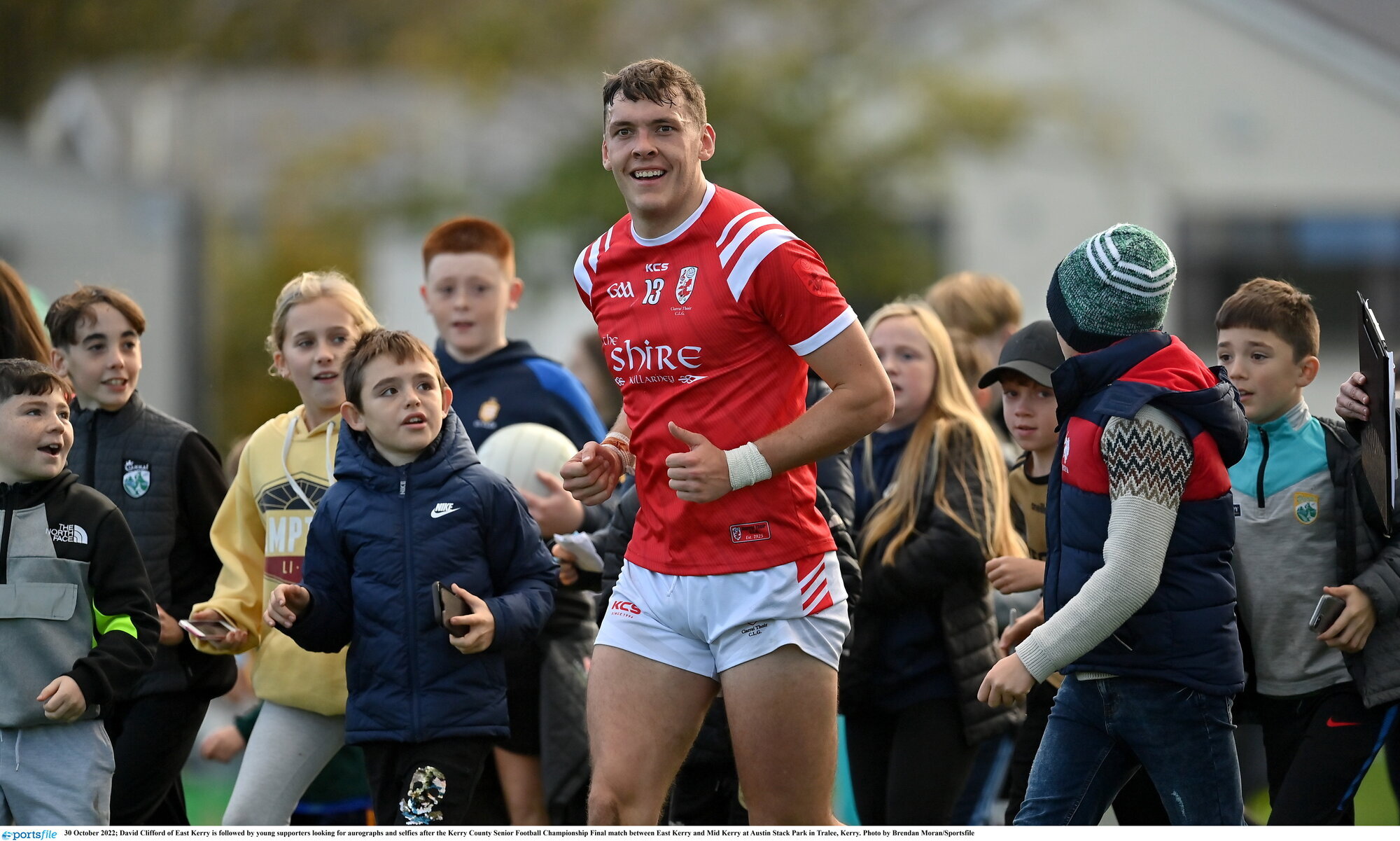
SPEAKING SENSE: David Clifford of East Kerry is followed by young supporters after the Kerry County Senior Football Championship Final. Pic: Brendan Moran/Sportsfile

Growing up in Portroe, my childhood was pure simplicity. You came in from school, gobbled down the dinner, crossed two fields, jumped two ditches and arrived in the hurling field.
Little did I think the impact that field would have on my life. I will never be able put a true value on everything it gave me. It was pure bliss. Often, we played a game of football first and then hurling, but no matter what, we were always active.
What we consumed through TV mattered too. When Wimbledon was on we played tennis (no shortage of arguments as to whether the ball was in or out). During the World Cup, we played soccer. All ages, boys and girls. Tubex was the local factory and shift workers finished at four so they often joined us and everyone was welcome.
I was struck by David Clifford's interview after his FOTY award on Friday night where he spoke about trying every sport as a kid and then recommended picking one if you get serious. He would have approved of our approach in Portroe. Sport was the centre of our community and I still have wonderful memories of those times.
In 2022, the world for a child growing up is far from simple. We have just been through a global pandemic, a really challenging time for all ages. Significant action was taken and thankfully we are back to a more normal lifestyle. During that turbulent time, the importance of clubs being the central hub and heartbeat of communities was never as important.
But it strikes me there is a silent pandemic at play in relation to obesity. Over the last two decades we have seen a significant increase in body fat and kids are challenged in terms of diet and activity levels to stay fit and healthy. Sport has a real opportunity to play its part in addressing this by retaining players from youth to adult and giving them the pathway to a healthy balanced lifestyle playing a game they have fallen in love with.
But to achieve this we have to park a few egos and put the player – the child – at the centre of our thinking. I’m talking about the football manager who tells the kid he can’t play soccer or rugby or he’ll be dropped. Or the hurling coach who stops players playing Gaelic football. I’ve heard and seen it all. I’m talking about the selectors who can’t see past winning the next Under 12 match and leave kids sitting broken-hearted on a bench. And I’m talking about the problems our most talented kids face too, with coaches fighting over them, trying to push them onto their ‘development pathway’.
I heard Ireland soccer international Clare Shine – a brilliant camogie and Gaelic footballer too - say recently she was turned off and disillusioned in her teens by the pressure various coaches were putting on her to play their game, so their team won. She was forever feeling she was letting someone down and eventually burned out and lost her love for the games. I’d say it’s by no means a unique experience.
We must stop forcing choice on kids too soon. All field sports must work together to grow the number of players playing games and being retained in sport. Put the player at the centre and allow them pick and choose the games they love the most. And if they leave your team because they prefer another, be proud you have given them some crossover skills to take with them. And always be ready to welcome them back with open arms.
There is an argument that athletics is the key sport, promoting movement at all levels from walking to sprinting and jumping and throwing. If the fundamentals of movement are in place and you are physically fit then all sports are on the agenda from there. Then it's back to the one you love the most.
With all the challenges facing today's kids and the ever-increasing access to substances, there is real value for parents in knowing a child is at their club three or four times a week. And it's important too that parents value that peace of mind. The support of parents is so vital to a child's sporting journey. That means encouragement and approval, not pressure. The only question a parent needs to ask after training and matches when they are young is 'Did you enjoy it?' Everything after that is a bonus.
The drop-and-collect model is not ideal. And volunteers are in scarce supply. If it's important to you and your child, I'd recommend to anyone to make an effort to lend a hand in whatever way. If your child sees you pulling out of the car park every evening, it’ll make it that bit easier for them to turn their back one day too. Your commitment could be infectious. And clubs provide an environment where people look out for each other which is so important these days.
Many GAA clubs will be holding their Juvenile AGMs in the coming weeks and secretaries' reports will focus on matches and trophies won. The time has come when the most important question to be asked is: Will we retain all of our players for next season?
There are many factors at play when it comes to retention. No doubt quality coaching has a real impact. When I was involved with development squads in Tipperary, I told the coaches I would be asking the parents what the kids are saying when they get back into the car. If you hear a child say they absolutely loved it and cannot wait to come back next week you are in business. You have to create an environment where kids can learn the skills while having fun and making mistakes along the way.
We have Darren Gleeson coaching our U8s and 10s in Port and he has great people with him. You can be sure these kids are enjoying it and have a much better chance of staying with the game.
It haunts me to think that the GAA, for one, is losing six out of 10 kids to the game between 12 and 21. Some are moving to another sport, which is fine. But only a small portion. This stark drop-out has got to be tackled through a unified approach across the country.
The age-grade debate raging at the moment is one factor, but only one part of the big picture. There are issues in schools too, especially secondary. Our games programme in GAA is too centred on the elite. Eight or nine primary schools might feed into one second level school. That could be upwards of 100 lads or girls who were used to playing for their school – 25 might now get picked for a Rice Cup panel, or whatever. And the rest can stay back in class while the fun is going on. And this is at a vulnerable age where a kid might easily drift away from his club having left behind some of the friends they grew up with.
We all know a club that is excellent at keeping their players. There are pockets of brilliance around the country with great coaches who involve everyone and invest equally in all their kids. We have clubs that continue to outperform their size and population because they bring almost everyone through to their adult teams. We have to learn from each other and share best practices as ultimately the winner will be the player.
We must consider too the many new arrivals to this country, who are becoming a greater part of every parish. We must prioritise all-inclusive communities where players and parents are encouraged to become involved and get to know their new surroundings.
There aren't one-size-fits-all solutions. In some of the bigger urban areas, it might make sense to have more than one club, to prevent kids being lost under the sheer weight of numbers. In rural areas, we may have to accept more amalgamations to keep the games alive. Pride and history can never stand in the way of the player.
The Government can do more to support local villages and rural Ireland in general. There are people in our parish who cannot get planning permission to stay and live in the village where they grew up. It feels wrong and I don't see leadership to address the issue. If it's happening in Portroe it must be the case in other parts of the country.
Meanwhile, it is great to see the integration process has finally kicked off under the leadership of Mary McAleese and it should provide an opportunity for our three Gaelic games associations to come up with a unified approach to transform participation and retention in our games.
We have a duty of care to the next generation to grab these opportunities to make meaningful gains in retaining our people from youth to adult. In the discussions and inevitable disagreements that will come, it will be vital the player is always put first, given the opportunity to choose and play the sports they love, and develop personally and collectively while creating memories that will last them a lifetime.