Enda McEvoy: Why should there be a downside in qualifying for the League final? 
We live in an age of impossibly sophisticated recovery regimens and backroom teams whose dimensions border on the size of a Cecil B De Mille cast. Whoever reaches the final and whatever the outcome, the winners and the losers will be hopping off the ground two weeks later. Rested, recovered, hydrated, the works. Not just fit but match-sharp, their sights calibrated, their stickwork oiled to a fetching gloss.
Enda McEvoy: Why should there be a downside in qualifying for the League final? 

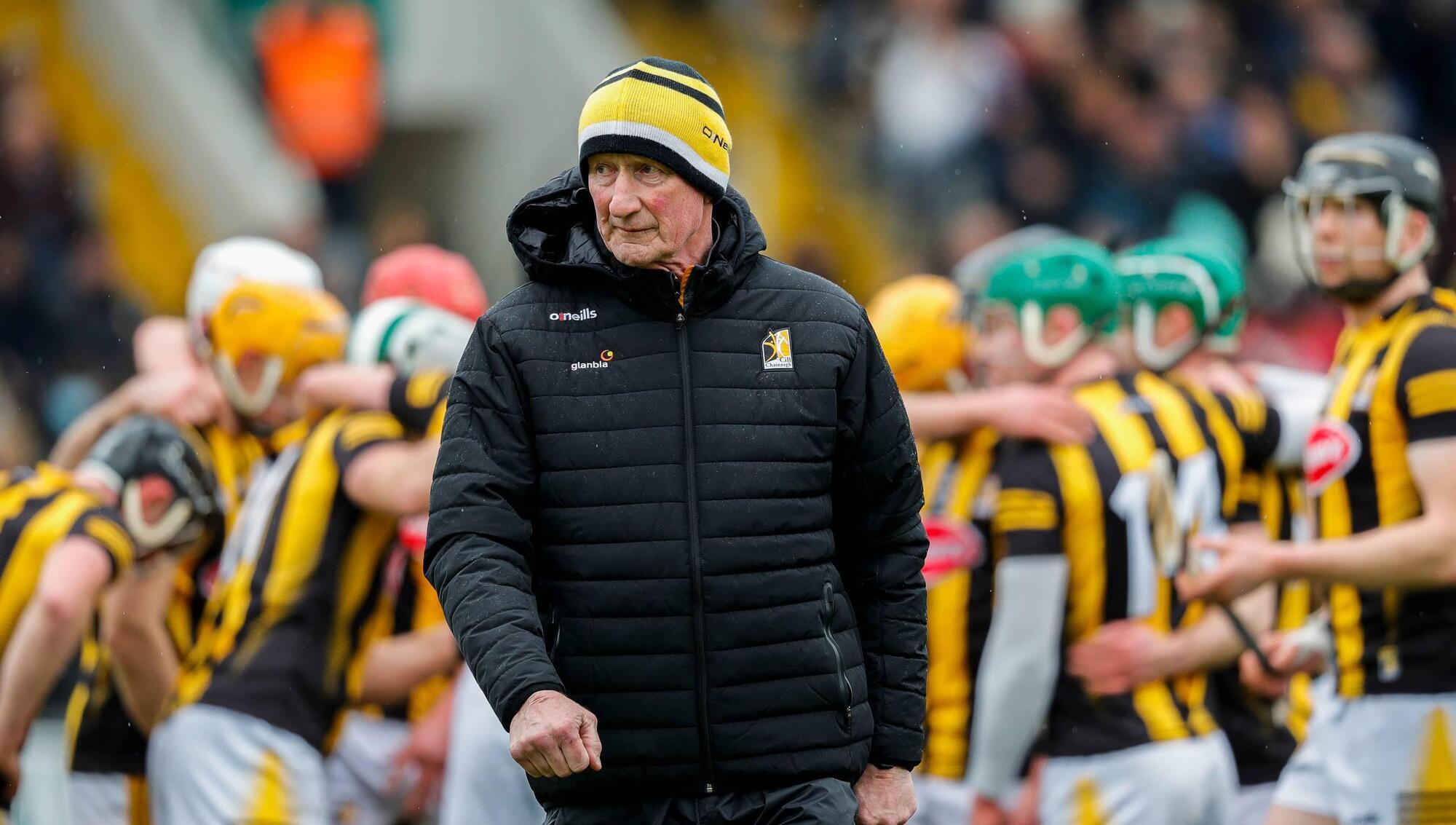
Kilkenny manager Brian Cody 

The form team in the country versus the crowd commonly deemed the most likely to take down and/or succeed Limerick. 

It is a National League semi-final to look forward to with relish and the other usual condiments.

Cork and Kilkenny meet in the first semi-final.

Right. Puerile witticisms out of the way, best to begin by contemplating what we can reasonably anticipate this weekend. Expecting little from league semi-finals is always a surefire way of avoiding disappointment.

Liam Sheedy made an interesting point recently about the potential downside of the fortnight’s gap between the league decider and the opening round of the championship. It will be witnessed, he posited, not next weekend - because both finalists, having got that far, will be giving it the holly - but this weekend, because one or more managers will conclude that a three-week run-in to the championship is preferable to a two-week run-in and will tune the dial accordingly.

Not that the reader should fall for any post-hoc rationalisation from supporters of this weekend’s losers to the effect that they’re suddenly and joyously “better off out of the league”. Guff.

We live in an age of impossibly sophisticated recovery regimens and backroom teams whose dimensions border on the size of a Cecil B De Mille cast. Whoever reaches the final and whatever the outcome, the winners and the losers will be hopping off the ground two weeks later. Rested, recovered, hydrated, the works. Not just fit but match-sharp, their sights calibrated, their stickwork oiled to a fetching gloss.

For the millionth time, moreover, there cannot possibly be a downside to Wexford (four titles in their history, the most recent in 1973) or Waterford (three titles in their history) going for it here. Or to Cork (most recent title 1998) doing so. What would be so terrible for Kieran Kingston and his players about taking on Limerick as freshly minted league champions? They might not win, but if so it’ll be because John Kiely had the better team, not because Cork had allowed themselves to be beguiled down a cul de sac.

Whatever the outcome tonight their campaign could scarcely have been more satisfactory. It wasn’t a given that they’d be able to remount after the All Ireland final; in the event they reeled off four straight victories, with an average winning margin of 11 points, before rewarding themselves with a trip to the sunshine and sea air of Wexford last Sunday. Those are the kind of foundations on which championship challenges can be built. The wins and the R and R.

The return of Conor Lehane is to be welcomed. For most of his first coming he never quite added up to the sum of his considerable parts and was patently a better first-half performer than a second-half one. Chaps who consistently knock over three points per outing constitute a precious species, though, and assuming Lehane slips back into the groove he’ll be a desirable last-quarter substitute come the championship. The strength of the panel and all of that.

If it’s pushing it to decree this to be a bigger match for the visitors than for the hosts we can be sure nonetheless that the former will, as per a Cody team, be offering 110 per cent. If a game is worth playing it’s worth winning, as he’d say himself. We can be equally sure that if Kilkenny win they will not be out-hungered in the final, regardless of how ravenous Wexford or Waterford may be.

Hunger has not been an issue on Noreside for a long time now. Stuff like strategy and tactics and coaching, on the other hand, well… Cork played young man’s hurling at Croke Park last August and ran Kilkenny off the pitch.

To date Cody’s newcomers look mobile and handy and able to take care of themselves. On the negative side they’re linking up with a cohort – the middle order, as it were – who’ve been hanging around the place for the past three or four years and haven’t kicked on. Some of them hardly will at this stage. John Donnelly is one they can’t afford to allow disappear through the cracks.

But Kilkenny are blessed to have Padraig Walsh, albeit cursed to require him on three lines – half-back, midfield and half-forward – simultaneously. In any normal family he’d be the best hurler of his generation. In Walshes of Tullaroan he’s merely the third best. (Tommy and Grace, in case you had to ask.) Can’t be easy.

Talking of members of famous families, Rory O’Connor has racked up 3-17 from play in four starts for Wexford. Inference? O’Connor is thriving because under Darragh Egan he’s receiving more clean ball, in better positions, nearer to the enemy uprights, with fewer opponents belabouring him, than under the previous administration.

Tomorrow will demonstrate if this is in fact the case. It will also highlight the degree to which Wexford are moving the sliotar up the field earlier than was their wont when Davy was manager. Admittedly this was low-hanging fruit for Egan to pluck given that greater engagement with the opposition in the last 30 metres of the field was always going to be their next evolutionary step.

Waterford are another crowd who could do with a little more in the last 30 metres of the field. Even with Dessie Hutchinson working his voodoo they haven’t had quite enough happening there over the past couple of years. Not when it mattered most, which is another way of saying “when they were facing Limerick”.

One local school of thought has it that Mikey Kiely is sufficiently capable in the air and sufficiently direct to be a viable option at wing-forward. In view of his UL Fitzgibbon Cup exploits Waterford are likely to keep him closer to goal. At very worst he’ll offer a presence and create space for Hutchinson.

Some other observations.

Much has been written about Darragh Egan’s backroom team. The presence there of Willie Cleary, formerly the county’s hurling development administrator, should not be undervalued.

We lost Nicky Furlong – historian, farmer, author, raconteur and card-carrying proud Wexfordman – during the week. Nicky’s magnum opus was The Greatest Hurling Decade: Wexford and the Epic Teams of the ‘50s, the most stylish and elegantly written GAA book ever. Its price went up by a tenner on eBay during the week. Brostaigh oraibh; no self-respecting student of the sport ought to be without a copy.

Still on Wexford and returning to the importance of the sport’s secondary competition, try this on for a chunk of alternative hurling history. Instead of drawing with Cork in the first two league finals in Thurles in 1993, Wexford win one of them by a point. Energised and emboldened, instead of drawing with Kilkenny in the Leinster final they have the wherewithal to win by a point. Now new men, they proceed to claim the All-Ireland and retain the title in 1994.

Thus 1993 is the year of liberty, Christy Kehoe is the messiah and Liam Griffin remains best known as a hotelier. All for want of one more point against Cork. Sliding doors, huh?

It’s almost too obvious to state that one or other semi-final may well go to extra time. Perhaps even both.

Either way, Kilkenny versus Waterford next weekend.

More in this section

Sport

Newsletter

Latest news from the world of sport, along with the best in opinion from our outstanding team of sports writers. and reporters

Cookie Policy Privacy Policy Brand Safety FAQ Help Contact Us Terms and Conditions

© Examiner Echo Group Limited