Kieran Shannon: Cork and Limerick could share four of the next five All-Irelands
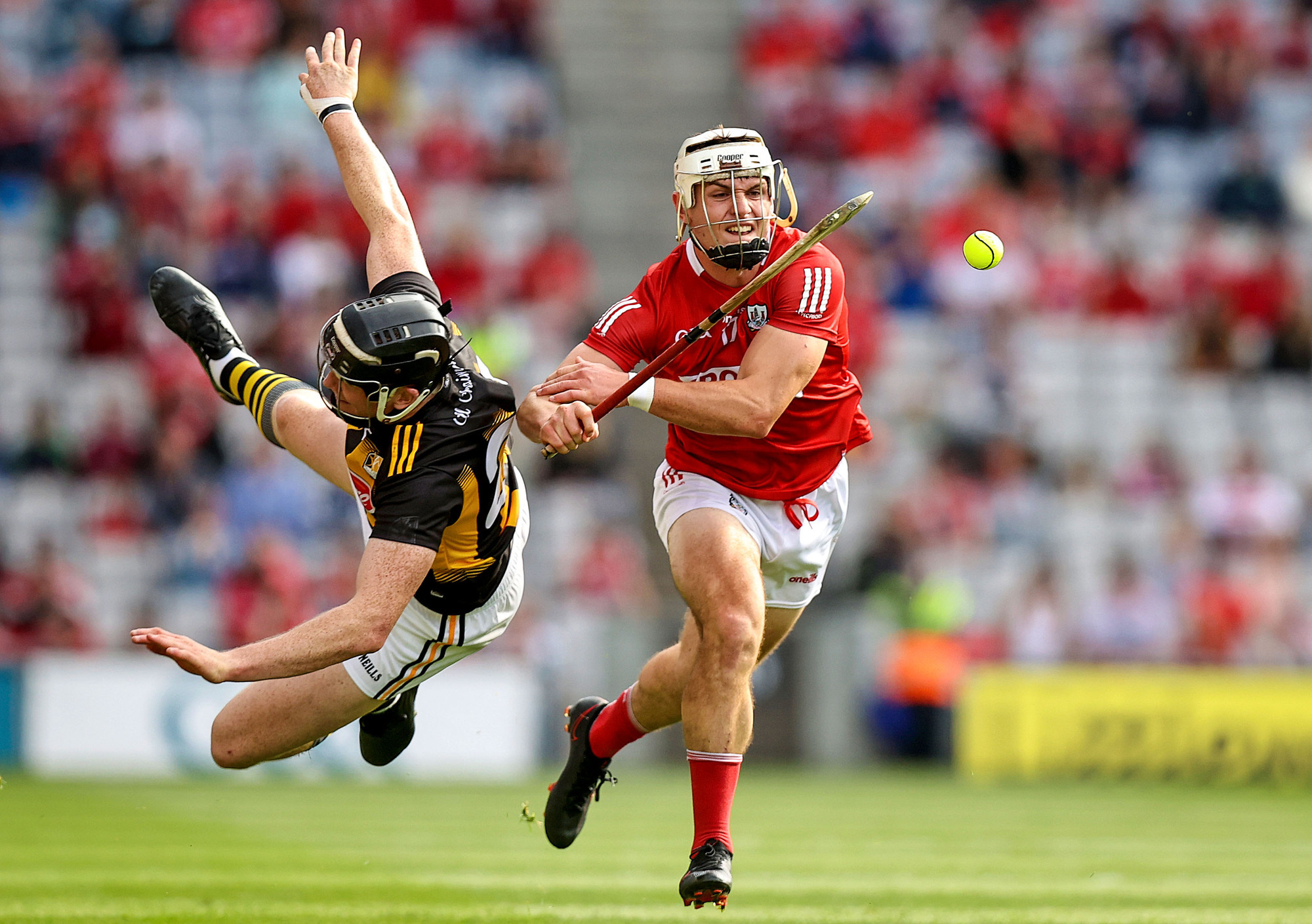
A DIFFERENT BEAST: Cork’s Seán O’Leary Hayes wins possession ahead of Kilkenny’s Walter Walsh in Sunday’s semi-final. The Rebels have come a long way in a short space of time. Picture: Inpho/Tommy Dickson

If you do your job so well for long enough, eventually you become the bad guys.
Or at least more people begin rooting for the other crowd than are rooting for you.
So it is with the Limerick hurlers. While John Kiely’s team haven’t been as incendiary as Ger Loughnane’s to prompt cries that they should feck back off across the Shannon having won their breakthrough All-Ireland, such has been their recent majesty and dominance they’ve created the peculiar and once unfathomable scenario whereby plenty of neutrals would like if Cork, a county with 30 All-Irelands, won on Sunday week, much the same way they’d find it refreshing if Kerry instead of Dublin won the football.
But a bit like with the big ball, people should be careful what they wish for.
Just as Seán O’Shea and Co will hardly be satisfied with just the one Celtic Cross, Cork aren’t going to just feck off back across the Lee if they win this All-Ireland.
Like the machine Limerick themselves designed, the Cork project, while being built on the go, is one that is being built to last.
For the first time in decades, there is a sense of cohesion, alignment, and even synergy in Cork GAA.
While not everyone may yet be rowing in synch, everyone is rowing in the same and right direction.
In no small part due to the appointment and coordination of Aidan O’Connell as high performance manager, there is serious joined-up and big-picture thinking.
Take the Cork U20s, managed led Pat Ryan and coached by Donal O’Mahony, that won the 2020 All-Ireland last month and will contest the 2021 decider next Tuesday.
O’Mahony was part of John Meyler’s senior management, but rather than being discarded by the system after the 2019 All-Ireland quarter-final defeat to Kilkenny, he has been placed elsewhere back into the system, the wiser and better for his supposed “failure”.
In his reflections he’d have identified that a factor in Cork’s incapacity to win a senior All-Ireland since 2005 has been because their forwards hadn’t the workrate of the leading teams. And that such a shortcoming wasn’t so much the fault of the players as the system: It — coaches like him — hadn’t coached or emphasised such a part of the game enough. So he and Ryan have gone about changing that. Although they’ve been delivering silverware, for them it’s even more important that they’re delivering readymade players for senior county hurling, like forwards that can work and tackle.
Talented ballplayers that are on Kieran Kingston’s senior panel have occasionally been left off the U20s starting 15, their spot taken by a possibly more modest but harder-working talent, just so they realise tackling isn’t optional but compulsory for the new prototype Cork forward.
The plan going forward is that just like in Limerick with their academy, a player in Cork going into even a minor setup will already know some of the prerequisites that goes with playing for the county.
The same message is also being preached within the senior set-up.
From the opening league game against Waterford, it was obvious the Cork forward line were intent on carving out a new identity for themselves, namely in their appetite for work and for goals.
The way they look at it, if you shoot for goal and miss, the worst thing that can happen most of the time is that it whizzes over the bar; either way the umpire will be reaching for a flag.
Last Sunday was only the second time in nine games this year where they failed to score at least two goals but what mattered was that the threat of scoring goals was constant.
At every stage in the game Kilkenny were conscious they were playing a goalscoring team and when Jack O’Connor did eventually speed off for his customary motorbike ride, it reverberated in a way that a goal in any previous Cork campaign of the past decade could never have.
Cork and their crowd hadn’t simply been lifted.
The opposition had been breached, the frog stung by the scorpion. Cork’s (new) nature couldn’t be contained and everyone knew it.
Of even greater psychological magnitude was Cork’s response to the closing minutes of normal time. It was bad enough when Patrick Horgan missed that 65 when Cork were three points up, conjuring up ’Nam-like flashbacks for pluralist and scarred Cork supporters of when Colm O’Neill missed an injury-time 45 down in Killarney to leave the door open for a Fionn Fitzgerald Hail-Mary equaliser; something else when Adrian Mullen blasted to the net, reviving the extra-time ghost of 2018.
Only this Cork team operate in the present, not in the past.
In no small part down to the work of performance coach and former rugby professional Cathal Sheridan — Sligo by birth but Munster and therefore by extension Cork by nurture — this Cork group tend to pay little heed to history.
Because a lot of it can be a form baggage while the more positive aspects of it are there anyway. And once the Cork crowd sensed the team weren’t burdened by the past they in turn were liberated, inspiring the team to keep sprinting to the finish line, just as they’d drove Cork teams of yore home as well.
Of course, there is one more race to run this year. Cork are not expected to win it. It was noticeable how both Kieran Kingston and Diarmuid O’Sullivan used the line that Limerick’s name seemed to be already etched on the cup; like John Kiely and his team three years ago, they’d obviously pre-planned exactly what they were going to say and do after winning through to the final.
Clearly Cork are embracing the underdogs tag. There are echoes of 1999 here, when Cork won an All-Ireland at least a year earlier than most had anticipated, and indeed 2018 itself: Heading into that game there was a sense — whatever about a consensus — that Limerick were probably still a year away from beating as seasoned a team as defending champions Galway.
Maybe this time the champion prevails. As hard as it is to beat a team twice in the one season, this Limerick team have an astonishing capacity of doing just that: Beating Galway in that 2018 final six months after edging them in a crucial promotion decider in Salthill; beating Waterford in both the Munster and All-Ireland finals last year.
Cork though have grown considerably since that first-round match in Thurles six weeks ago. And regardless of how Sunday week goes, they will continue to improve. With Galway now entering the post-Joe (and quite likely David Burke) era, Tipp on the verge of the post-Mahers one, Waterford possibly entering a post-Cahill one and Cody’s Kilkenny now much like Harte’s Tyrone post-2008 — perennially in the top four without getting back to being top dog — you could well be looking at Cork and Limerick sharing four of the next five All-Irelands.
From each starting the last decade on strike, they’re now both best geared to top this one.