Kieran Shannon: Record-breaking potential of Limerick hurlers is the stuff of dreams
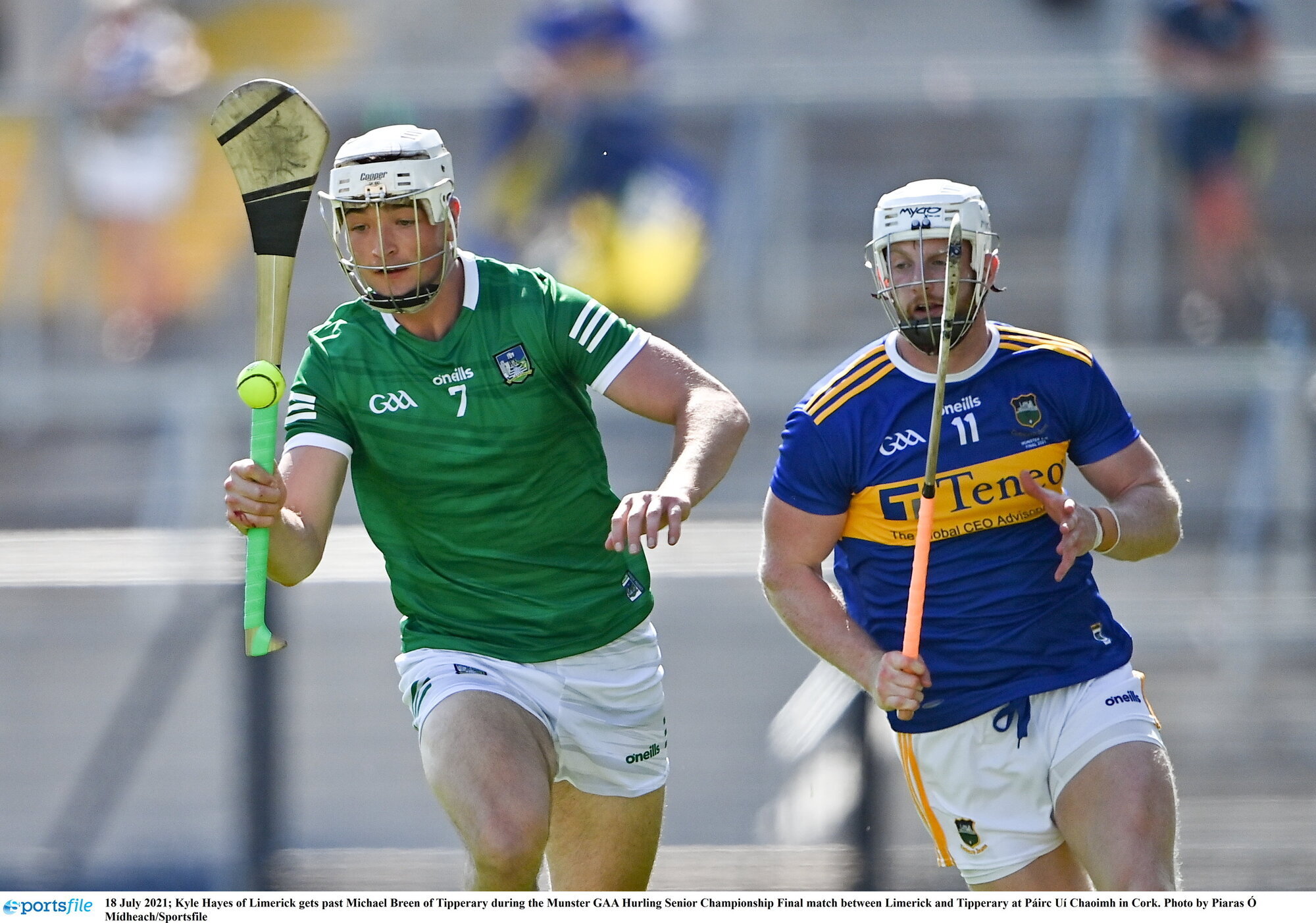
Limerick’s Kyle Hayes on his way to goal pursued by Tipperary’s Michael Breen at Páirc Uí Chaoimh on Sunday. Piaras Ó Mídheach/Sportsfile

For a team that seems to pay little heed to history, Limerick have a habit of evoking — and creating — it. Almost every championship day they go out now they have us stretching for the record books as well as new superlatives.
Already Keith Duggan has described Kyle Hayes’s goal last Sunday as the county’s Ciarán Carey moment for the 21st century: another astonishing solo run from another astonishing player as comfortable playing in the half-back line where he began his run as the half-forward line where he finished it.
Only this was a goal, hurling’s own modern Maradona and Mugsy Mulligan moment, something it hasn’t had since Ring in ’46 when the Kilkenny lads were around him “like wasps” but he “kept running and decided to myself, ‘You’re going in the right direction anyway’” and at the 21 realised “Ring, there’s a goal in this for you, boy, if you want it” and so “left go a rasper of a shot”.
The only thing Hayes’s effort was missing was that it didn’t blow a shower of water off the net. Otherwise it was Ring as well as Carey for millennials.
As for the third-quarter comeback that immediately preceded it, it too had echoes of ’96; as Anthony Daly in these pages noted yesterday, in the drawn Munster final of 25 years ago Limerick were also 10 points down at half-time to Tipp and came back.
But as he’d elaborate, Sunday was something even more stunning than that. It took Limerick the whole of that second half in ’96 to reel Tipp in and force a replay. Kiely’s Limerick managed to turn it all around in just a quarter.
About the only thing he’d seen like it in sport was Leinster’s incredible turnaround against Northampton in the 2011 Heineken Cup final. In all his time following hurling, he couldn’t recall a second-half transformation like it.
If he were older or dug a little further back into the annals of the sport he loves, he’d have been able to find one: the 1956 league final between Wexford and Tipp back when the Rackards and Reddin were in their pomp. Like Limerick, Wexford entered the game as All-Ireland champions but found themselves 2-10 to 0-1 behind at half-time having played against the wind.
“Whatever happened in the dressing room is not known,” Seamus King wrote in , “but Wexford came out a transformed side and in an incredible second half tore away at Tipperary’s lead, reduced it, annihilated it, and eventually went on to win by 5-9 to 2-14, to the consternation of their opponents and the amazement of everyone.”
That’s how far back you’ve to go though: 65 years for a lead to be reduced and annihilated in similar fashion, leaving everyone from Daly to Jackie Tyrell standing in amazement and Tipp once more in consternation.
The way the rest of that season panned out, Tipp were evidently scarred from the experience, just as Wexford were buoyed by it; in their Munster semi-final Tipp would again give up a double-figures halftime lead before losing to a Cork side that in turn would be seen off by a Wexford side gracious enough to shoulder Christy Ring off the pitch in what would be his last All-Ireland final appearance.
Whether last Sunday’s second half will also have such drastic contrasting impacts on the psyche of both parties will be among the most compelling storylines of the rest of the championship.
Tipp will need considerable reinvention or at least rejigging as well as rehabilitation. They’ve turned it around before under Liam Sheedy, as recently as only two years ago. But back then the quintet of the three Mahers and Noel McGrath and Seamus Callanan were all 60-to-75-minutes men. How many of them now are? One, maybe two at a stretch?
While Sheedy may not make many changes to the personnel in his playing rotation, the same may not be said of the sequencing. Starters — and stars — may need to become finishers and younger subs will need to become starters.
There’s another substantial difference between now and two years ago. Limerick collectively and individually are now stronger and wiser since — and for — 2019.
That’s not to say they’re invincible. Truth is, if Aaron Gillane had been sent off as he should have been, they’d have lost last Sunday. That incident also conjured up a blast from the past. It’s quite possible that Paud O’Dwyer fudged the call for the same reason Jimmy Cooney only showed Michael Duignan a yellow card after he pulled across David Forde in the 1998 All-Ireland semi-final: as Cooney admitted in Jim O’Sullivan’s book , he was conscious that there were nine points between the teams and reducing the trailing team to 14 men would effectively finish the match as a contest and a spectacle.
When Duignan in his usual brilliant co-commentary last Sunday described Gillane as being a lucky boy for escaping a red card, he was speaking from personal experience. Whatever luck Limerick didn’t get from officialdom in Croke Park in 2019, they got it in Cork last Sunday.
All in all it leaves Limerick in a similar point of dominance as to where Clare were entering that All-Ireland series in ’98, or at least where they were when Anthony Daly lifted the provincial trophy that summer in Thurles and they blissfully unaware of the suspensions and distractions and fake news granny deaths that were to follow.
Just like Loughnane’s Clare, Kiely’s Limerick have now managed to win three Munsters and two All-Irelands in an incredible four-year span. Indeed, by virtue of the two league titles they’ve also won in that period, and it’s fair to say they’ve now eclipsed that great Clare team and are on the brink of surpassing a string of champion teams, from Mackey’s team of the ’30s to Babs’ Tipp and Farrell’s Galway and the Cork teams of the ’80s and mid-noughties. Even the Cork team of the late ’70s is coming within view if Kiely’s men ever chose to look that way.
Right now, of the eight teams remaining in the chase for Liam McCarthy, an All-Ireland final appearance seems beyond only an out-of-sorts Waterford and a Covid-disrupted Dublin. All the rest are capable of reaching it.
But as for winning it? Limerick appear out on their own in a way unimaginable even when ‘Dreams’ and Dolores rang around Croker in 2018. In ignoring history, they’re creating more and more of it.