John Fogarty: Knockout championship failure is key to the success of GAA’s plans
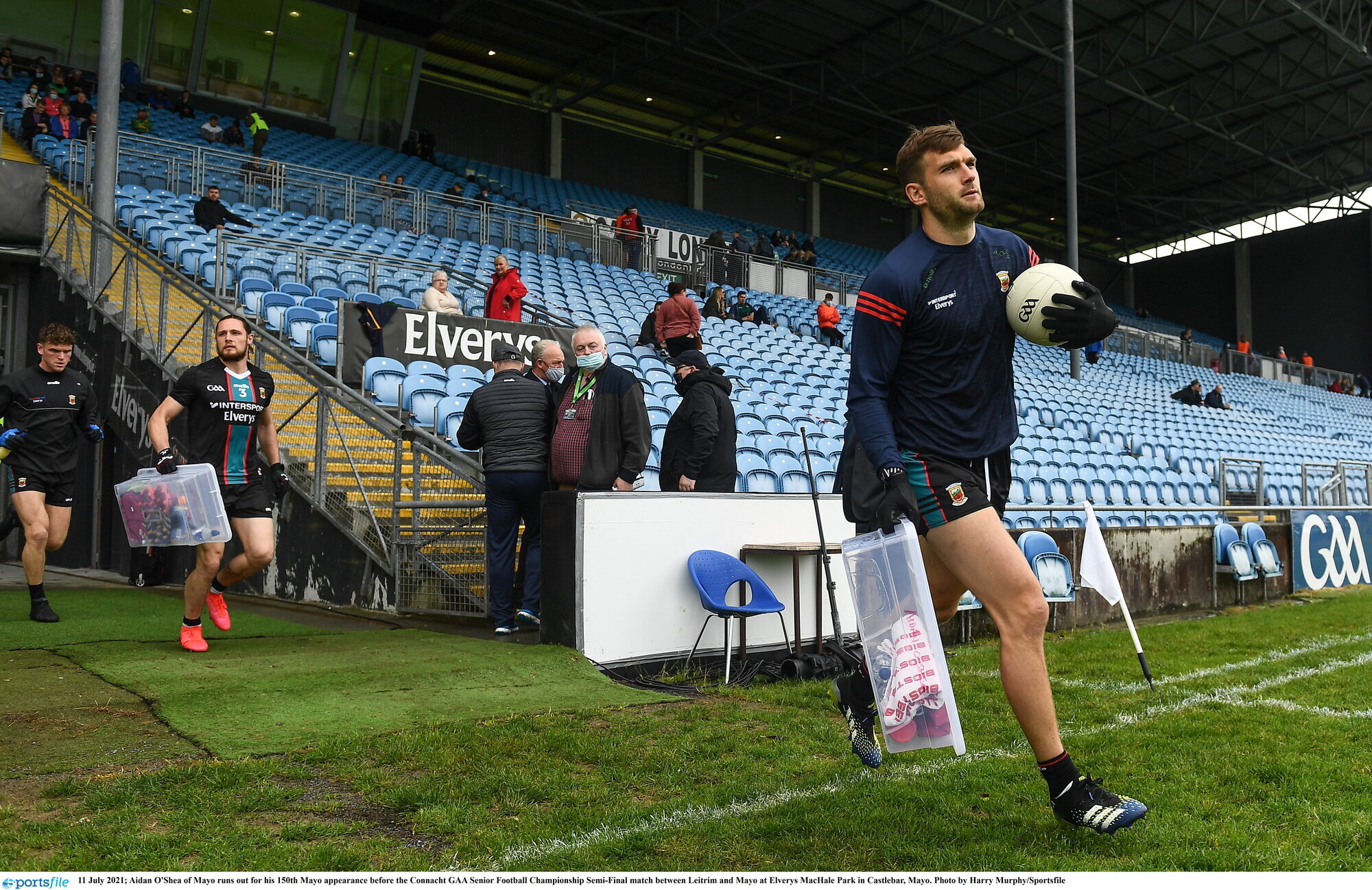
Aidan O’Shea runs out for his 150th Mayo appearance, a 24-point mauling of Leitrim in Sunday’s Connacht SFC semi-final at Castlebar. The caps on attendances masks the fact that football — at least until the business end of the Championship — had become a turn-off, writes our columnist. Picture: Harry Murphy/Sportsfile
Allow us this flight of fancy but imagine Mel Brooks at the ripe old age of 95 has decided to stage his famed musical The Producers for one final run in Dublin’s Bord Gáis Theatre.
To play Max Bialystock and his accountant Leo Bloom, he has cast former GAA president John Horan and his successor Larry McCarthy. As the plot goes, Bialystock and Bloom hatch a plan to earn $1m (€843,245) each by making a Broadway flop, overselling shares in a play designed to fail.
In Horan, Brooks sees an administrator who held little regard for the provincial championships and introduced the yet-to-be-launched secondary Tailteann Cup but oversaw the very thing he opposed, a knockout provincial-based All-Ireland senior football championship.
“One of the big challenges is to tackle the monster that is the traditional feature of the GAA that is the provincial championships,” he said in June of last year.
“Ulster and Munster you’d find it hard to move in terms of the Munster hurling championship and the Ulster football championship.”
Shortly before departing office in February of this year, Horan expressed his preference for the Allianz League-based Sam Maguire Cup.
“I think that if you were to restart it all back again you probably wouldn’t do the provincial structure for the football championships. I would be an advocate of the league structure where it would be more competitive and more beneficial and we’d have better quality games.”
Due to the time constraints, a knockout championship was exactly what the doctor ordered last year but given the inequalities existing in each province, might Horan have hoped it would prompt a need for change in the same way the pandemic accelerated the implementation of the split season?
Only just as Bialystock and Bloom’s “Springtime for Hitler…” turned out to be a smash hit, Cavan and Tipperary put spanners in the works and instead of calls for change their provincial successes were followed by demands for a return to the knock-out provincial system.
As Bialystock bemoaned: “I was so careful... I picked the wrong play, the wrong director, the wrong cast... where did I go right?”
On McCarthy’s watch, the tried and tainted knockout provincial-based Sam Maguire has been given another go only this time the results are exactly what was anticipated. With 19 of the 31 competing counties having exited, the average winning margin is above 11.5 points. At 9.6 points per game, the Ulster SFC may be below that mean but the difference in the northern province is nothing to write home about.
The Central Competitions Control Committee (CCCC) insist they were three weeks shy of being able to provide qualifiers, to give inter-county footballers a second bite of the cherry as they have done for hurling for a second successive season. Only the hurlers are playing in a tiered system, which is exactly what Croke Park wants to introduce in the other code.
So the stage has been set for the type of change McCarthy wants as much as Horan. “We will hopefully be bold and trial one of the new formats,” McCarthy said earlier this year.
“One of the options links the Allianz League to the Championship. It would appear to have the potential to make the Championship competition more competitive, at least in the early rounds. It has the potential to alleviate the issue of non-competitive games which exist in some of our football competitions.”
That provincial councils are not hitting their restricted capacity quotas, as proven by the number of football games where tickets have gone on general sale, may have as much to do with pandemic-fuelled agoraphobia and the number of tickets that can be purchased as the fare on show, but the mismatches matter.
The caps on attendances masks the fact that football — at least until the business end of the Championship — had become a turn-off.
Pre-Covid, crowds at Dublin’s Leinster games were on the wane. To an extent, Mayo have replaced them as the cash cow — their early exit in the 2018 season and its impact on coffers established that — but there were still tickets available close to throw-in for their 24-point mauling of Leitrim.
If there were 3,500 in Thurles on Saturday for Tipp and Kerry, it didn’t look it. Tipperary saved face, devising a rearguard action that stymied Kerry but not as much as it thwarted their own offence. They might have exited the competition with their chests puffed out but they knew their defence as Munster champions was not going to extend beyond a game.
Neither manager David Power nor captain Conor Sweeney have been afraid to speak in favour of a competition reshuffle that could very well plunge them into the Tailteann Cup. Even a historic provincial title only goes so far. “I know I’m killing myself saying that because we’re in Division 4 next year,” said Power on Saturday as he called for change.
“Here’s to failure,” toasted Bialystock. Indeed, by only setting the Gaelic football’s premier competition back can the GAA’s plans to revolutionise it move forward.
Referees must explain their sin bin stance

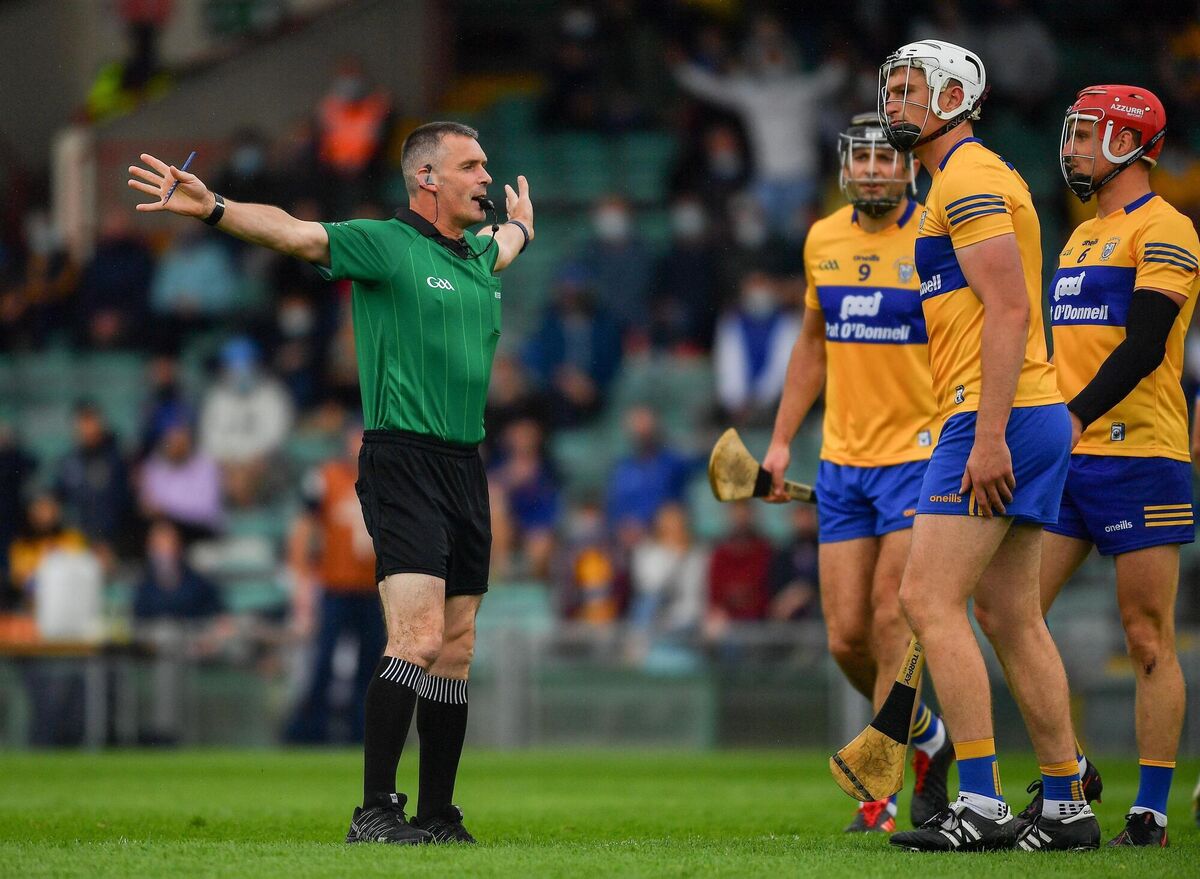
Whatever about the rights and wrongs of the referees’s decision to endorse James Owens’s sin bin decision last Sunday week and determine goal opportunities in the new rule as ones for the team and not just the fouled player, managers and players are entitled to be briefed on the interpretation.
After seeing his team benefit from Aidan McCarthy’s departure from the field for 10 minutes, Tipperary manager Liam Sheedy shrugged: “I think with the new rule, inside the 21 is the danger-zone.”
But managers shouldn’t have to accept that their players now walk a thin line by committing a foul inside the 20-metre line or semi-circle.
Never before have defenders gone into a weekend so uncertain about what they are allowed and not allowed to do.
This column previously made a similar point to Fergal Horgan’s, that if a defender is bringing down a forward inside the 20m line or “D” they are asking for trouble. But that was on the understanding the goalscoring chance applied only to the offended player, not just his team.
That interpretation, confirmed last Thursday by the referees development committee, makes it open season for sin bins.
In fairness to referees, they have asked the GAA to issue a statement clarifying why they believe the four sin bin incidents in the Liam MacCarthy Cup prior to this past weekend were the correct calls.
Rarely has there been such solidarity among match officials, but a press release would be beneficial to participating counties.
In the absence of that, referees should address each panel before the throw-ins this weekend and outline their application of the sin bin simply because it is nothing like most people expected it to be.
County camps to fortify Covid defences

Last year, the idea that a safety-first approach by teams would benefit Kerry in the long run was blown apart when Mark Keane caught and kicked that Luke Connolly skyscraper in Páirc Uí Chaoimh.
We’re not talking about the defensive approach taken by Peter Keane or his side but how they were so careful to avoid Covid cases that they sent players in a convoy of cars to Monaghan for the league game in October.
On top of temperature checks, social distancing off the field and what not, they were doing the whole kit and kaboodle.
The likes of Dublin, on the other hand, simply used a second bus for their team and, as it turned out, that was more than suitable on their way to claiming a sixth consecutive All-Ireland title. Incidentally, Kerry did the same for Saturday’s trip to Thurles.
But after what happened to Mayo this past week and the potency of the virus’ Delta variant, perhaps county set-ups and their Covid officers are looking to re-fortify their protocols. There is anecdotal evidence that some squads have received one vaccine shot, if not two. Not all counties are so resourceful but those with a mind to still being in the competition on August 29 might be.
Vaccines obviously don’t prevent players from contracting coronavirus but limiting activities and movements outside of training will surely be on the agenda for James Horan’s group ahead of facing Galway on Sunday week.
Leitrim were never going to take advantage of Mayo’s difficulty but Galway are the type of team who can, should further cases or close contacts be discovered.
Email: john.fogarty@examiner.ie