Eimear Ryan: If rewards are so great, players are incentivised to go to ground
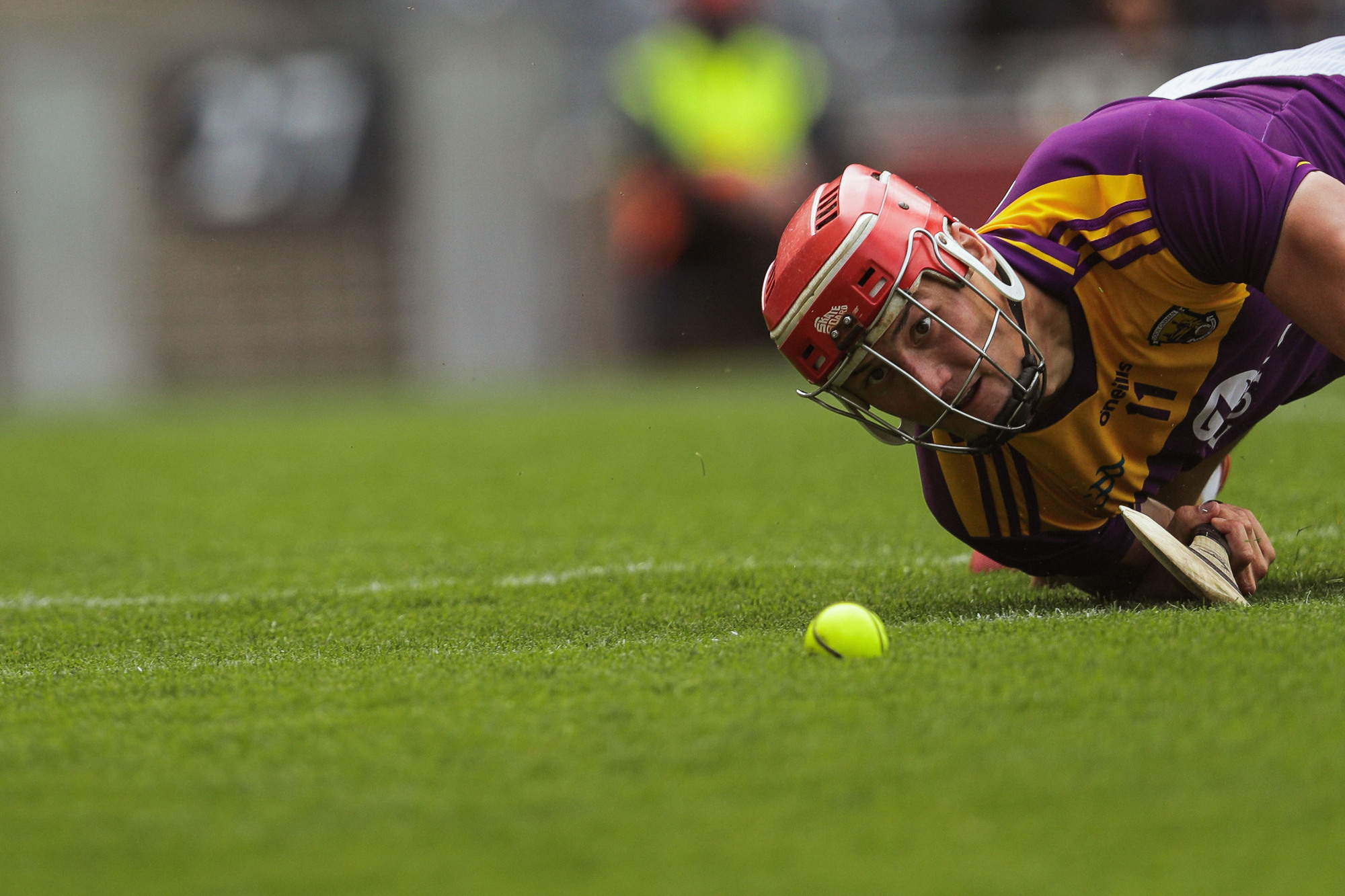
Lee Chin has eyes only for the sliotar against Kilkenny in last weekend’s Leinster SHC semi-final at Croke Park. Chin went to ground for a spell in the first half — though to be fair, he was fresh off a barnstorming run down the pitch and possibly just needed a rest. Picture: Inpho/Brian Reilly-Troy
My partner is a soccer man — or a football man, as he would say himself. He supports Cork City and Liverpool, and has also adopted various ‘boyhood clubs’ in different leagues around the world: Juventus, Benfica, Dortmund, the Portland Timbers.
Before we met, he never watched hurling and I never watched soccer, but we have now come to a grudging appreciation of one another’s sports. (I do, however, still doggedly call it ‘soccer’.) When we first knew each other, I may have made a scathing comment or two about the culture of diving in soccer. ‘It’s the face-clutching,’ I tutted. ‘And the rolling around. How are they not mortified? How do they look at themselves in the mirror?’
I would’ve crowed over the tell-tale delays — how the stricken player would go to ground a split second after contact, using their own momentum to fling themselves onto the turf. He just looked at me bemused. ‘This happens in the GAA too, like,’ he said. I dismissed this out of hand; hurlers didn’t engage in malingering.
He likens my inability to perceive diving in the GAA to the Invisible Ships Phenomenon. In this popular myth, when Magellan landed in Brazil in 1519, the indigenous people were unable to perceive his fleet of tall ships — because nothing in their frame of reference had ever prepared them for such a sight. By the same token, because I grew up steeped in GAA culture, with its emphasis on toughness, bravery, and honesty, my brain rejected the evidence of my eyes. I couldn’t see the diving then.
But, reader, I see it now.
The games this past weekend were massively entertaining, but also provided us with a litany of simulation. It would nearly be unfair to name names, since so many players are at it, but here are a few off the top of my head. Lee Chin went to ground for a spell in the first half against Kilkenny — though to be fair, he was fresh off a barnstorming run down the pitch and possibly just needed a quick rest.Â
At one stage a prone Sean Finn took his helmet off only to put it straight back on again, sensing that it was not the time for delaying tactics after all. And after fouling Tony Kelly, Cathal Barrett swiftly went to ground himself — anything to distract the ref from giving him a second yellow. I admire all these players so much, and their courage and commitment are beyond doubt, but it is comical to see them playacting like this.
As a camogie player, it’s especially strange to watch. Women simply do not have the cultural capital to roll around on the pitch as if shot. We would be laughed out of the place. We are constantly on the back foot, having to insist on our toughness and fitness, and can’t afford to show cracks in the veneer. Hurlers, on the other hand, have the luxury of being assumed strong and brave from the get-go. It is a given. The same freedom sport gives men to hug each other, express feelings, and even cry, also permits them to reveal weakness and vulnerability — especially if it will win them a crucial free.
In recent years, there has been a shift in terms of conduct on the pitch. Back in the day, there was an emphasis on not showing weakness, and maybe even (in more romantic types) a sense of fair play. There are still some players — Bonner Maher springs to mind — who rarely go down, no matter who’s pulling and dragging out of them, and who subsequently are not awarded too many frees either.
The new code of honour — perhaps inevitably, given the players’ time investment and near-professional commitment — is to win for your team at all costs. If you can do that by winning a free or penalty, getting a lad carded, or otherwise influencing the ref (who is after all only human and not omniscient), then why not? No sense in dedicating half your life to something only to nobly lose. Your ethics aren’t going to keep you warm through the winter, but an All-Ireland medal might.
And lookit. There are certain calculated decisions you might make during a game. There are the times when you feel the hand on the back and you let yourself go head over feet, because you’re outnumbered and are probably not going to emerge from the ruck with the ball in your hand. Better to get the free — and you were being fouled. Or there are times when you feel the jersey pull and you might lean away from it, all the better to exaggerate the stretch of fabric for the ref’s benefit. There is inventing a foul, and there is merely highlighting it. The ethical line might be murky, but it’s there.
We’re not yet in soccer territory, where diving has become a masterful technical feat, players using their considerable core strength to upend their own equilibrium and propel themselves to the floor. You can see how it developed in soccer; in a low-scoring sport, every goal counts, and penalties are precious. If a behaviour is rewarded, it will quickly become part of the game, a device in every player’s toolbox. With freetakers in hurling becoming increasingly unerring, even from great distance, it’s logical that we’re seeing the same behaviours creeping in. If diving results in a pretty much guaranteed point, then it’s the practical thing to do.
When Jake Morris was flattened out by the sideline last Sunday, neither he nor Aidan McCarthy, who did the flattening, ever dreamed it would result in a penalty for Tipp. In what universe are penalties awarded for fouls outside the big square? Not even in soccer. Just like the tall ships in 1519, this outcome was not within the players’ frame of reference. It is now. That’s what worries me about that call — the impact it may have on the game’s future. If a forward can win a game-changing penalty by being brought down anywhere inside the 21, then we are incentivising players to go to ground.

Subscribe to access all of the Irish Examiner.
Try unlimited access from only €1.50 a week
Already a subscriber? Sign in