Eimear Ryan: Explosive Camogie League climax, now batten down hatches for championship
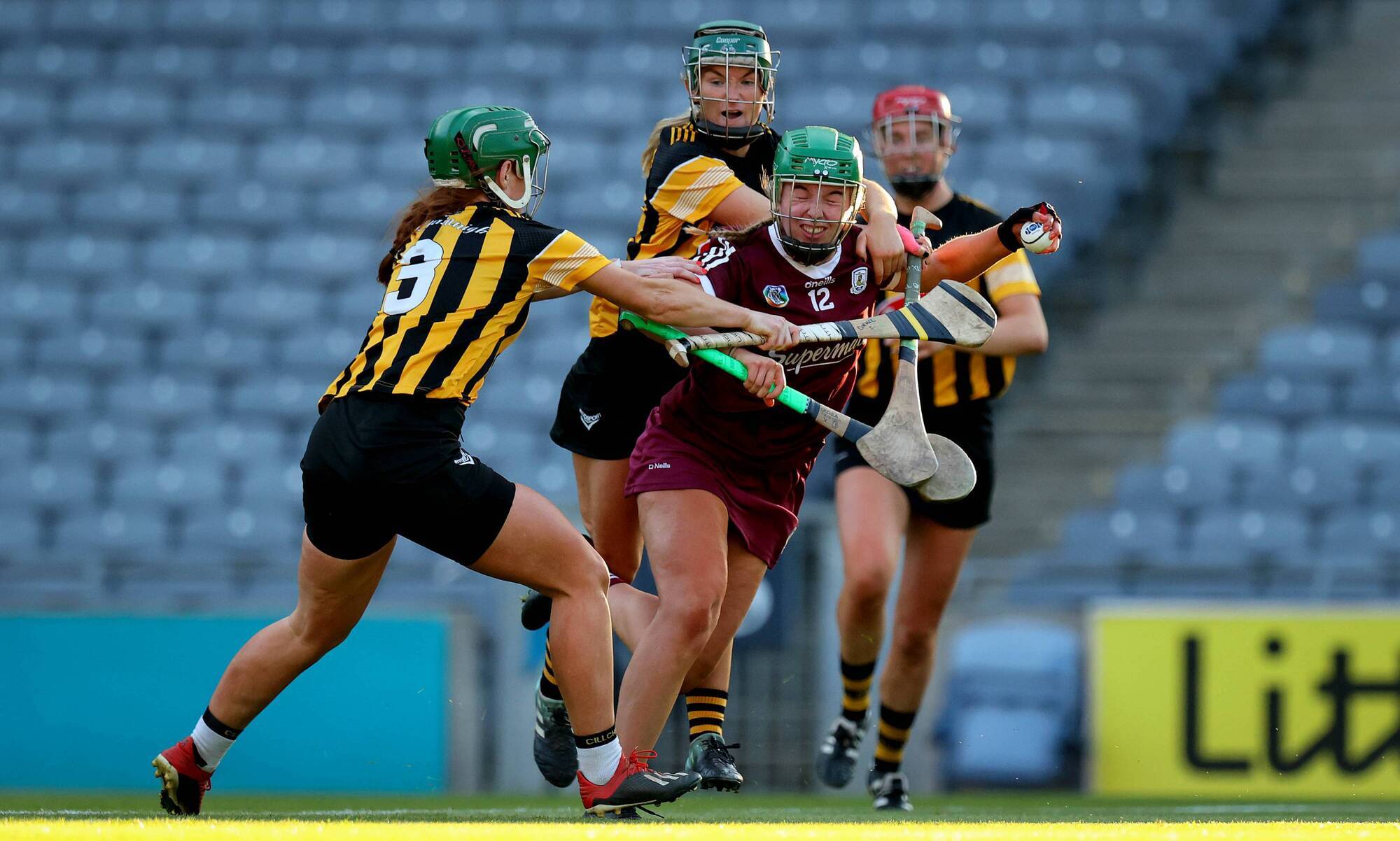
Kilkenny’s Colette Dormer tries to halt the progress of Galway’s Niamh McGrath in last Sunday’s Littlewoods Ireland Camogie League Division 1 final in Croke Park.
Last Sunday night’s camogie final between Galway and Kilkenny brought an explosive conclusion to the league, which has lit up in the knockout stages in recent weeks.
Though the first half was a bit of a slow burn, things accelerated quickly after half-time, beginning with Aoife Doyle’s pacy solo-run and classy finish in the 33rd minute. The two teams exchanged scores frantically for the remainder of the match; when Aoife Donohue levelled it for Galway a minute into injury time, I figured we were heading for a replay. But as they’ve done so many times before this year, Kilkenny hauled the game out of the fire, capitalising on Galway mistakes to run out winners by three points.
In 2021, Kilkenny have made a hallmark of coming back from behind, first against Limerick and then Tipperary, and now Galway. At times they have reminded me of Jürgen Klopp’s Liverpool in their tendency towards brinkmanship, creating daunting challenges for themselves in order to kick into a higher gear — not unlike how journalists procrastinate and work right up to deadline in order to write fuelled by cortisol and adrenaline. (Just me?)
But this was their most impressive comeback yet. In goal, Aoife Norris was outstanding. Level-headed and brave, she prevented at least three Galway goal chances. As towering a figure as the TJ-esque Denise Gaule is, it was good to see Kilkenny less reliant on her this week, with Doyle, Katie Nolan and Mary O’Connell stepping up in a big way. They also had great impact off the bench, with Steffi Fitzgerald scoring a vital late point, and Katie Power returning to play after a long absence with injury.
Galway can take many positives from the game too. Niamh Kilkenny kept Galway in touch through sheer force of will at times, and Niamh and Siobhán McGrath’s telepathy would remind you of another set of McGrath siblings (Tipp’s Noel and John, no relation).
If a Sunday night fixture was an odd one from a player’s perspective — it was ten past nine by the time Meighan Farrell lifted the cup, and a long road back to both counties — it was the perfect end to the weekend for viewers.
With no other GAA matches on the TV schedule, camogie was given the space and time to shine. Adding to the atmosphere was the fact that the game was in front of a smattering of supporters at Croker, bringing much-missed atmosphere back to live hurling — though the crowd wasn’t so loud that you couldn’t clearly hear a Kilkenny mentor react in real time to Doyle’s goal: ‘Win the ball Aoife! Come on Aoife! Take her on! Take her ooooonnn!’
Meanwhile, the hurling league has come to a much more sedate close. Table-toppers Galway and Kilkenny will duke it out for the title should they meet in championship – not that either side will much care about that aspect of the stakes. If they don’t meet in championship, well, then they’ll just be declared joint winners. (I’m not sure what Solomon figure gets to decide what happens to the trophy, but I’m intrigued to find out.)
The flexibility and pivot-ability of all involved is commendable, but it would make you wonder — do we need a knockout stage to the league at all? The thrilling camogie semi-finals and final would suggest yes, but for several years now the hurling league has been openly run-off as a secondary competition, a prelude to and laboratory for championship. Is that okay, or should we expect more from the league — or at the very least, something very different from championship?
The league is an interesting game of chess for management in some ways. The priorities seem to be: 1) don’t get relegated; 2) don’t get thrashed by anyone you’ll likely meet later in the year; 3) try out lots of young lads and get them championship-ready; 4) don’t show your hand too much. On that basis, several of hurling’s top-flight managers will be happy enough with their campaign.
It’s difficult to compare the GAA with professional sport, but it’s still interesting to look across the water to English soccer, where the prestige placed on competitions is reversed. There, the knockout FA Cup is the silly season, whereas the league — with its gruelling 38 fixtures — is seen as a club’s real test of character. And there is a certain pleasure in watching the vagaries of the league table, as hypnotic as watching a vote tally on election day after the distribution of surplus ballots.
Imagine, if you will, a league modelled on the Premier League, with 18 counties from Divisions 1A through 2A involved. Teams that rarely meet due to geography would be guaranteed two dust-ups a year (or at least one, if we’re being realistic). There would be thrills and spills. There would be upsets, with the Laoises, Offalys and Westmeaths catching the so-called top-flight teams on the hop from time to time. How are such teams supposed to approach the level of the Limericks, Galways and Kilkennys if they rarely meet them?
Of course, because of our club and county system — not to mention amateurism — this would never work in practical terms. And in writing this, I realise I’m just nostalgic for the short-lived round robin format of 2018 and 2019.
My native Tipp went from the ridiculous to the sublime under this format, from being dumped out of the championship in June 2018 without a single win, to winning the All-Ireland the following year. But even with a shock early exit, you can’t really complain. You had your chance; multiple chances, in fact. Consistent performance is rewarded in league formats in a way it isn’t in knockout; less hinges on luck and controversy and refereeing decisions.
But in a way, isn’t that why we love the traditional championship — its volatility, its randomness, its occasional cruelty? It’s only days away. Batten down the hatches.