John Fogarty: Cursed advanced mark could spoil the summer for Gaelic football fans
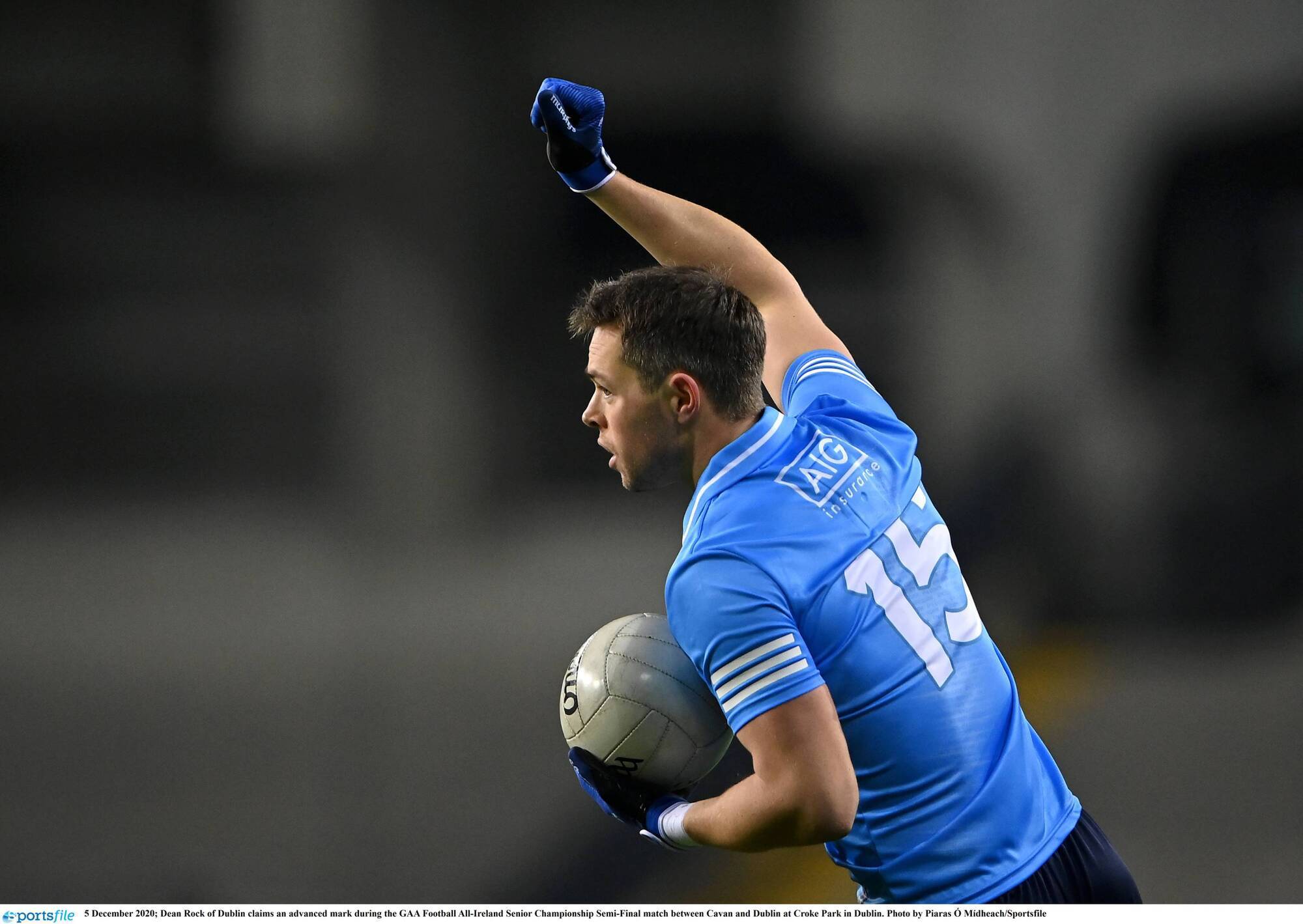
CALLING IT: Dublin’s Dean Rock claims an advanced mark in last year’s All-Ireland semi-final against Cavan at Croke Park. Picture: Piaras Ó Mídheach/Sportsfile

Save for the Division 3 final, maybe it was right that Gaelic football sat out this past weekend.
With all the congratulatory slaps it had been receiving, it was coming perilously close to putting its back out.
Never mind that it has yet to offer any real indication that it will produce new champions, the shining example Dublin has set in playing expansive, free-scoring football is enough to convince people that it is in a great place. And that this comes at a time when hurling folk seem determined to talk themselves into a crisis, well that makes things dandier for those inclined.
But a root up the backside isn’t too far away for football. Another All-Ireland for Dublin in just over nine weeks and the brickbats will be flung without discrimination. And for all the schadenfreude about cheap scores and the death of defending in hurling, a rule has been implemented in football that has the same undesired effects.
GAA Congress has produced a few doozies in its time but the introduction of the advanced mark at its special gathering in October 2019 was one of the most retrograde steps it has ever taken. You would hope that only for the pandemic and Croke Park’s encouragement not to debate contentious matters that something hasn’t been done to weed it out of the game.
Then again, clubs don’t have the power to put forward playing rules changes until 2025. And the playing rules committee who proposed it back in 2019, many of whom were reappointed earlier this year, isn’t known for changing their tune. But the time to ask them to reconsider what is an insult to footballers’ intelligence as it is to the game is rapidly approaching.
The argument will be made that it has made little impact on the game but wasn’t it supposed to contribute to more footpasses? According to witnesstheanalysis website, there were 112 kick-passes in last year’s All-Ireland final (65 for Dublin, 47 for Mayo) compared to an average of 110 per game in 2017.
Of the 489 points scored in the 16 Division 1 games this year, only 19 came from advanced mark kicks, the equivalent of 3.27%. Each of last year’s All-Ireland semi-finalists averaged less than a mark a game despite Mayo scoring three in December’s final loss to Dublin.
So what’s the problem? Well, aside from arresting the flow of a game and rewarding the catching of a lateral, often uncontested kick as it does as a direct one, likewise failing to distinguish the difference between a catch in the chest as one above the head, those were 19 occasions when a goal or point from play opportunity was lost due to this abhorrent rule.
Worryingly, the stronger teams are slowly but surely realising the benefits of the advanced mark. It should come as no surprise that Dublin and Kerry returned the largest number of marks during this year’s league.
Kerry’s return of three in the opening day trouncing of Galway was the biggest return in a game in Division 1. In all but the draw with Kerry did Dublin manage to register a score from the kick and catch free.
On their way to the six in a row, Dublin pointed four marks in five SFC games compared to five in their seven league matches in 2020. Of their points only tally for the Championship, those four marks comprised 3.84% and in last year’s league the five marks made up 4.9%. In this year’s league, that has increased to 6.15%.
In topping Division 1 last year, Kerry’s points-only tally was 115 and they scored five marks (4.35%). This year, their mark total represents 5.8%. Mayo, who will miss Cillian O’Connor for many reasons especially his return from marks, averaged one per game in Division 2 this year (4.9%) compared to five in their seven round games in Division 1 last year.
In the six Division 1 North matches, there were eight marks scored, Armagh and Tyrone each firing over three. With Kieran Donaghy now on board as a selector and forwards coach, Armagh’s trio came in the relegation play-off win over Roscommon. But in the round stages the two teams who finished above them as well as the top pair in Division 1 South all scored more marks than those who ended up in the relegation play-offs.
Better teams are availing of an alien rule which the playing rules group may not have envisaged would be utilised so pragmatically and efficiently by forwards. Championing the catching of a kick in front of a marker, they have dumbed down the game.
Perish the thought that such a soft, measly-won score could be the winning of the All-Ireland final in August. But that frightful scenario is possible as football, once the game of catch and kick, morphs into a kick-and-catch bastardisation.
Sliotar makes hurling a different ball game
Given that he played in and has spoken about an era where goalkeepers were known to shave the rims of sliotars to gain extra yardage on their puck-outs, Brendan Cummins’ presence on the committee to look at the hurling ball is a shrewd one.
Chairman Ned Quinn will also be joined by Munster GAA PRO Bob Ryan and if there aren’t recommendations to ensure the rims of the standardised, soon-to-be microchipped sliotar aren’t between 69mm and 72mm as per part two of the GAA’s Official Guide, then it will be a shock.
Such a measure is bound to require policing prior to throw-in as the rims of official balls can be filed down unless the microchip included in them recognises when they have been tampered or doctored. To increase the sweet spot and the chances of ash hitting leather as opposed to the stitching, Dónal Óg Cusack did as much.
“I remember when I was playing I would file off (sliotar rims) because I wanted to hit a consistent shot,” he said in 2017.
“I would be filing the rims down to take the edge off them because when I was playing I wanted that consistent ball all the time.”
This column recently studied a senior championship sliotar and the rims are so minimal on it now that Cusack would have no reason to take matters into his own hands. Manufacturers are clearly catering for the demands of the players hence why Patrick Horgan’s comments last week about the yellow ball being more inconsistent were strange.
On one hand, the concern and care hurlers have for the tools of their trade should be appreciated but where do you draw the line between it being evolution and a different ball game?
Provincial championships are on trial
Context and timing, as we know, is everything in the GAA. On the back of a 2020 All-Ireland senior hurling championship, bedevilled by cynical fouls, that concluded two months earlier, the divisive sin bin/penalty rule was introduced in February.
Had the structure of the senior inter-county football season been also up for debate then, the chances of the provincial championships being retained in light of Cavan and Tipperary’s successes would have been great. Why, there would also have been a few who would’ve echoed Father Beeching and asked is there anything to be said for another knockout championship.
As it turns out, there will be this summer but for the amount of effort put in by players and management may it please be the last. And now that Cavan and Tipperary have been demoted to Division 4 and will do extremely well to extend the defence of their titles beyond their opening SFC games, the outlier nature of the 2020 All-Ireland SFC will be recognised.
Barring a similar turn-up for the books, the provincial championships as the starting points for the Sam Maguire will be fortunate to survive beyond Special Congress later this year. That 14 of the 31 teams, many of them in Division 3 and 4, will exit the competition over the next two weekends underlines the brutal nature of it but the disparity too. Whatever format delegates choose this autumn, whether it’s making eight-team conferences of the provinces or flipping the league into the championship, the provincial competitions as we have known them are on trial and they are going down.
Email: john.fogarty@examiner.ie