John Fogarty: Splitting Dublin becoming a sad possibility
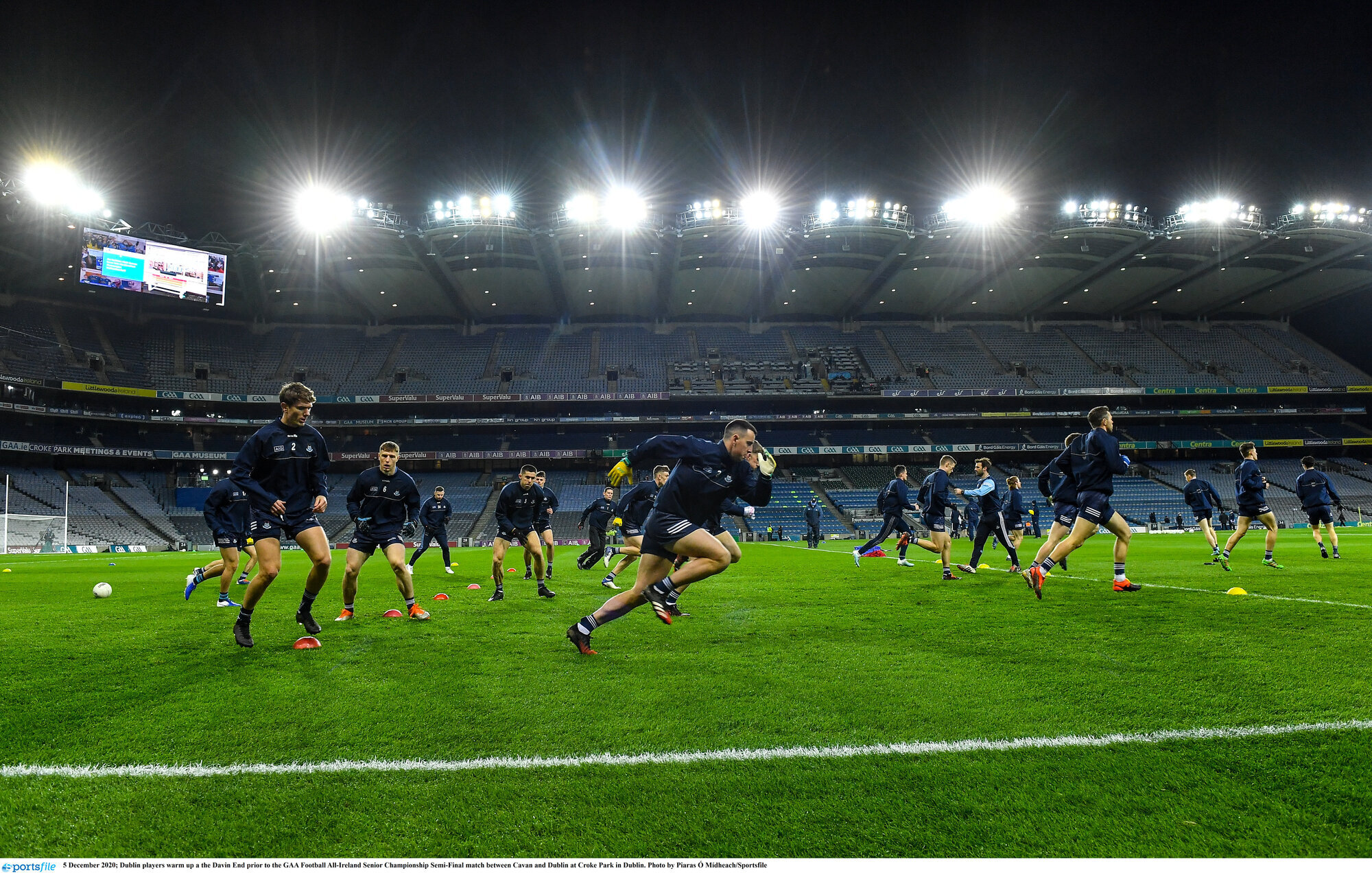
Dublin players warm up a the Davin End prior before the All-Ireland SFC semi-final against Cavan at Croke Park at the weekend. There have been renewed calls to split Dublin into two amid the county’s domination of the sport. Picture: Piaras Ó Mídheach/Sportsfile

You can’t simply say Dublin were asking for it.
It wasn’t them who looked to be split as the Strategic Review Committee (SRC) proposed back in 2002.
Yet they didn’t completely throw out the idea of being divided in two. “We met the Dublin officers and they were positive,” said former GAA president and SRC chairman Peter Quinn at the time. “That’s not to say they agreed with everything, but they committed themselves to adopting a positive approach in taking it to their clubs. People must remember that even if Dublin is split, it will still be the biggest two counties in terms of population.”
Nine years later, their lack of self-awareness in their Blue Wave strategic plan when they called for financial and administrative provincial status reopened the argument.
“It will require Dublin County Board to step up to its responsibility to implement the strategic initiatives recommended in this review,” it read. “It will also require Central Council to embrace a different funding model, one which addresses the strategic significance of Dublin. One way of addressing this issue is for the GAA to extend provincial status to Dublin for certain purposes.”
Standing as they were as newly-crowned All-Ireland champions after winning six of the previous seven Leinster SFCs, wanting their cake and to eat it wasn’t a good look for Dublin.
Setting out an objective of winning the Sam Maguire Cup every three years was slammed as “not practical” by then senior football manager Pat Gilroy.
Six All-Irelands in the following eight seasons and on the cusp of a seventh in nine on Saturday week, it turns out it wasn’t ambitious enough.
While defending the Blue Wave, Dublin secretary John Costello in his 2011 report spoke of the need to change the structure of the football championship.
“Perhaps we have played hostage to the constraints of geography and history for too long and I believe there is now a mood for change.”
There certainly is at the moment but it is very much directed at Dublin’s geography and history as they dismissed another team with ease this past weekend.
Regularly and with some clarity since 2011, Costello has explained why breaking up Dublin would be disastrous for the GAA yet to be looking for provincial funding at the same time as the senior footballers are crushing those around him beggars belief.
What was most interesting about Gilroy’s contribution on The Sunday Game was his willingness to consider the capital being split providing there was consideration given to amending other county boundaries.
Stressing the county and provincial structures aren’t working, he said: “If that (dividing Dublin) is part of the solution, fine, but see what the problem is first. I’m not so sure that a million people are interested in Gaelic football.”
But Gilroy did stress that aside from population and proximity, the advantage Dublin has in attracting the best because of higher paid positions and those people getting involved in the county’s clubs. “That’s a huge bonus. No other county gets that bonus. That’s a fact.”
So how do you equalise that advantage?
For a whole lot of reasons such as a sense of place and identity, the idea of breaking up the county is something this column has been reluctant to support.
However, reality is pushing us ever closer to determining it as a genuine solution. Look at how the county could deliver the two teams below and the idea that it would diminish competition falls flat on its face.
Drawing comparisons with a professional sport is an exercise fraught with danger but it is worth considering in the case of Dublin’s size as roughly 19% on the island of Ireland live in the county.
Melbourne, the home of Australian Rules and with a population of 4.485m, also around 19% of its country’s total population, provides half of the AFL premiership’s 18 teams. Sydney, with a 5.23m population and close to 20% of Australia’s population, has nine of the 15 Australian teams involved in the National Rugby League competition.
A win for Mayo in 11 days’ time would be hailed as proof that Dublin’s dominance at senior football level is cyclical when it is anything but.
In truth, it will only delay the GAA facing up to the fact that it should have been more careful with what they wished for in the capital.
Dublin North: Stephen Cluxton (Parnells); Eoin Murchan (Na Fianna), Jonny Cooper (do.), Philly McMahon (Ballymun Kickhams); James McCarthy (Ballymun Kickhams), John Small (do,), Eric Lowndes (St Peregrine’s); Brian Fenton (Raheny), Brian Howard (do.); Aaron Byrne (Na Fianna), Ciarán Kilkenny (Castleknock), Seán Bugler (Oliver Plunketts/Eoghan Ruadh); Paddy Small (Ballymun Kickhams), Dean Rock (do.), Cormac Costello (Whitehall Colmcille).
Dublin South: Lorcan Molloy (St Anne’s); David Byrne (Naomh Olaf), Rory O’Carroll (Kilmacud Crokes), Michael Fitzsimons (Cuala); Cillian O’Shea (Kilmacud Crokes), Cian O’Sullivan (do.), Robbie McDaid (Ballyboden St Enda’s); Michael Darragh Macauley (do.), Tom Lahiff (St Jude’s); Niall Scully (Templeogue Synge Street), Kevin McManamon (St Jude’s), Dan O’Brien (Kilmacud Crokes); Paul Mannion (do.), Con O’Callaghan (Cuala), Colm Basquel (Ballyboden St Enda’s).
John Kiely’s Limerick in search of perfect 10
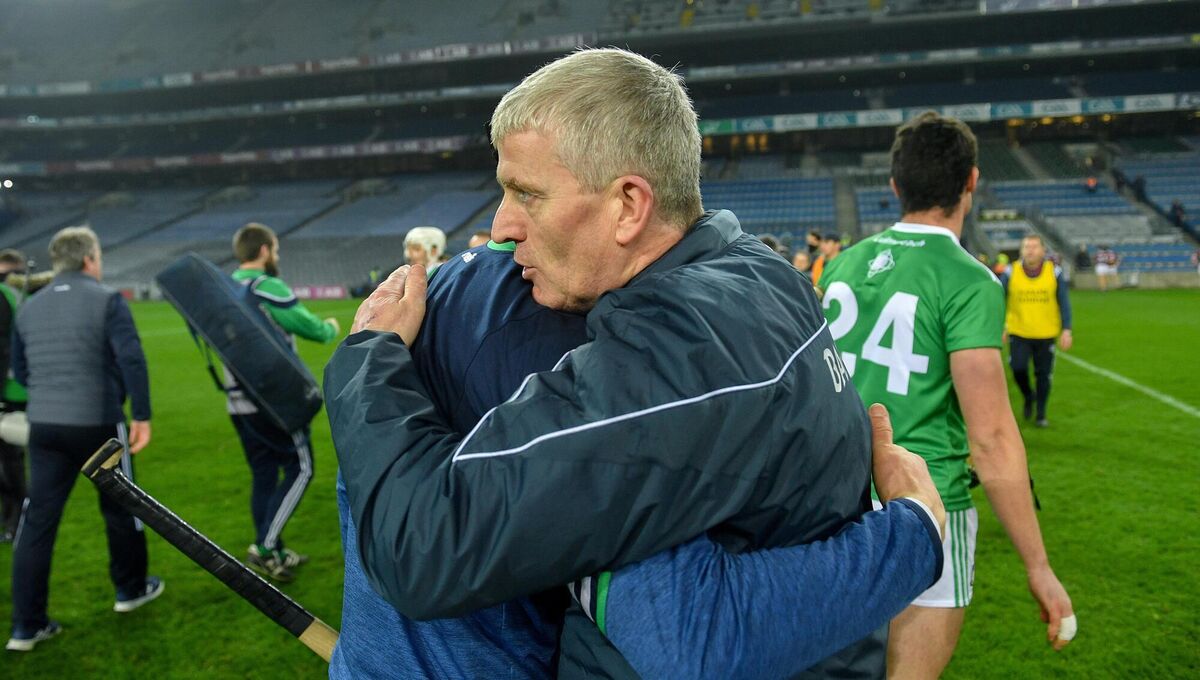
As John Kiely’s Limerick side bid to complete the perfect season this Sunday by making it 10 wins from 10 across league and championship, just who were the last team to complete it? Well, we’re not quite sure (answers to the email address on this page, please).
Nineteen years ago, Kiely’s friend Nicky English also guided Tipperary to the double and they were undefeated across the two competitions but drew with Kilkenny in their fourth-round Division 1 clash in Nowlan Park.
Even the great Kilkenny teams of the 2000s who claimed all the season silverware on offer didn’t do it. A March defeat to Galway was the one blot in the Cats’ copybook in 2002. A year later, they won all but two league matches — losing to Tipperary in a round game and drawing with Wexford— across the season.
In 2006, they emulated Tipperary’s feat of going unbeaten for the entirety of both competitions, their draw against Limerick in the Gaelic Grounds the only time they failed to win. Three years later, a March loss to Waterford was their one blip.
Should Limerick beat Waterford for a third time this year, the abandoned league semi-finals and the Munster SHC first round game against Clare doubling up as the Division 1 final will be thrown at them. The change of the hurling championship structure from provincial round robin to qualifier will also be mentioned as an asterisk.
None of it will stick, though. To win 10 games on the bounce in any season would be special, but in 2020 when the league couldn’t have been more removed from the championship, it would be pretty phenomenal.
Lousy way to treat All-Ireland semi-finalists
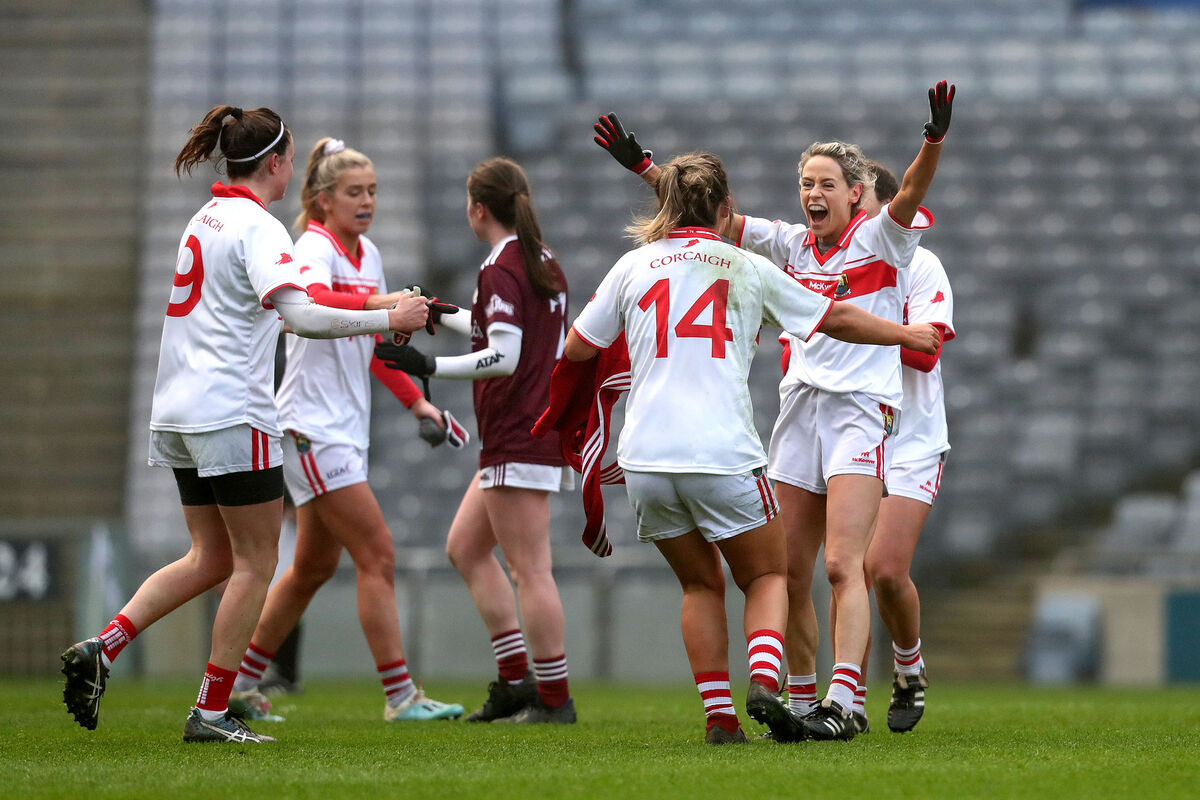
What a fine mess the Ladies Gaelic Football Association (LGFA) have landed themselves in with their treatment of the Galway senior team on Sunday.
To put the blame on them for their poor start against Cork when their entire logistical situation was thrown into disarray by the All-Ireland semi-final being moved from Parnell Park to Croke Park was lousy, yet that is exactly what LGFA president Marie Hickey did on RTÉ Radio yesterday morning.
“They spent quite a bit of time in the dressing room and then emerged out onto the pitch,” she said.
“They would have had the opportunity to get out onto the pitch earlier had they not spent so much time in the dressing room. They could have been out on the pitch earlier.”
Not informed that they couldn’t enter the Croke Park pitch from the Hogan Stand side, the game was delayed as Galway players rushed around to the Cusack Stand.
Then having just six minutes to warm up was insulting.
The integrity of the competition was brought into question, as it was when the LGFA should have had a more suitable Plan B than hoping Limerick men’s senior hurlers didn’t qualify for an All-Ireland final so that LIT Gaelic Grounds would be available for the semi-final. Parnell Park was not the next best alternative.
As the GPA and WGPA convene emergency general meetings next Monday to vote on a merger, the hope would be that the same can soon happen between the GAA and LGFA, but the latter have a lot to learn about looking after their players.
Email: john.fogarty@examiner.ie

No obligation. Ts&Cs apply.
More in this section