Éamonn Fitzmaurice: A monster has been created. That isn’t Dublin’s problem, but it is everyone else’s
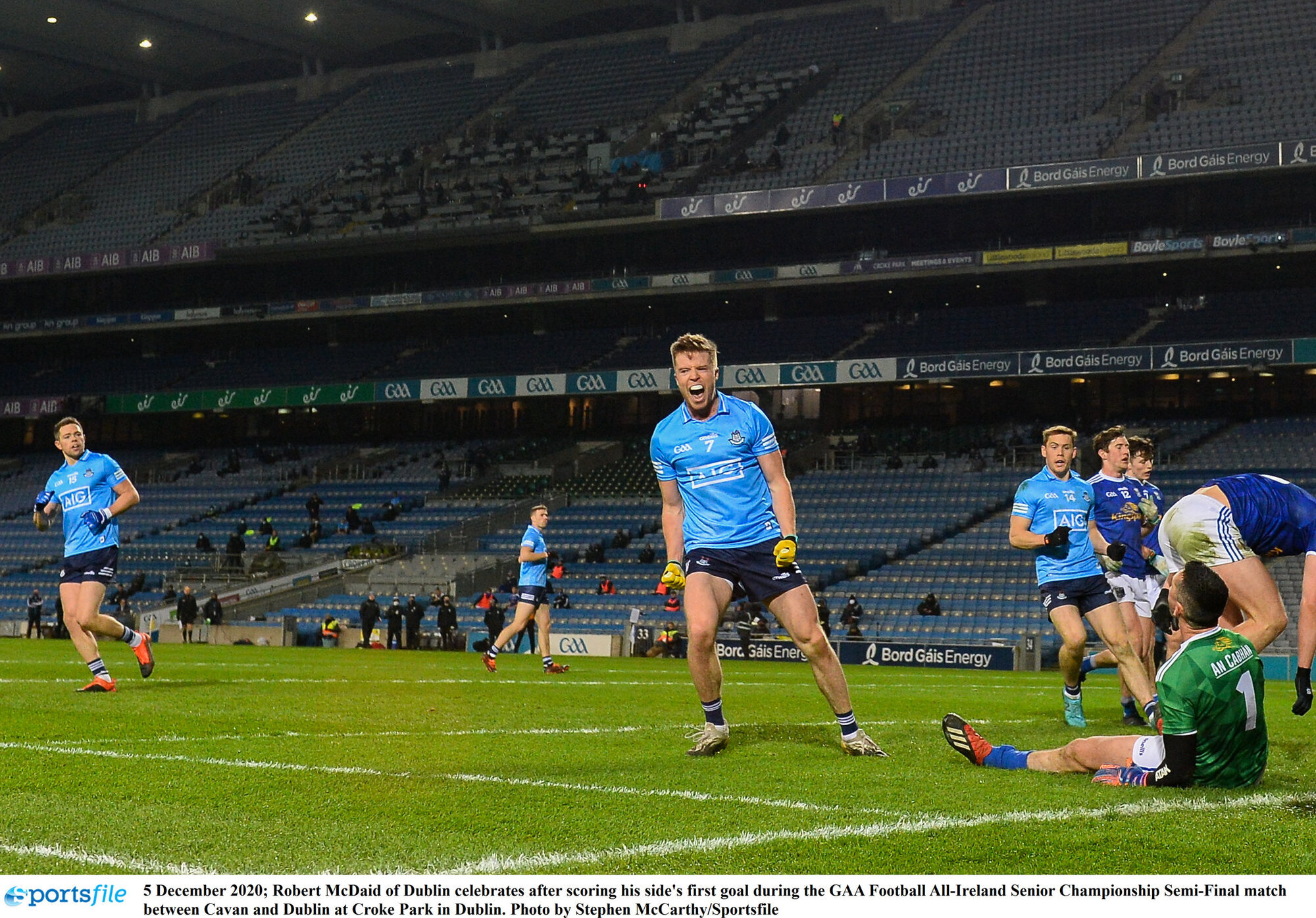
Robert McDaid of Dublin celebrates after scoring his side's goal in their one-sided All-Ireland semi-final win over Cavan. Picture: Stephen McCarthy/Sportsfile
UNUSUALLY for an All-Ireland semi-final weekend, two of the biggest talking points to emerge were less to do with the actual football and more about broader issues around the game in general.
Dublin are now so dominant that it appears there are only one or two teams in the country that can even compete with them. And secondly, how two Division 3 teams were found out and got annihilated on the big stage.
With regard to Dublin, it has got to the point where there will be a serious debate about how the GAA can help put the brakes on a monopoly or how to help everyone else catch up. Context is important though.
Kerry had a chance to put them to the sword in the drawn game last year and if that had happened, we may not be having this discussion. So far this year they have yet to meet a Division 1 team in the championship and they haven’t the All-Ireland won yet.
There is so much to admire about the way Dublin GAA carries out its business on and off the field but a monster has been created. That isn’t Dublin’s problem, but it is everyone else’s. As there was a plan earlier this century to strengthen the GAA in the capital there needs to be a similar strategy now to level the playing field.
There are many thankless tasks within our great association but being an administrator must be near the top of the list. Damned if you do and damned if you don’t.
Credit is in short supply and there is always some genius with a better way of doing things. Fixtures have long been a colossal issue that the GAA has tried unsuccessfully to tackle. One of the huge positives to emerge from the Covid-19 pandemic has been the shredding and reimagining of the planned 2020 calendar.
It has forced us to look at GAA fixtures differently and there has been much to like.
There are still plenty of issues to iron out though. The split season with the clubs going first was an unprecedented success. It was something even going back to when I was playing we would have loved.
I was fortunate to get to play a huge amount of football (and hurling) with my club as we survived late into the year but as the inter-county demands have increased I have witnessed how tough it is to balance club and county commitments, particularly where they overlap. We are getting closer to solving that particular conundrum. Add a defined close season for everyone and we will be in a great place.

The other major feature of this year’s championship has been the straight knockout element. it provided us with contests and unpredictable results that we all have enjoyed.
It was great for Cavan and Tipperary to win provincial championships after a long number of years. Kerry and Donegal didn’t get the second chance that would have probably seen one or both of them back in the last four.
However, this is where we have to ask ourselves a question.
As imperfect as the qualifiers and then the Super 8s were, at least they did a good job of filtering the best four teams into the semi-finals. This means that the semi-finals and final have given us memorable games in the recent past.
The second chance championship doesn’t seem to harm hurling.
Waterford lost the Munster final but have fought back to the final, reminding us that we can still have some romance, even with a second chance.
I don’t have the answers, but I think we have to carefully consider what we want from our championship, and then devise the best structure to deliver that.
The National League standings provide a broadly accurate assessment of where teams are in the overall pecking order.
While Mayo are temporarily a Division 2 team, they still operate like the Division 1 side that they have been for the last 20 years. There is a gulf between each division, and a chasm between Division 1 and 3.
Both Cavan and Tipperary were game and tried their best in the weekend’s semi-finals but ultimately the intensity and accuracy of the victors was on a completely different level. After the elation of their provincial wins these defeats will hurt. I hope they park it fast and enjoy their fantastic 2020 achievements.
Tipperary will rue the goal chances they missed, particularly the two early ones which may have set a different tone for the game. Mayo were outstanding in possession.
I wrote on Saturday that I expected them to have focused in the last three weeks on playing in the final third and this quality work shone through yesterday.
Cillian O’Connor is playing as well as I have ever seen him and Aidan O Shea is thriving inside. Ryan O’Donoghue and Tommy Conroy are giving them something different and Kevin McLoughlin and Diarmuid O’Connor are working up and down the field.
Tipperary did not help themselves with some of the turnovers but once again Mayo’s workrate was exceptional.
They scored a remarkable 3-12 from turnovers. As seems to happen to most teams (except Dublin) when a team zone in on a particular aspect, other areas in their game suffer. Mayo’s defensive performance will have taken some of the gloss off the win. This will be their focus for the next week and a half.
They coughed up a slew of goal chances and conceded three. But for David Clarke this game — remarkably — could have been a contest. These goal chances came from Tipperary players putting their head down and going straight at their man as Mayo missed tackles and failed to stand up their men. Con O’Callaghan will be licking his lips.
Mayo have improved from last year’s semi-final when they were blown away after half-time. They are now better equipped to deal with Dublin and the fact that the champions have yet to be tested in this year’s championship will give the Connacht men hope.
When analysing a Dublin performance during this period of pre-eminence, the old classic Ger Power line from the 80s comes to mind. At a pre-All Ireland press day when asked for his opinion about the upcoming decider, he deadpanned: “Put me down for what I said last year.”
Dublin are performing at an impossibly stratospheric level that no one is able to get near at the moment. There is no lessening of their hunger as evidenced by their work-rate.
Brian Fenton is back to his best with Dean Rock excelling and Robbie McDaid continuing to deputise for Jack McCaffrey to such effect that the flying doctor is not being missed at all.
When comparing the key performance indicators from the Leinster final and Saturday night, the similarity is amazing and proves just how consistent Dublin are. They had 38 shots against Cavan, converting 25 of them, while against Meath they had 37, converting 24. They won 80%-plus of their own kickout in both games and won 41% of Cavan’s long kickouts — that number was at 50% against Meath.
The stat that jumps off the page though is the amount of scores that they get from turnovers. 1-12 against Cavan and 0-12 against Meath. This is down to their own workrate as witnessed against Cavan when on more than one occasion two or three Dublin players descended on an isolated Cavan player to strip them of possession.
It is also down to the opposition making mistakes in possession.
While it can be frustrating to watch we have to understand and sympathise with the players here though. Their heart rate is at 180 and they are out of gas having had to work so hard to get the ball back in the first place that they are fatigued in possession.
Mistakes happen and counter-attacks founder before they can get going. At times on Saturday night in Croke Park, Cavan simply couldn’t get back up the field when they forced a turnover with only 13 attacks in the entire first half, compared to Dublin’s 24.
Scarily for Mayo there are aspects of Saturday’s performance that Dublin won’t be happy about and will look to improve on for the final. For example, a couple of goal chances were butchered because players were selfish and shot rather than making one more decisive pass as Rock did for the McDaid goal.
The joys of taking down Goliath!