Planning ahead for a smoother housing season
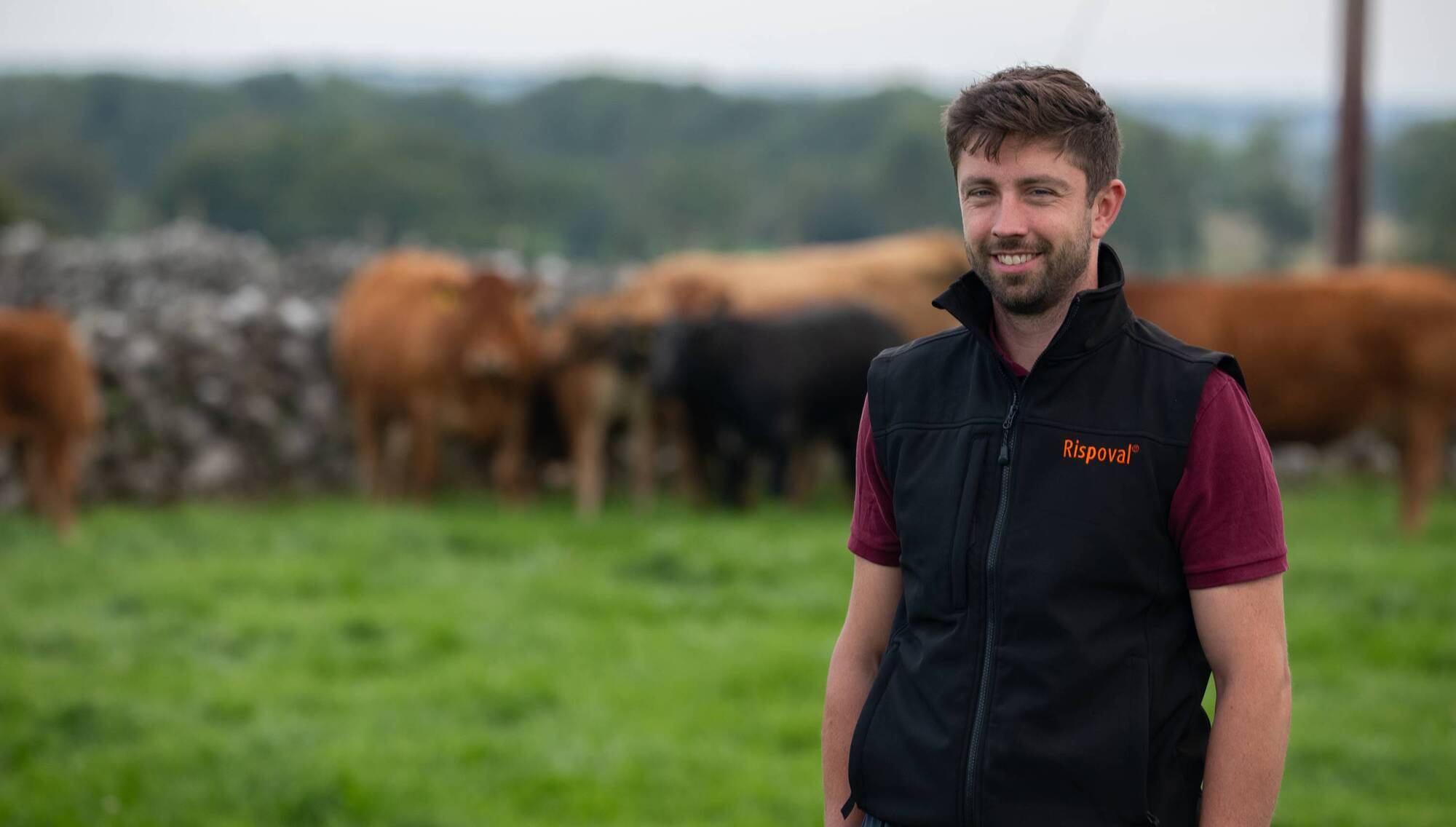
Eoin Glynn, a veterinarian based at Gorteen Acre Veterinary Clinic in Athenry, Co Galway. Eoin works in mixed practice while also running a suckler herd at home.
For Eoin Glynn, veterinary work and suckler farming go hand in hand. Based at Gorteen Acre Veterinary Clinic in Athenry, Eoin works in mixed practice while also running a suckler herd at home.
With around 25 to 30 cows and calves, he has developed a practical, planned approach to herd management—one that aims to reduce stress at key points in the calf’s development and make the most of his time on the farm.
Eoin’s herd includes Charolais, Limousin and Belgian Blue cattle. Cows and heifers are synchronised and fixed-time AI is used to create a tight but staggered calving season, running from the end of January through to April.
The approach is designed to make the workload more manageable, both on the farm and at home.
“A tight calving season allows me to plan activities at calving time around my family, work and other commitments.”
For Eoin, planning is particularly important because the herd is managed alongside a busy veterinary practice. Having a clear calving window helps him organise labour and focus attention where it is needed most.
Calves are weaned in October or November, with most sold at that time or shortly afterwards. Eoin says the herd has built a consistent relationship with the same buyer, who returns year after year for the calves.
Because payment is based on liveweight, maintaining growth through the weaning period is a key priority.
“We wean in October/November and sell most calves then or shortly after. We’ve had the same buyer coming back year on year for the calves. We get paid per kg liveweight, so we want to avoid anything that will impact growth at this crucial time.”
Eoin begins creep feeding approximately three months before weaning. By the time calves are weaned, he aims for them to be eating a minimum of 1.5 to 2 kg of meal.
Where conditions allow, he also prefers to wean outdoors. Rather than removing all the cows at once, cows are taken away gradually, leaving a small number of adult animals with the calves. This helps reduce the disruption to the group.
Eoin describes pneumonia as a multifactorial challenge, with the potential to affect calves’ performance well beyond the initial illness. His approach is to reduce stress wherever possible by planning parasite treatments, vaccinations and weaning as part of one overall management programme.
“Pneumonia is multifactorial and can affect calves’ long-term performance. We minimise the risk through careful planning of parasite treatments, vaccination, and stress-free weaning — stacking the odds in the calf’s favour.”
Lungworm is another consideration, particularly for the larger, earlier calves that are often eating more grass. Eoin says he treats calves as soon as coughing is noticed.
Eoin vaccinates all his calves with Rispoval 2. Rispoval 2 protects calves against RSV and Pi3, which are common causes of pneumonia in weanlings. The course consists of two intramuscular injections, administered three to four weeks apart. His aim is to complete the course at least two weeks before housing, so the calves have time to develop protection before the combined stresses of weaning and housing.
“We vaccinate all our calves with Rispoval 2. It’s a two-shot course, given intramuscularly, three to four weeks apart. We aim to have the course finished at least two weeks before housing—so calves are fully protected before the stress of weaning and housing.”
The timing forms an important part of Eoin’s wider management plan. By preparing calves in advance, he can avoid adding vaccination to an already demanding period and keep the focus on maintaining intake, growth and animal welfare.
Eoin has been using Rispoval 2 for the past five years. He says that, during this time, the herd has experienced minimal cases of pneumonia. When a case does occur, he has found it generally easier to treat, both on the farm and in veterinary practice.
“Over the last five years since using Rispoval 2, we’ve had minimal cases of pneumonia. And when we do see a case, in my experience they’re generally easier to treat. That’s been our experience on the farm — and in the practice as well.”
For Eoin, vaccination is one part of a broader plan rather than a replacement for good management. Careful weaning, attention to lungworm, appropriate nutrition and early observation all play a role in helping calves through the most challenging stages of the season.
Eoin’s advice to other suckler farmers is to complete the calf vaccination course before housing, rather than leaving it until the animals are already under pressure.
He also believes that a well-planned vaccination programme can make the daily workload more manageable, particularly for farmers who are fitting stock work around employment and family commitments.
“Vaccination helps make the job easier in the evening — less stress on the animal, and more enjoyment out of farming. And it’s more profitable at the end of the year.”
For a farmer who is also a practising vet, Eoin’s approach is straightforward: plan ahead, reduce avoidable stress and give calves the best possible start through the critical period before housing.
Rispoval® 2 contains modified live Bovine Pi3 virus (strain RLB 103) and BRSV (strain 375). Legal Category: POM (E) in ROI, POM-V in NI. For further information, see SPC or contact your veterinary surgeon or Zoetis (www.zoetis.ie/). Prescription decisions are for the person issuing the prescription alone. Use medicines responsibly (www.alpha.ie) or (www.noah.co.uk/responsible). MM-52442 (Sep 2026).
For further information, please contact your veterinary surgeon or Zoetis, 2nd Floor, Building 10, Cherrywood Business Park, Loughlinstown, Co Dublin D18 T3Y1. Call or visit — Use medicines responsibly —