Closing the skills gap: why micro-credentials matter now
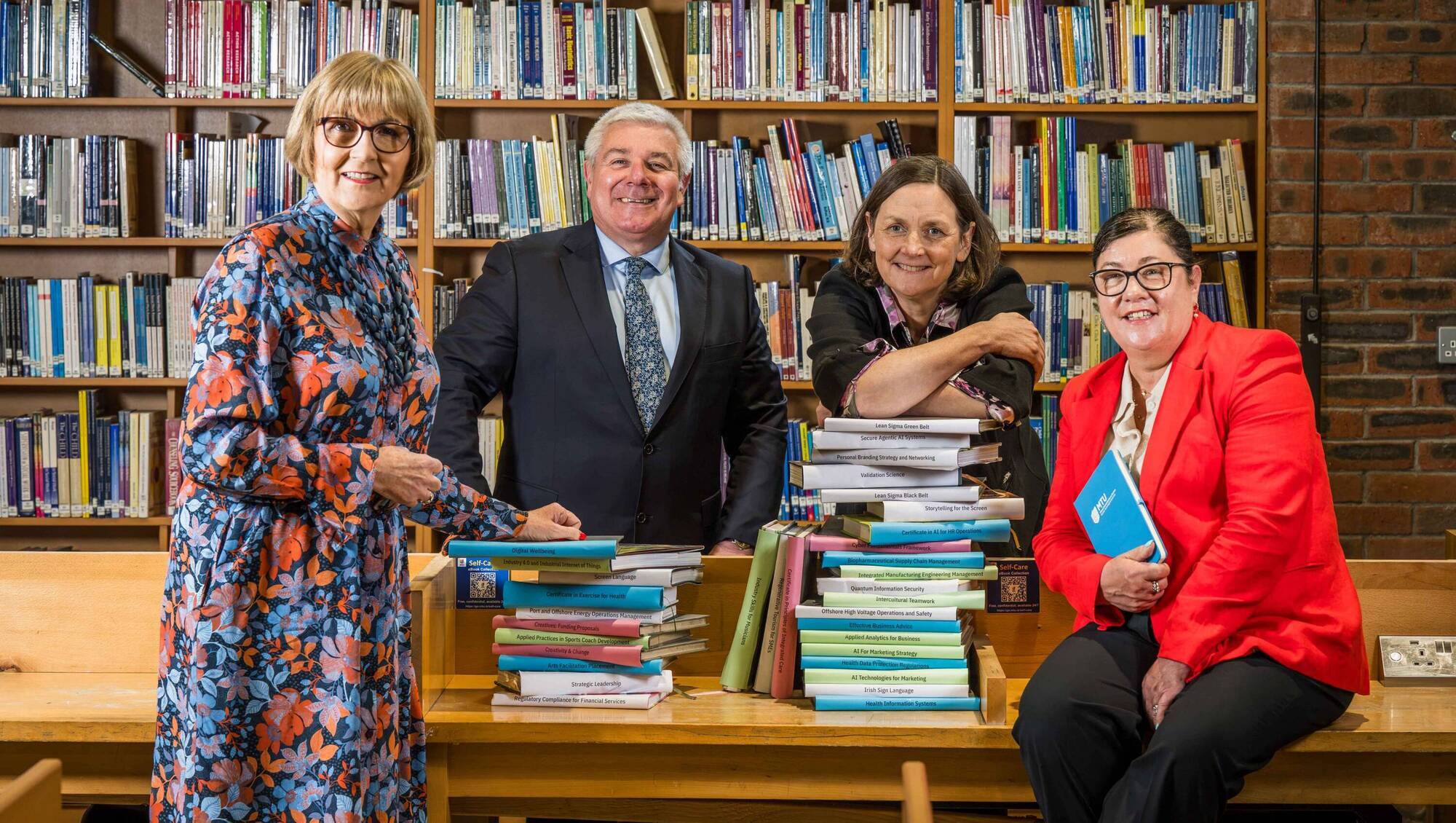
Launching the micro-credential courses at MTU, Prof Maggie Cusack, president, Gerard O’Donovan, vice dean of business; Mariel Brooks, project manager; and Prof Christine Cross, vice president academic affairs, and registrar. Picture: Joleen Cronin.
Across sectors—from digital technologies and engineering to sustainability and regulatory capability—businesses are struggling to recruit people with the right expertise. Skillnet Ireland’s report, Ireland’s Talent Landscape 2025, notes that 42 per cent of organisations are experiencing difficulties sourcing employees with the required skillsets, particularly in technical and engineering roles, digital technologies, and regulatory functions.
At the same time, global labour markets are evolving at pace. The World Economic Forum’s Future of Jobs Report 2025 highlights significant workforce transformation driven by technological change, economic uncertainty, demographic shifts, and the transition to a greener economy.
For Ireland, this is more than a trend—it is a call to act.
National policy has long recognised the need for a more agile and responsive skills system. Ireland’s National Skills Strategy sets out a vision for a flexible, innovative, and interdisciplinary approach to education and training—one that supports employer engagement, promotes lifelong learning, and aligns skills development with the evolving needs of the economy.
Micro-credentials are emerging as a practical and scalable way to translate that vision into action.
These short, focused, and accredited learning opportunities enable individuals to upskill or reskill in specific areas without committing to full-length programmes. This makes them particularly relevant for working professionals, career changers, and employers seeking to build capability quickly in fast-moving fields.

Evidence across Ireland’s skills landscape points to growing demand for flexible upskilling—especially among those already in employment. Research consistently shows that employers are struggling to source technical, digital, and regulatory expertise, while policy and labour market analysis increasingly emphasise lifelong learning, faster skills development, and more responsive provision. In this context, shorter accredited learning is becoming a key mechanism for developing capabilities in areas such as AI, data analytics, sustainability, leadership, and sector-specific practice.
This matters because Ireland’s skills gap is not theoretical—it is immediate, practical, and increasingly complex. Employers need people who can work confidently with digital tools, respond to evolving regulatory environments, lead organisations through change, and contribute to industries being reshaped by decarbonisation, automation, and artificial intelligence.
Micro-credentials help bridge that gap.
They allow learners to gain recognised qualifications in manageable units, enable employers to target workforce development in strategically important areas, and support education providers in responding more quickly to emerging demand.
In an economy where the half-life of skills is shrinking, flexible learning is no longer optional—it is essential infrastructure.
That is why micro-credentials deserve attention—not simply as a new educational format, but as a timely and practical response to one of Ireland’s most pressing workforce challenges.

MTU’s micro-credentials are closely aligned with priority skills needs identified across Ireland’s labour market. They are designed to be flexible, industry-relevant, and skills-focused, supporting learners to upskill or reskill rapidly in response to workplace demands.
This alignment is significant. Skillnet Ireland highlights ongoing shortages in technical and engineering capability, digital technologies, and regulatory expertise, alongside strong and growing demand in areas such as cyber security, data analytics, sustainability, artificial intelligence, and advanced manufacturing.
Against this backdrop, MTU’s micro-credentials can be understood as more than short, flexible courses. They represent a targeted response to clearly identified skills gaps—providing individuals and employers with access to learning opportunities in areas where demand is already evident and expected to grow.
This approach aligns closely with Ireland’s National Skills Strategy, which emphasises flexible, relevant, and employer-connected learning, as well as with global evidence highlighting the impact of technological change and the green transition on workforce skills requirements.
Micro-credentials in these areas respond directly to documented shortages in technical and engineering skills, as well as the growing need for expertise in advanced manufacturing.
Programmes in these fields align with strong employer demand for digital capability, reflecting both national shortages and global trends toward technology-enabled work.
Courses focused on sustainability support the increasing need for expertise linked to decarbonisation and the green transition.
These offerings address ongoing demand for leadership capability, strong communication & business skills as employers continue to invest in workforce development and organisational resilience.
The availability of part-time and flexible learning options reflects both national policy priorities around lifelong learning and employer concerns about time constraints and accessibility.
Overall, micro-credentials at MTUrepresent a practical, evidence-based response to Ireland’s evolving skills needs—agile, targeted, and aligned with both national priorities and global change.
For more information visit mtu.ie/microcredentials