US investment vital for Irish regional development
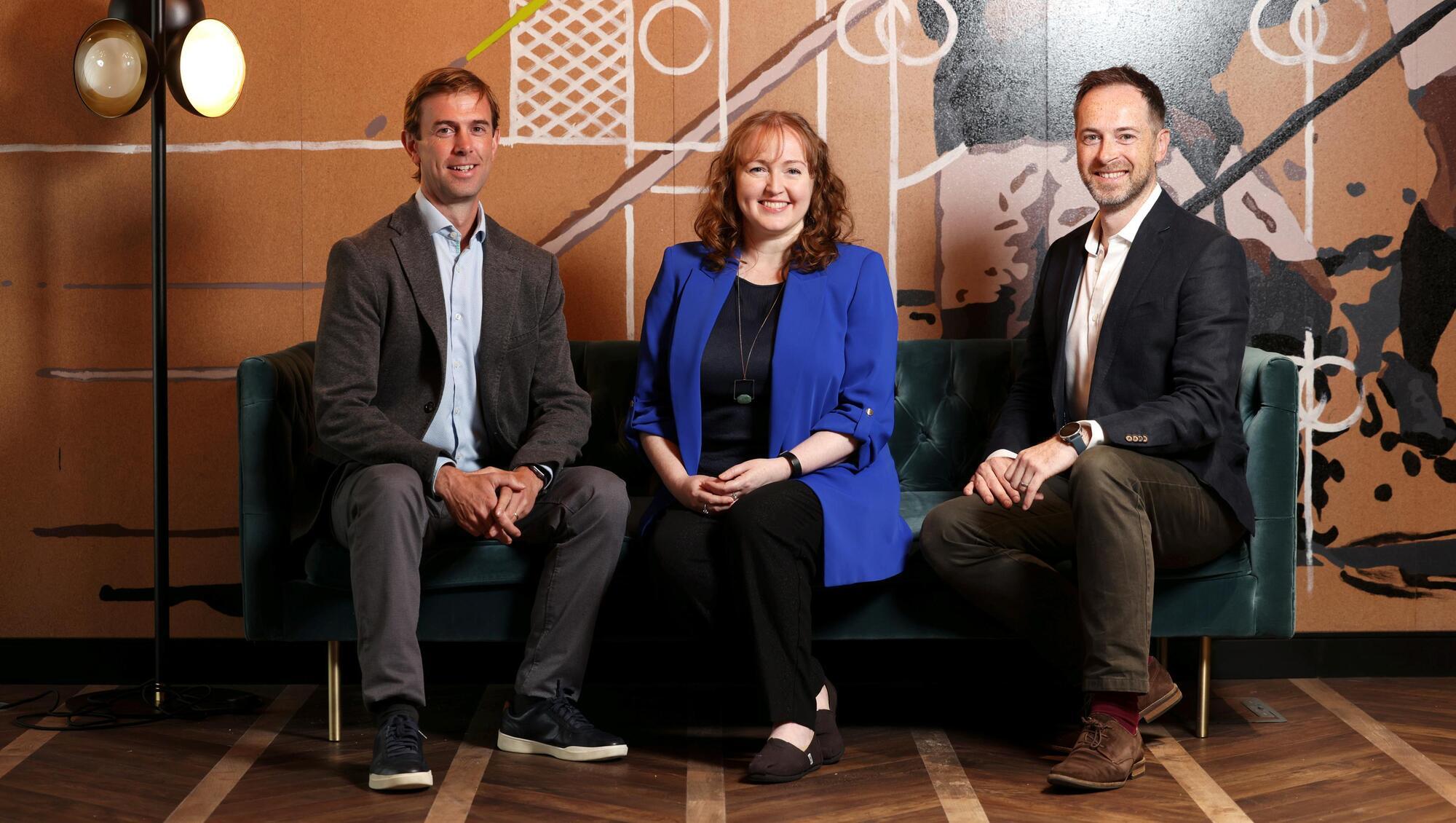
Jan Fitzell, Partner, Deloitte Private, Claire McHugh, CEO, Axonista and David Shanahan, Partner, Deloitte pictured at the launch of the Deloitte Fast 50 Awards 2022.
US investment’s role in regional development in Ireland As government policy looks to regional balanced investment, we are seeing US investment play an increasingly important role in the regional development agenda.
This fact is reflected in recent figures published by IDA Ireland which set out that 52% of FDI won in 2022 went to regional locations with corresponding employment growth in every region of the country.
These results highlight the positive impact of the “Project Ireland 2040” strategy and what can be achieved with real focus on shared development goals for regional investment.

Despite some uncertainty as we emerged from the pandemic, the Irish economy has performed well in 2022. We have learned from the COVID-19 pandemic that although uncertainty continues to be a factor, businesses are resilient embrace change and look for new ways to grow despite economic barriers.
As the fastest-growing economy in Europe for the past decade, and with the economy forecast to outperform global GDP growth over the next two years, Ireland appears to be well-placed to drive development from continued inward investment.
The impact of such increased investment can be felt at a local level.
There has been continued substantial growth in FDI despite the difficult global economic environment. As reported by the IDA, the numbers directly employed in the multinational sector in Ireland have reached 301,475, the highest ever level, and an increase of 9% on 2021. As a result, employment levels have increased in all regions of the country.
Recent government figures show significant growth in regions in 2022, with 127 of the 242 investments won went to regional locations. This has led to an overall increase in employment levels across all regions (with Midland’s region experiencing an increase of 10.5% and the West region experiencing an increase of 7.3%).
Innovation and the digital agenda continues to keep pace and the Deloitte Insights Tech Trends 2022 report has highlighted, there are seven key technology trends that organisations need to pay attention to as they plan for the future.
These areas are data-sharing made easy, cloud goes vertical, blockchain (ready for business), IT disrupting thyself (automating the scale), cyber AI (real defense), the tech stack goes physical, and field notes from the future.
We must continue to invest in our regional third-level institutions to ensure that we have a skilled, diverse, pipeline of available talent to cater for these trends.
In order to keep pace with the digital agenda coupled with international tax changes the Department of Finance have acted quickly to ensure that Ireland's R&D tax credit regime remains competitive and to meet the definitions of a qualifying R&D tax credit under the so-called OECD Pillar Two rules which is most welcome.
R&D will also play a critical role as we look to action our climate targets as companies look to develop new technologies, processes and alternative ways of delivering their products and services to meet their sustainability targets.
The corporate tax regime in Ireland is both transparent and stable, which provides certainty for investors.
Ireland’s headline tax rate of 12.5% continues to be competitive in the global economy, even with an increase of the tax rate to 15% for larger companies under recently announced Pillar Two measures.
As a cautionary observation, Ireland has been a major beneficiary of globalisation in recent years. Corporation tax receipt amounted to €22.6 billion in 2022, almost 50% higher than 2021. This will need to be kept under review by our policymakers: as international tax reform will undoubtedly impact on the corporation tax base.
As companies increasingly embrace hybrid and remote working, they want to ensure that their people are located in jurisdictions that meet their employee’s expectations of work and life.
While regional locations offer so much from culture, the arts, music, to windsurfing, people’s desire for a place they can call home has never waned. According to the Knight Frank Housing Report published in April 2022, there is a strong demand for housing in Ireland of approximately 30,000 to 40,000 units per year.
The supply of housing in Ireland lags demand, with 20,433 units completed in 2021, and an average supply over the last ten years of 12,000 per year.
The Department of Housing, Local Government and Heritage released “Housing for All”, a new government housing plan to 2030 for Ireland. The government’s vision for the housing system over the longer term is to achieve a steady supply of housing in the right locations with economic, social and environmental sustainability built into the system.
While the commitment to action and clear roadmap has been well received by the FDI community, it will be important to be able to demonstrate that the annual targets are being met.
Increased demand for mobile workers internationally (especially across the EU) may lead valuable talent choosing other countries over Ireland to live and work given the lack of available affordable housing, and this is certainly a threat to regional development.
Talent attraction and retention will play a vital role in increasing inward investment from abroad and also encouraging members of our own diaspora to return to Ireland. In 2022, Irish taxpayers paid personal tax at marginal rates of 48.5% on salaries above €36,800 and 52% on salaries above €70,044. The effective rates are uncompetitive in comparison to other countries both inside and outside the EU.
Special Assignee Relief Programme (SARP) is an initiative aimed at encouraging skilled personnel to relocate to Ireland by granting an exemption from income tax for 30% of earnings between a €75,000 and €1m. However, in order to be competitive, the Irish SARP needs to be further modified as it is a key piece of Ireland Inc’s offering.
There is no doubt that the global economy is facing some headwinds with the outlook dependent on the future trajectory of the war in Ukraine, inflation, interest rates, monetary policy and geopolitical developments.
Job losses in tech companies have dominated headlines this year — but we must remind ourselves that it follows several years of unprecedented growth.
The fundamentals of investment and innovation remain the same. As recent history has taught us, even when faced with uncertainty businesses cannot afford to stand still: change is the only constant.
Business leaders drive opportunities for growth through expansion into new markets and continuing to redefine how they serve their customers in local markets, embed sustainability into business strategy and ensure that they have the right talent to innovate and compete.
While Ireland Inc is well placed to continue to win new investments in an increasingly competitive environment it is important that government policy decisions continue to enhance Ireland Inc’s FDI offering. When Ireland Inc wins, regions win too.
Learn more at www.deloitte.com/ie