What will future of Irish communications look like in 25 years?

The next 25 years will welcome an unprecedented era of telecommunications, primarily through the evolution of AI.
In 2026, Vodafone Ireland made history when it conducted Ireland and the EU’s first mobile video satellite call from a standard smartphone in Ireland. Afterwards, the first question on most people’s minds was, “When can I get my hands on that?”
The technology will be a game changer, not just for emergency service responders but for anyone who needs to access data while traversing a remote region.
“Your phone will be able to flip over on to satellite coverage if there’s no mobile coverage,” explains Deryck Fay, author of Connecting A Nation: The Story of Telecommunications In Ireland. “Hill walkers, for example, could use it to check a map or the weather. From a tourism point of view it will be huge.”
Vodafone Ireland is planning a commercial roll-out of the technology for 2027 but regulatory and technological challenges need to be surpassed first.
“We need more satellites to have continuity of service,” says Sheila Kavanagh, network director of Vodafone Ireland. “Our partners AST SpaceMobile are focused on that. There are a number of regulatory hurdles too. The spectrum we use for this technology needs to be approved by the telecoms regulator. Today our spectrum is for terrestrial and this is non-terrestrial use.”
The future is firmly on the mind of Vodafone Ireland. The company is ploughing forward with a €360 million investment programme in support of businesses, regional development and emerging technologies that will take them up to 2030.
When Sheila Kavanagh looks back over the last 25 years and beyond to the next quarter century, she realises the pace of change is getting faster.
“A development that once took five years might only take a year now due to advances in technology and capability.”
As the longest-standing business network in Ireland providing advice, innovation, expertise, and consultancy for its customers, Vodafone Ireland is acutely aware that technology is transforming operational requirements for everyone.
“Customers want a frictionless business and seamless connectivity: always on, always connected, always reliable. Every minute lost on a network is business lost for a customer. We’re seeing that increasingly with small businesses as well as large corporates.”
Vodafone has more than 1,000 employees in cyber capability outside and within Ireland. “The leverage of that skill set, the knowledge, experience, and the ability to bring relevant consultants to business customers, is great.”
What changes are in store for Irish business over the years ahead? In the short term we are seeing a move from physical SIMs to e-SIMs for mobile. There is increased saturation of fibre coverage around the country on account of the National Broadband Plan and SIRO, Vodafone Ireland’s project with ESB to create a 100 per cent full-fibre-to-the-building (FTTB) broadband network.
AI, meanwhile, is likely to become all-consuming. From a customer perspective, this will require increased bandwidth, notes Deryck Fay.
“I was on holidays recently. I’d normally use lots of data for Google Maps but this time I was regularly asking ChatGPT, ‘Give me an itinerary for Paris: a bar, an informal dinner, somewhere I can see the Eiffel Tower light up.’ That interaction requires more data and more bandwidth.”
Within telecommunications, AI is graduating from a customer service tool to the central orchestration layer for network operations. Those networks, predicts Sheila Kavanagh, will be increasingly managed through Zero Touch Operations [minimal human intervention, using automation and self-healing capabilities]. AI will probably manage energy consumption too.
“[Telecommunications] are a massive user of energy and trying to use that in a responsible and efficient way is important for us,” says Kavanagh. “We use AI technology to measure patterns of usage across the network over long periods of time. It is able to predict how to switch capacity up and down based on usage patterns.”
As Vodafone refines AI usage for its internal business, “there’s no reason why we can’t productise and introduce that capability to other utility services: electricity, water, gas networks. We all have the same challenges.”
The impending introduction of 6G and quantum technologies may turn telecommunications into a distributed, intelligent system that observes different parts of the physical world. This is happening right now in the form of 5G sensing, which uses radio signals to detect objects, track movements and map environments. It’s a technology that might be used in smart city management: tracking real-time traffic patterns and adjusting traffic lights to ease congestion.
The proliferation of AI brings with it an increased focus on cybersecurity. Six out of 10 Irish businesses use the services of Vodafone Ireland and look to the company for assistance. “Vodafone is well positioned in terms of capability, knowledge and expertise,” says Kavanagh. “As businesses’ operating models evolve to a more AI-centric model, the demands of the network will be very different than the demands today.”
Historically, data networks focused on downlink capacity [data flowing down to the user, like downloading an app], but AI requires more uplink [transmitting data from a local or personal device to a central source].
AI is also likely to demand a greater scale of edge computing [bringing computation closer to the source of data in order to reduce latency and bandwidth] and data sovereignty [binding electronic data to the laws and rules of the country where it is located or hosted].
The future of communications holds variables beyond the control of telecommunications companies. Fay cites the importance of security around undersea fibre cables.
“The danger of those being cut is possibly overstated, but if a lot of them were cut it would make a difference.”
Building regulations and retrofitting of homes may be causing problems around indoor mobile coverage. “Insulation cladding on the outside of a house acts as a radio shield, making mobile coverage inside quite poor.”
Then there is climate change. During Storm Éowyn, the cyclone which hit Ireland in 2025, more than a third of mobile phone users lost signal and one in 10 landline phone services were disconnected. Scientists are unanimous in predicting these extreme weather events will increase in frequency and severity.
“As we become dependent on mobile communications, the resilience of those networks is going to come under increased scrutiny and pressure,” says Fay, who has worked in telecoms for two decades.
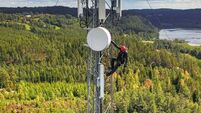
“When I started working in the industry, mobile phone sites were often on hilltops housed in a container or a concrete structure with a generator and diesel tank. They were typically set up to have a few days supply if the power went out.”
These stations became smaller over time and “now there is no room for a generator. They’re completely dependent on mains power. If that goes, mobile coverage goes.”
Vodafone Ireland works closely with business and the Government to make their networks resilient. “Because of the nature of our electricity grid there has been challenges keeping the network up and running in the event of storms,” says Kavanagh. “We are trying to think outside of the box. How do we bring another layer of resilience for events like storms?”
The ability to make satellite calls from a standard smartphone – Vodafone Ireland’s latest innovation due to reach market in 2027 – is one such layer.
The next 25 years will welcome an unprecedented era of telecommunications, primarily through the evolution of AI. Vodafone Ireland plans to continue creating a strong digital infrastructure to support the country’s prosperity and competitiveness, in partnership, of course with their customers. “We are going on a journey together with business,” says Kavanagh. “We are learning and growing together.”