The little sticker that can. Why a win at Blas is a recipe for food business success
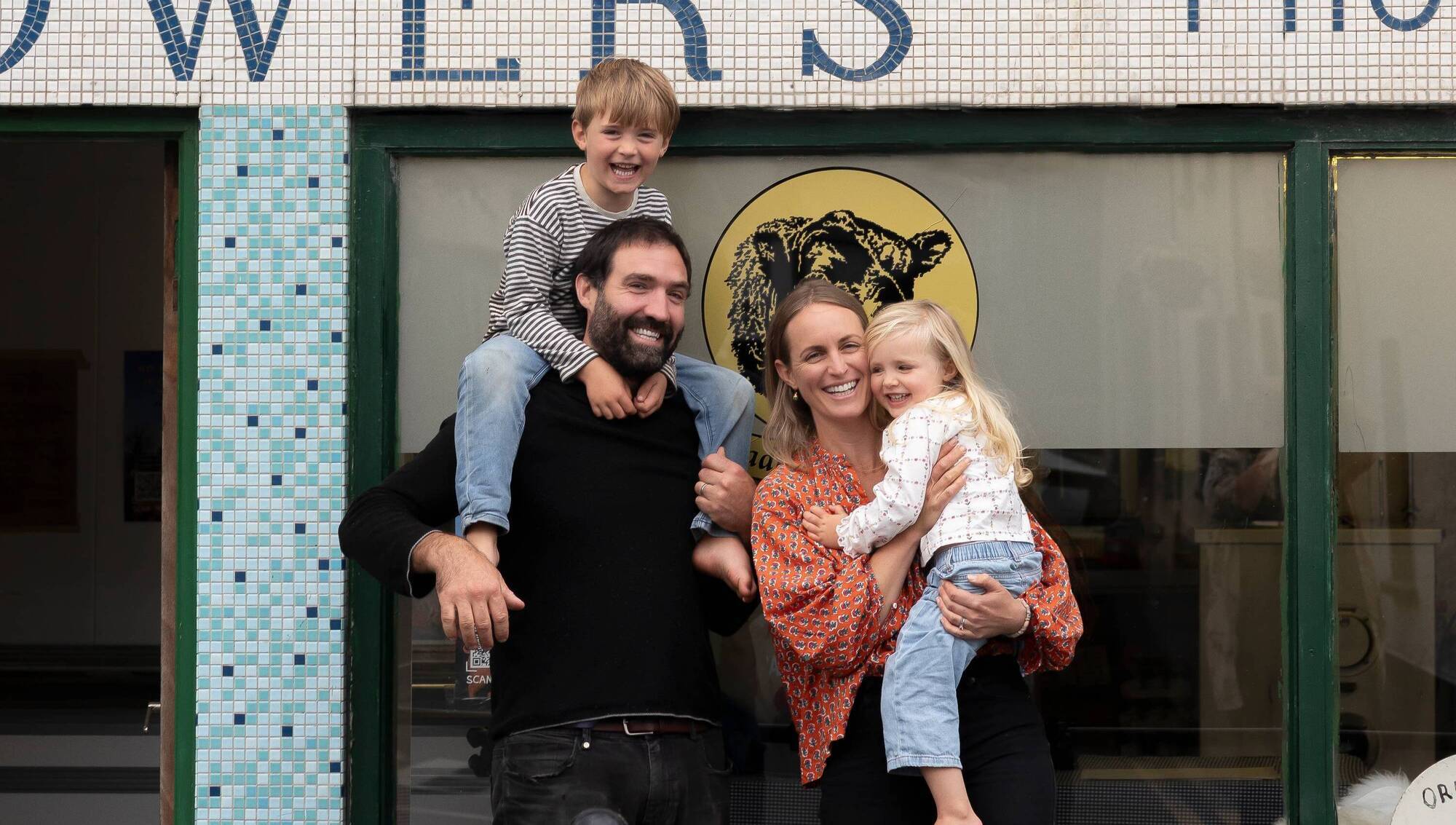
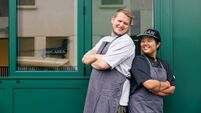
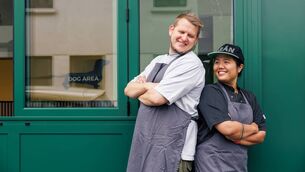
Nick and Cass McCarthy of Lúnasa Farm with their children outside their butcher shop in Clarecastle.
Winning three successive Gold Awards at Blas na hÉireann proved transformational for Cass and Nick McCarthy of Lúnasa Farm.
The couple is that rarest of things in Ireland: first-generation farmers. They established their regenerative organic farm and whole animal butchery in Co Clare, in 2022.
Today their heritage-breed pigs and pasture-fed cattle are raised on their farm, near Quin, before being butchered and transformed into premium cuts in their Clarecastle butcher shop.
“We’re a whole animal butcher, properly nose to tail, and produce 100 per cent grass-fed and finished beef and pasture-raised pork,” says Cass.
“We don’t use any food additives. Our products are not ultra-processed products. We just use real ingredients. You won’t find preservatives, E numbers or colours.”
The couple has found a ready market of people who are just as committed to quality, ethically raised meat as they are, and willing to pay a premium for it, despite the availability of cheap steaks in supermarkets.
“I think there is more awareness now about the provenance of meat and what is being added to it, as well as the whole sustainability of eating meat, which is a really big one for us too,” says Cass.
Winning Blas na hÉireann awards has helped demonstrably.
For example, when Cass began hand-making beef sausages, already popular in her native Australia, friends and family here suggested no one would buy them. “But I knew they were great. So I made them and they were really good, but they were right, no one was really buying them,” she explains.
Winning Gold at Blas na hÉireann, and being able to put that precious Gold sticker on her delicious garlic and black pepper beef sausages, changed perceptions immediately.
“As a result, people were willing to try them. They’d see that sticker and say, ‘Oh, I’ll try those’,” says Cass.
“Now, every week, our beef sausages sell out and for us as a small business that’s what it’s all about.”
Winning a Blas na hÉireann award made a sweet impact on Richie Greene’s business, Skellig Jam, too.
He and his wife Jackie set it up during Covid, when his work in the construction industry, and Jackie’s bed and breakfast, came to a sudden halt.
Having been working all over the country, Greene was delighted to be home in beautiful Ballinskelligs for an extended period, much of which he spent making jam, ready for when the B&B reopened.
“It was only when everything was stopped for a while that I realised I was actually sick and tired of never being home,” he recalls.
So he suggested making jam full time instead. It only sounds like a massive swerve until you realise the jam making was a serious hobby for Greene, whose earliest memories are of being taught how to make it by his grandmother.
He still makes it “the old-fashioned way using only fruit, sugar and nothing else,” he explains.
Today the couple has a range of 15 jams, marmalades, sauces and ketchups, which they sell in supermarkets and independent stores.
Winning successive Blas na hÉireann awards helped to supercharge sales and, as a consumer himself, he understands why.
That’s because, when faced with a choice in store, both his wife and his wider family of foodies – and two of his brothers are chefs – will always opt for the product with the Blas na hÉireann sticker on it.
Indeed, even if they spot a sticker on a product they weren’t in the market for, they will likely buy it anyway. “They always want to try it because they know it will be good,” says Greene.
Blas na hÉireann, the Irish Food Awards, are open to any food producer on the island of Ireland. As befits Ireland’s development as a “food island”, entries are growing steadily and this year stood at more than 3,000.
According to Fallon Moore, who has run the competition with her father, Artie Clifford, in Dingle, Co Kerry, since its inception in 2008, it attracts both new and mature food businesses.
Producers enter online and then submit products to judges on a category-by-category basis for a blind tasting competition.
With more than 200 categories, from bread to ready meals, it’s a huge logistical undertaking, but one that has, year after year, successfully winkled out the crème de la crème of Irish food.
Even if you don’t win, taking part has enormous value, not least because of the invaluable feedback from expert judges.
“If you get to the finalist stage it means you are in the top five in your category in the country, and that is hard to achieve. The gold, silver and bronze awards are almost the cherry on top,” says Moore.
Jon Geary saw the value of that first hand when he won a Gold Award last year. He set up his ice cream parlour, Little Mamma’s Gelato, in Donegal town in October 2018, making gelato on site.
At the time friends thought he was nuts to be heading into the winter selling that most seasonal of products. In fact Geary, a chef, quickly proved that when a product is this good, people will buy it year-round. Today he produces more than 100 different flavours, with new ones added annually on foot of trips each January to see what’s new in Italy, the home of gelato.
Not alone does his ice cream parlour have a loyal customer base in Donegal, but retailers began asking if he could supply them too, helped by his success at Blas na hÉireann.
“Two years ago we got to the finals with a sorbet, and last year we won a gold for our wild berry cheesecake gelato, which catapulted everything,” says Geary.
Today Little Mamma’s Gelato supplies more than 60 retail customers and, thanks to its win at Blas, was approached to take part in Lidl’s Kickstart supplier development programme, a big step up that has seen it stocked nationwide.
“It has just been fantastic for us.”