The small Dutch person and property in your pension

Seek expert advice: While the Dutch are among the world's tallest people, not every Dutch person is tall; and not all pensions are the same. Photo: iStock
, specialist pensions adviser with Elevate Financial Planning, compares the 2008-2025 performance of two sample pensions, one with and one without a property element

The Dutch are among the world's tallest people, but not every Dutch person is tall. An average describes a group, not every individual case.
Everyone knows someone who made a fortune from a rental. That is your small Dutch person: real, but not the average.
After almost two decades advising people on pensions, I know the commercial side. I see ads up and down the country promoting property through pensions, and I understand why. Property is familiar. You can drive past a rental. You cannot drive past an ETF index tracker. I have no doubt that advertising property would attract more business to my own firm too.
But what is easiest to advertise is not necessarily what is best for your pension. There is nothing wrong with property. It is everyone's favourite toy. But I really do not think putting nearly half a pension into one Irish building is best for most people. So let's keep it simple and see how the S&P 500 has done against Irish property.
Say you have €800,000 in a self-directed non-standard PRSA. The CSO says the median home bought in 2025 cost €387,000. After €3,870 stamp duty and a €20,000 cash reserve, €389,130 goes into the index.
The RTB's standardised new-tenancy rent was €1,755 a month in late 2025, a gross yield of about 5.4 per cent. The model uses each period's national rent and price data, not today's yield.
Gross matters. My tenant never misses a payment, the property is never empty and the boiler never breaks. At first, I deduct no running costs. I am giving property the better side of the argument.
Price and rent data overlap only from late 2007, so I tested 2016 to 2025, then 2008 to 2025. The S&P figures include reinvested dividends, in euro, before fund, platform and pension charges. The property gets its change in value plus every euro of rent, reinvested in the index each year. Neither route gets extra contributions.
From 2016 to 2025, the modelled property return was about 13.1 per cent a year with rent, against 13.9 per cent for the S&P 500. On €800,000, the index route reaches €2.95 million and the property route €2.83 million. Even in a strong property decade, the index wins by about €127,000.
The longer test starts in 2008, close to property's worst possible starting point.
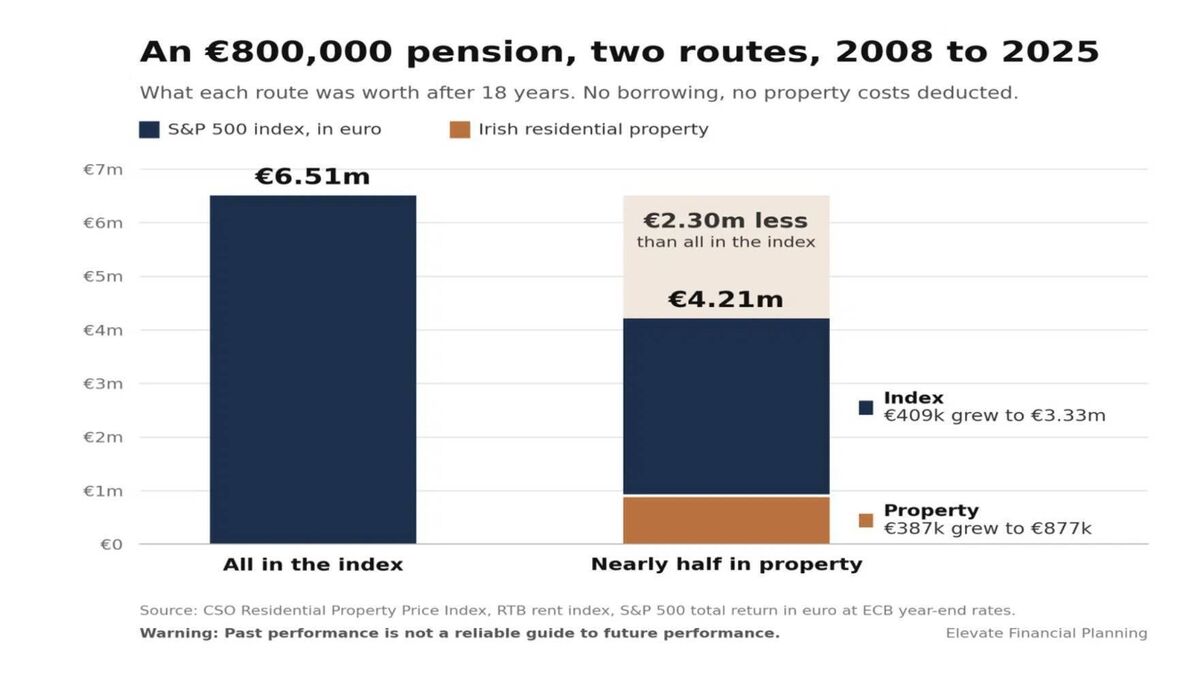
In 2008, Irish property prices fell 13.4 per cent while the rent kept coming in. The S&P 500 fell 33.4 per cent in euro. Property offered more protection that year.
But Irish prices kept falling, dropping 55.1 per cent from April 2007 to March 2013. Prices regained that peak in July 2022. Adding every euro of rent collected, without reinvesting it, a modelled property bought at the start of 2008 recovered its cost by 2017. Reinvesting rent as above brought recovery forward to 2014. The S&P 500 recovered its 2008 loss by end 2010 in euro, including reinvested dividends, before charges. Shares show the damage daily. A property's loss stays hidden until valuation or sale.
From 2008 to 2025, the modelled property return was about 5.1 per cent a year with rent, against 12.5 per cent for the S&P 500. In the index, €800,000 would have become about €6.61 million, against €4.85 million for the property route. Providers such as Newcourt require a property management agent. Assume an agent's fee of 10 per cent plus VAT and 5 per cent of rent for insurance, LPT and repairs, and the gap widens from €1.76 million to roughly €1.96 million.
To be fair to property, borrowing cannot be ignored, especially if your pension is smaller and you borrow to get there. A suitable non-standard PRSA can usually borrow up to half the value, subject to lender approval, with the loan repaid within 15 years and before retirement.
Say you have €400,000. You put down half the price, €193,500, and borrow the rest at an assumed fixed 5 per cent, keeping €40,000 in cash. Repayments of about €18,400 a year come out of the rent.
From 2016 to 2025, borrowing would have worked before costs: about €1.56 million against the index's €1.48 million. With the same assumed costs, it falls behind, to about €1.46 million.
From 2008 to 2025, it is far worse: rent falls short of repayments in most years, and the pension covers the gap. It ends about €1.69 million behind. At the 2013 low, 82 per cent of the deposit was gone, on paper.
Borrowing makes timing matter far more.
Putting nearly half a pension into one building, in one part of a small Irish market, is a massive concentration risk. Many already have their job, home and business tied to Ireland.
The S&P 500 spreads the money across 500 companies. It still carries US and currency risk, but it is far broader than one Irish property.
Liquidity matters at retirement too. Once you have been 60 for a whole tax year, Revenue taxes an ARF or vested PRSA as if you withdraw 4, 5 or 6 per cent a year, depending on age and fund size, property included. But you cannot sell the back bedroom. The index can be drawn down a slice at a time. The property is all or nothing.
Property may beat the index over the next 18 years. Maybe yours will be the small Dutch person. But history says one property is not the most sensible starting point for half a pension. For me, the return record, running costs, liquidity problem and concentration risk make a simple index stronger.
But if there's one thing we learn from history, it's that we never learn from history. That saying really rings true. Maybe the past is no guarantee of the future, but to me, concentration always seems to be a blind spot for us, from a financial and cultural standpoint.
- Note: This article is general information, not financial advice.
- Warning: Past performance is not a reliable guide to future performance.
- Warning: The value of your investment may go down as well as up.
- Warning: If you invest in these products you may lose some or all of the money you invest.
- Warning: These products may be affected by changes in currency exchange rates.