The holy wells of Kinsale offer a window to our sacred past
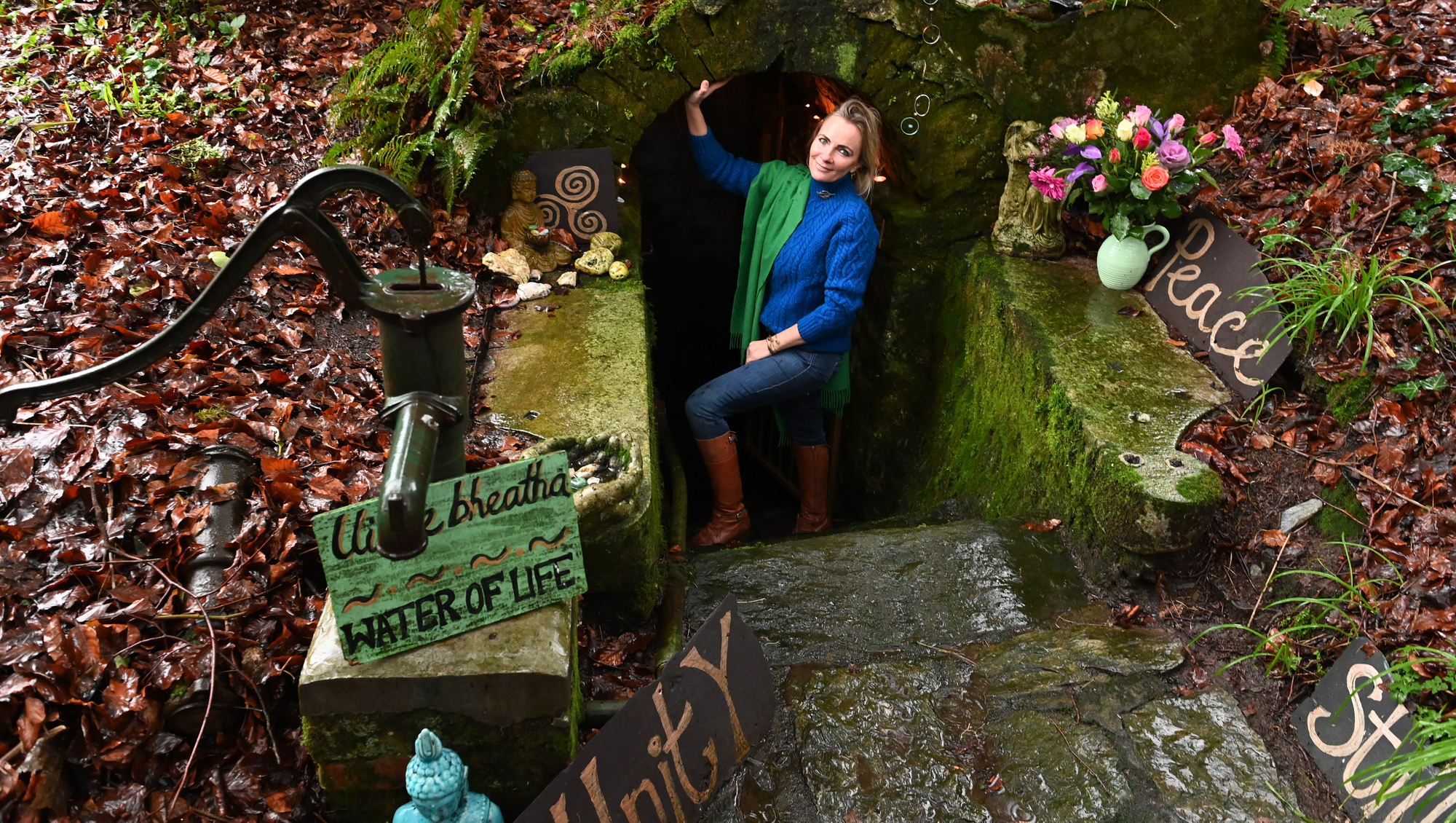
Charlotte Cargin has already found approximately 100 historic wells in Kinsale, Co Cork. The search for wells began 20 years ago after she uncovered a well in the garden at the family home of her grandmother at The Grove, Compass Hill, Kinsale, Co Cork. Picture: Larry Cummins
On a recent homeward journey from visiting an old friend in deepest West Cork, I took a detour to the holy Lady’s Well, just outside Bantry. Happy to cruise along the tourist-free lanes of the Sheep’s Head peninsula, the route eventually brought me face to face with devout faith in its most ancient form.
Cut into the hillside and tucked underneath an intricate canopy of beautifully shaped stones, this locally famous holy well announced its venerable credentials with the scores of Virgin Mary statues dotted around its base. A tattered leaflet carried the Biblical message of John 4:14: “Whoever drinks of the water that I will give him shall never thirst; but will become in him a well springing up to eternal life.”
When in Rome, I thought, setting myself to a long-ago ritual with the pleasing familiarity of donning an old sheepskin jacket. Witnessed only by a chirpy robin and a dozen curious sheep, I silently intoned prayers from my childhood, murmuring the required decades of the Rosary, walking in a circle and dropping a pebble in the well at each completion. Enveloped in a tranquil cocoon outside of the normal world, Henry David Thoreau’s observation that “heaven is as much under our feet as over our heads” never seemed more appropriate.

There are an estimated 3,000 holy wells dotted all over Ireland – more than any other nation in the world. Each reputedly possessed of some miraculous power, these sacred fonts remain signposts to an ancient past where mysticism and healing combined in a spiritual power still faithfully observed even in today’s secular world.
Offering hope and deliverance to a variety of petitioners from brides wishing fertility to the infirm seeking physical relief, the holy wells of Ireland still retain a magical significance for the thousands who visit them every year. We may live in the changed world of 2026, but surely this beatific natural resource should be better publicised. In a nation where tourism is so vital to our economic existence, why not showcase our holy wells to the millions of pilgrims seeking emotional sanctuary out there?
Not alone is Kinsale blessed with an abundance of scenic beauty, but is also festooned with a chain of holy wells. Charlotte Cargin has already uncovered and restored more than 100 in her hometown – aptly underlining the town’s former name as Fan na dTubraid, translated as Slope of the Wells.
Having already restored 30 of them to full working condition, she has called upon the voluntary labours of friends and locals in the town to assist on her voluntary mission. “I had an old ordnance survey map from 1932 which mapped out the location of each well. These were wells that I had never heard of, and it transpired that no one else had heard of them either.”
Tracking the streams with the map as her guide, Charlotte began to knock on doors of local houses, chasing the channels running through and underneath the land of the properties. “People were very intrigued. It was amazing how many old wells I found that were either completely buried or hidden in plain sight. People had no idea these wells were in their gardens.”
As it turned out, the first well she uncovered and eventually restored was right on the land where she lives – a fine house on Compass Hill called The Grove. “I live in the house that my grandparents once owned, which in the past was a meeting place for druids.”
Restoring the garden after the death of her grandfather, she uncovered and restored an ancient well long overgrown in a hidden corner.
“That was the first well I ever restored. To this day, I still drink from it and it's always full of ever-flowing pristine spring water.”
Given that her 1932 Ordinance Survey map listed just 30 wells in the Kinsale area, Charlotte has so far found an extra 70 and is drawing her own map complete with these numerous additions.
“Our ancestors during pre-Christianity times worshipped water as the divine. It is the life force of our existence that is flowing through all of us. The work has swept me away. It’s an absolute devotion.”
Planning to publish a book about her holy well restoration entitled ‘Restoring well-being through the wells of Éiru’ she has started a GoFundMe campaign to complete what has become a magical journey into the past. The global market for religious tourism is one of the travel industry’s largest segments, numbering an estimated 300 million visitors and worth over €2bn annually, servicing the growing trend for more authentic travel experiences. If the multitudes thronging the Roman catacombs or Spain’s Marian shrines happily feast on pasta and sangria in the evening, why should Ireland miss out in offering visitors a unique Kinsale window to our sacred past?