Transforming Ireland's MPAs into more than just lines on a map
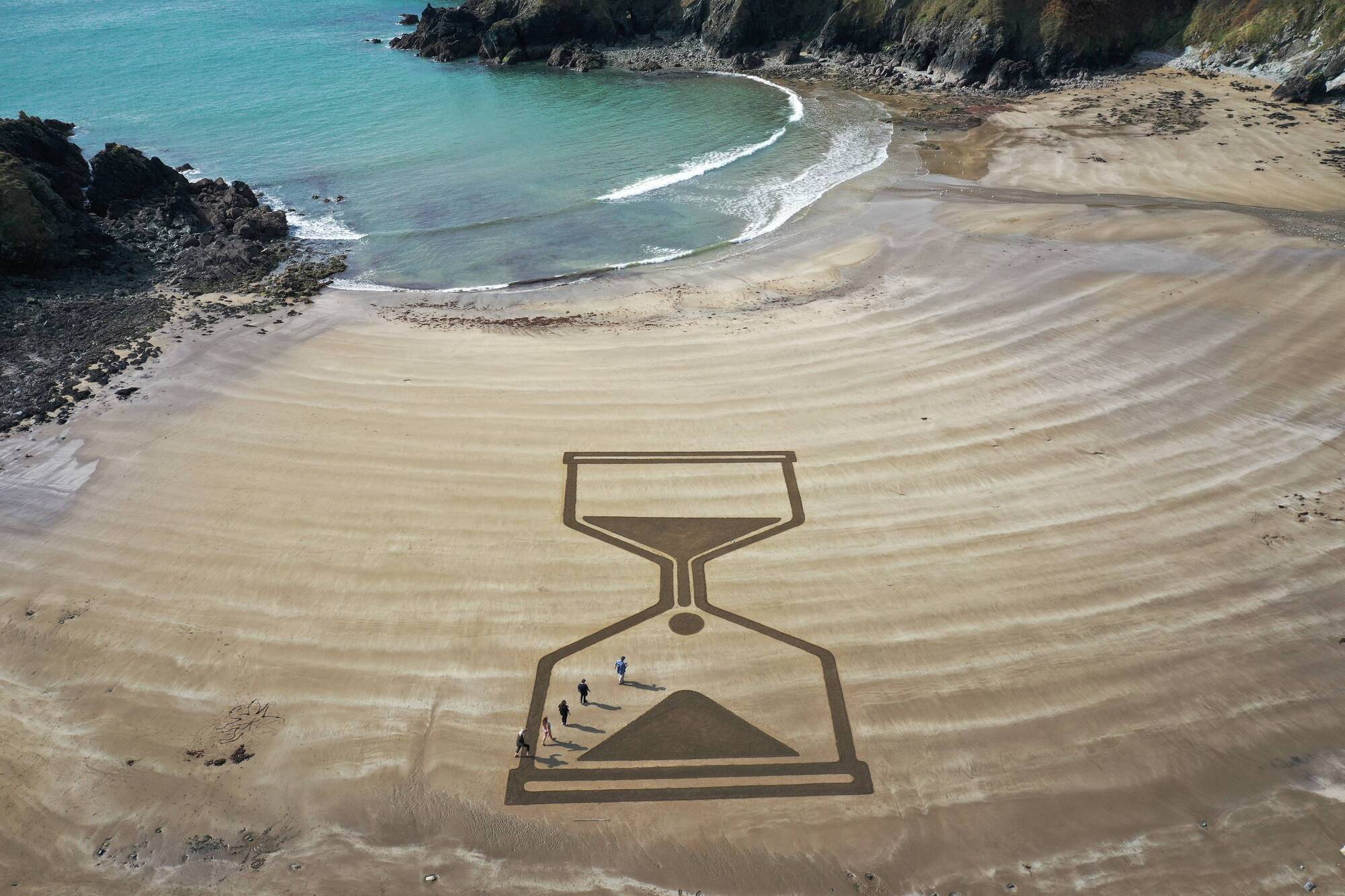
Fair Seas has unveiled a giant 200ft hourglass in the sand at Kilmurrin beach in Co Waterford after it was announced that it will be the middle of next year before any Marine Protected Area (MPA) legislation is passed into law. The work was created by visual artist Sean Corcoran and his artist friends. Photo: Sean Corcoran, The Art Hand
To get a clearer picture of how much progress Ireland is – or isn't – making in its efforts to achieve 30x30, it may initially seem like a good idea to look to our nearest neighbours for comparison.
While Ireland currently has just 9% of its ocean protected, and only 3.5 years remaining to reach the target of 30%, just across the pond in the UK the statistics paint a very different picture.
Approximately 38% of the UK's seas are now classified as protected, meaning they have already smashed their target of reaching 30% ocean protection by 2030, while Ireland is less than a third of the way there.
These figures, however, don't tell the full story.
"The UK would claim to have 38% of its ocean protected, but we really have to question the quality of that protection," outlines Belinda Bramley, who is co-founder and director of the UK charity Protected Areas Foundation as well as stakeholder engagement co-lead for the MPA Europe Project.
Belinda is one of a host of international experts addressing the World Ocean Week Conference in Cork City Hall, and has plenty of insights to share as to how Ireland is faring in marine protection compared to our global counterparts. Thankfully so, as the numbers can get quite confusing!
"Whether we look at that 9% of ocean protection in Ireland or the 38% in the UK, both of those figures could mean anything. The term 'protected' can cover this whole spectrum of Marine Protected Areas (MPAs) from those that are merely designated, where we've maybe got some lines on a map and some goals for that area, right through to those that are actually operational, where you've got some kind of effective management going on in situ to manage pressures on the area," Belinda explains.
"I recently presented evidence to the Joint Oireachtas Committee on Fisheries and Maritime Affairs about how the term MPA gets used incorrectly and why that's a problem. We use it for all kinds of MPAs at all ends of the spectrum, and this can cause confusion for the general public who don't realise that most MPAs are not actually operational and have never been granted the resources they need in order to start delivering benefits.
“Subsequently, because they're not delivering benefits people lose faith in them which can create mistrust. The longer we delay on MPAs, and the longer they're not operating or producing results, the higher the chance that stakeholders will disengage and lose trust and I think that's unhelpful in the current situation where it's already difficult for fisheries to deal with new initiatives coming into their space such as offshore renewable energy as well as MPAs.
"The truth is we haven't really given MPAs a fair chance yet, which is such a wasted opportunity for nature, for people, for the economy, and for overall climate health. We tend to think of MPAs, perhaps if you don't know much about them, as places out there where we're not allowed to go because things are protected but actually you need people making that happen and informing the public why that is.
“The key is helping people understand the role of MPAs, what makes this area so special, what about it needs protecting and from what, as well as having a clear management plan that the public can understand."
While Belinda is clear that Ireland has a long way to go in implementing these best practices, it unfortunately by no means makes us a global outlier.
“Ireland is not alone in not having MPAs that work. It’s an issue across Europe and the UK,” she emphasises. “What strikes me is that Europe has taken a very different approach generally to other parts of the world, in that we have a very particular species-based approach in designating MPAs, where typically they’re there to protect a particular species or habitat, rather than a whole ecosystem-based approach.
“The other thing that I think is striking is how few examples we have in Europe of what I would call effective Marine Protected Areas that are demonstrating ecological recovery and benefits to fisheries. Further afield in places such as Australia, Canada and South Africa, active management approaches are being taken and that’s where we have examples of effective marine protected areas.
“For some reason, in the UK and Europe we’re taking a risk-based approach where we only act when something looks like it’s going to cause a problem, rather than actually looking at the particular pressures on a particular ecosystem and working with our community groups to come up with an active management plan that’s actually going to produce results.” While it’s not happening as quickly as eNGOs would hope, however, there are some positive signs of progress beginning to appear closer to home.
“Portugal is taking on the lead in Europe in terms of marine protection. They have announced an ambitious programme to designate MPAs in the North Atlantic that was previously unprecedented so it’s fantastic to have their expert Adriano Quintela coming from Lisbon to tell the conference in Cork more about that.” Even closer to home, positive signs are emerging from Scotland about how MPAs can boost local fisheries by replenishing once depleted fish stocks.
“Arran Seabed Trust is a great example from Scotland of a community that just took action and closed off an area to bottom-towed fishing and now they're seeing the benefits of it not only for their scallop fisheries but their overall seabed. It's cases like that, where it's often down to one individual who is passionate at local level, where we can see great results.
“You only need one or two people who really want to drive things and when those people are from the fisheries that's even more powerful. It's in the fisheries’ interests to decide it's time for a change and that decision could come from a closed or restricted fishing area, which has happened in the Isle of Man for example.
“Throughout the world, the most effective and long-standing marine protected areas that we can look to have been a partnership between environmental organisations and local and national government as well as, crucially, fisheries, tourist industries, guide operators and local people, so that it’s a shared endeavour and a shared responsibility.”