Explore these walks in County Cork this summer
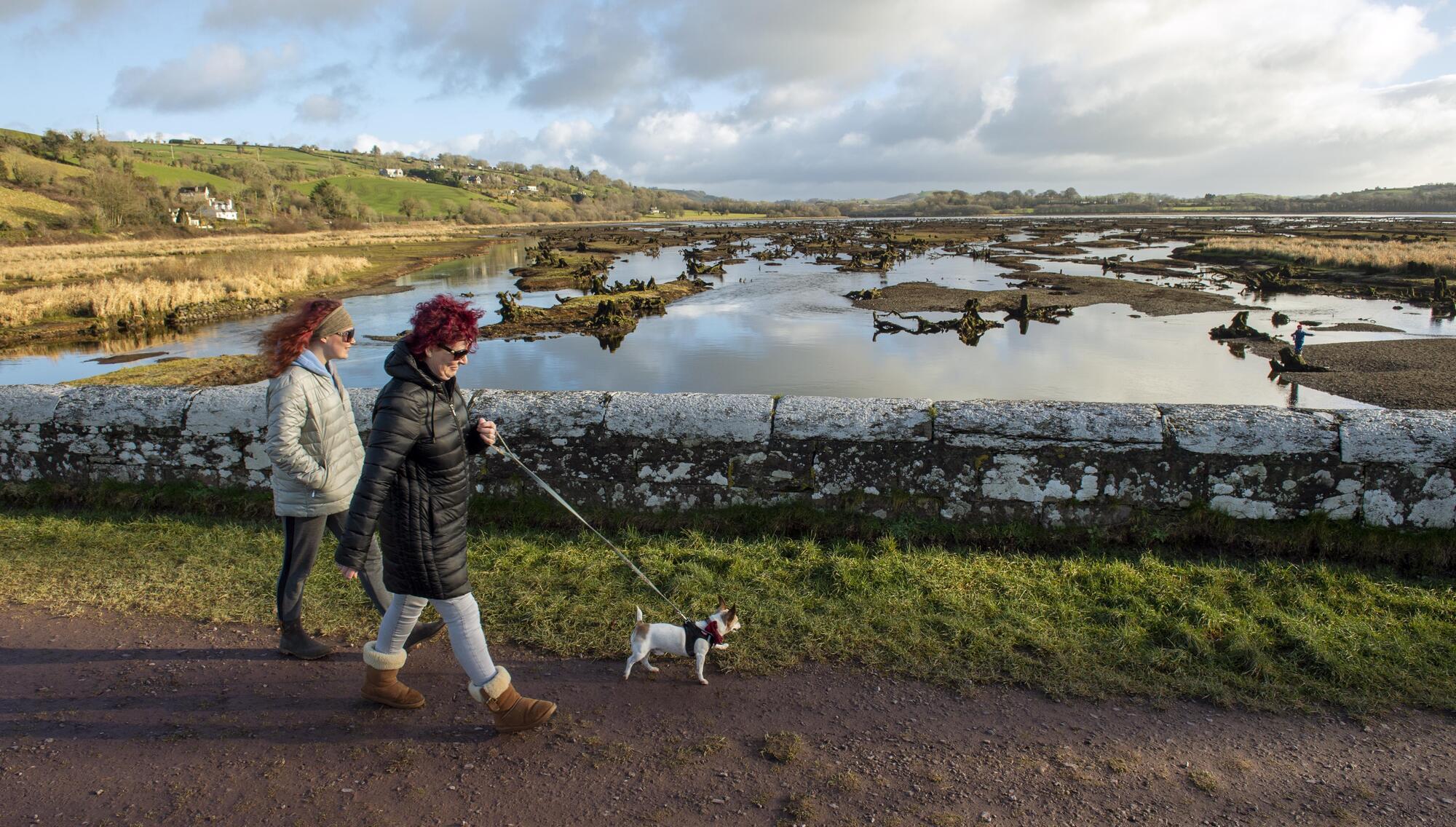
Aimee and Breda O’Herlihy walking their dog at the Gearagh nature reserve in the Lee Valley.
16km
Six hours
A tough walk over rough terrain. Ensure appropriate clothing, boots, food, drink, map, mobile.
It may be something to do with the sparse population of the peninsula that makes the Sheep’s Head such a spectacularly beautiful place. Nothing wrong with urban areas of course, but if you are looking to get away from it all for a day walk then the Sheep’s Head Way has dozens of truly magnificent walks.
This walk starts at the end of the peninsula as you drive west from Bantry on the L4704 through Ahakista and the village of Kilcrohane. The road gradually rises till you reach Tooreen carpark beside a small cafe. As you prepare to walk, take a moment to absorb the peerless views you are presented with. Straight away, you take in the continuous chain of mountains on the Mizen Head Peninsula to the south. Below you, the land falls to the churning sea, or the dazzling sea, depending on the conditions on the day.
Follow the red arrows on falling ground in a westerly direction. After a short while you will pass a helicopter landing area, to serve the lighthouse which is a little further on. Now automated, the lighthouse has directed generations of seafarers to safety. It is a stunning building in its own right and provides yet more gorgeous views northwards, this time to the Beara Peninsula. This is a serious fix for your lungs as they bathe in invigorating supplies of oxygen.
To continue, turn east and head back along the northern part of the peninsula under Ballyroon Mountain, well out of earshot of any traffic. Enjoy the occasional spectacle, if you’re lucky, of gannets plunging into the sea at incredible speeds. After about 5km, the trail turns southwards and is well signposted for the Poet’s Way. Now take a westward turn and you are back on the southern side of the peninsula on the trail.
On high ground now, you traverse a track through purple heather before finally descending to the carpark and, unfortunately, the end of this unforgettable walk. Once you’ve been bitten by the bug for the Sheep’s Head you will undoubtedly want to come back and try other of its fabulous routes. Or, take on the entire 88km over four or five days staying in B&Bs along the way.
4km
Two hour gentle stroll
Coming from Cork City, take the left turn about 1.5km before Macroom in the direction of Toonsbridge. There is a tiny carpark after 2.5km.
Ideal for young children and for older adults.
The Gearagh is the remnant of a once mighty oak forest that stretched across the hills and valleys of the Macroom area on the borderlands of Cork and Kerry. And while a lot of the forest is gone, the parts that remain provide enough of a taste of what an extensive forested land felt like. The Gearagh translates as ‘the wooded river valley; and the word also appears in another placename further upriver: Ballingeary or Béal Átha an Ghaorthaidh. The area was deliberately flooded in 1954 for the construction of the hydroelectric dam near Macroom which entailed the relocation of dozens of people and the end of a way of life which had endured since medieval times.
At first sight it looks like the set of a science fiction movie with its hundreds of tree stumps and channels through the River Lee indicating some huge upheaval that has taken place.
On a bright winter’s day the effect is mesmerising with silvery light bathing the entire place with its eerie magic. On spring days the feeling is quite different with the trees bursting into life and the birdsong like a heavenly choir.
There is only room at this point (north) for about 10 cars so best to visit at quiet times. The southerly carpark has about twice the capacity. Pass through a gate and over two of the historic bridges that lend character to the Gearagh. Almost immediately you enter a magical kingdom through a tree tunnel with some spur options left and right. If you look closely you will see the remnants of some of the houses of the people who used to live there: A ghostly echo of the past.
The Gearagh is rich in wildlife with any number of bird species observable depending on the season (lapwing, kingfisher, jay, goldcrest to name a few). And it is very popular with whooper swans and geese which use the upper reservoir as their landing strip. Also, watch out for foxes and otters.
Because of its ecological importance (Ireland’s sole remaining primeval river forest) there are growing calls for The Gearagh to be accorded world heritage status. The sooner the better.