Home Q&A: All you need to know about your property's oil tank

Many of us will inherit an oil tank when buying a rural, second-hand property, and aside from assurances from the vendors, it really is a pig-in-a-poke, writes Kya deLongchamps. Picture: iStock
THE humble oil tank is something that most of us pass in the garden or driveway without a second thought. It’s not exactly the star element of our landscaping fantasies. Sheer curiosity prompted me to take a closer look at mine over the Christmas holiday. I bought it when I built this house, and I went for the best bunded (double-skinned) 1000l tank I could afford as a ragged-arsed journalist. There are no obvious leaks, no terrible stench of kerosene, and the base support appears perfectly stable. Still, it struck me that I knew nothing about the tank’s overall condition.
What I do know something about is the potential lifespan of a typical steel or plastic tank. After a lot of mulling, research and urgent stabs on my desk calculator, I’ve decided to get ahead of any issues with my 20-year-old veteran and its connectors, replacing it, and swallowing down the additional expense of siting the tank slightly further away from my timber-clad house. Insured for spills? Yes, but hear me now: this does not cover tanks that have not been adequately maintained.
Many of us will inherit an oil tank when buying a rural, second-hand property, and aside from assurances from the vendors, it really is a pig-in-a-poke. There are guidelines surrounding the positioning and support for a tank, which are relatively easy for any surveyor to fit their level and tape measure over during the pre-purchase inspection. Still, an oil tank may be signalling strain in quiet ways.
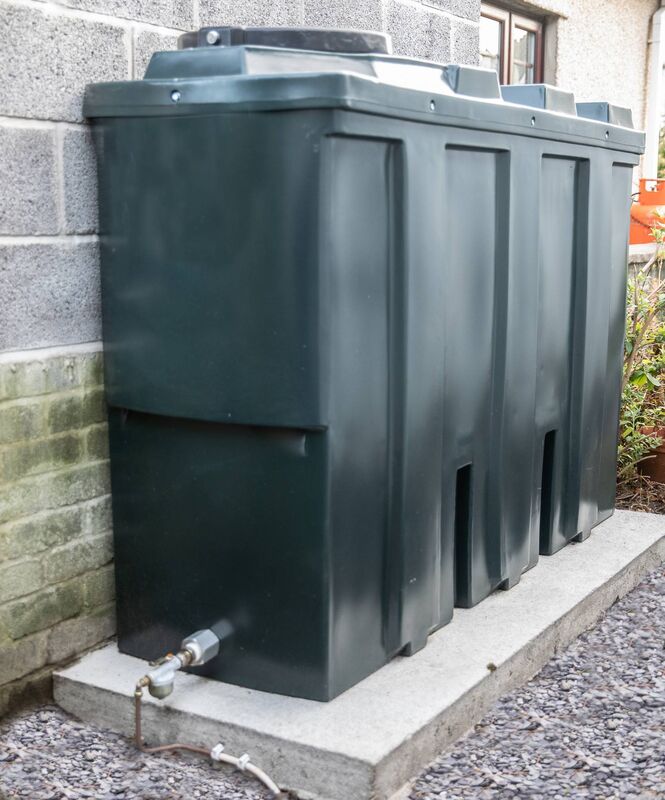
Minor leaks are potentially repairable, but a major leak of home heating oil into the ground around your property (quite likely leaching into the garden of your nearest neighbour too) is an environmental disaster, and the Environmental Protection Agency (EPA) will be informed by your insurer. It’s a major financial hit if it’s not covered by your home insurance policy. Think €15,000-plus to clean up the hazardous, petrochemical toxins with a specialist team digging down and out around the area following a full report by an environmental scientist.
It’s not just the subsoil that may need replacing, but some of the foundations of your building. You can double or even triple that number for a very bad spill. Worst-case scenario, your home may be deemed uninhabitable for the duration of the clean-up.
An oil tank in steel or plastic, bunded or single-skin, has a lifespan of around 20 years, but it should be checked by your heating engineer for leaks and corrosion every year when they carry out your annual heating system service. Things to look out for include unusual or obvious smells of oil around the tank, greasy drips or staining around any area of the tank or base, including the lines feeding the house, weird bulges, colour changes to plastic tanks and rusting on steel tanks (don’t just paint over this and dismiss it).
If your boiler is underperforming and your oil is going down faster than expected, the tank and lines should be given a condition inspection and report by an OFTEC (the Oil Firing Technical Association) professional. If in doubt, have a dedicated oil leak professional visit your home immediately. They may be able to fix the problem or put emergency remediation steps in place even before you call your insurance company.
When you do decide to replace your tank or are forced to, there’s the chance to both upgrade the tank itself and to enhance the safety standards demanded by current building regulations in how and where it is positioned. There are two materials in tanks, two choices in skins and various profiles and sizes to suit many situations. Let’s start with single-skins and bunded tanks.
Bunding describes the double skin of an oil tank. What this does is to provide a second level of protection if the inner skin of the tank should degrade and leak oil. Bunded tanks are not mandatory for tanks under 2500l, except where your home is sited close to a water course, pond, a well, drain or an area of particular environmental vulnerability.
They are recommended where your tank is sited within 50m of agricultural land. Obviously, they offer additional peace of mind for any homeowner, but they only hold a percentage of the tank’s volume. Having a bunded tank doesn’t mean forgetting about it forever. They degrade just like any other tank. A replacement firm will decant the usable oil from the oil tank to a holding vessel and replace it with the new one, but clearly, it’s easier when the tank is not full to the brim, making this a perfect spring/summer upgrade for a tank past its best-by date.
Steel or plastic? There are pros and cons for both materials. Steel is generally regarded as a high-quality material, with anti-corrosion properties and impact resistance as standard. It offers a tank that’s harder for villains to drill into than plastic, and they have a more handsome look if the tank must be left on show. Plastic tanks are well priced in single skins or bunded, seamless (unlike steel tanks) and are light to move if you have to change the position of the tank.
Plastic tanks come in a wider range of shapes than steel, too. In terms of recycling, steel tanks appear to remain cleaner than plastic tanks, collecting less sludge over time, and once cut up, they are slightly easier to recycle. In terms of security, a motion sensor light around the area of a tank is a good first line of defence. The size of the tank in litres should be determined by your heating engineer. This will match the insulation level of the home (its energy efficiency and demand for heating), the occupancy of the house, and its square metres.
A great big volume of combustible, petrochemicals within metres of your greatest investment is something to take very seriously. Building new or renovating, your oil tank should be at least 1.8m from the walls of your home if they are not made of a non-combustible material like block and render. This would include things like non-fire rated window, eaves, and doors, so even with a block-built house, you will likely be advised to place the tank 1.8m from the house walls or any of this detailing.
If the tank is close to a fire-rated wall, it still needs around 100mm for the tank to swell, as it will react to temperatures in a sunny spot and swell when filled. If the tank is near a hedgerow, OFTEC recommend a 600mm distance to prevent the screening material from going up in the unlikely event of fire.
If there’s an opening window close to the tank position, you will likely get occasional smells floating through the window in summer. The tank needs to be in a place where it’s unlikely to get an impact (like the belt of a reversing vehicle, for instance) and a concrete base (10cm would be standard). This should extend 300mm all around from the tank’s widest girth. If the base or a raised support fails, the tank may either leak or, God forbid, collapse off the support.
Give a lot of consideration to both seeing and smelling the tank (though without leaks, this should be minimal outside of a splash during filling). The answers to all these questions with a new or existing tank will be best answered by a reputable, often registered heating engineer or your builder. Don’t wing it. If you suspect your tank is actually leaking, this is a 24/7 pollution emergency. Don’t wash the area down. Throw down some sand or kitty litter if the oil is visible, and get professional help right away.


CONNECT WITH US TODAY



Be the first to know the latest news and updates