Home Q&A: Could I install solar panels on my apartment balcony to cut energy costs?
I live in an apartment. Can I install a solar-PV balcony system to reduce my energy bills?
Home Q&A: Could I install solar panels on my apartment balcony to cut energy costs?

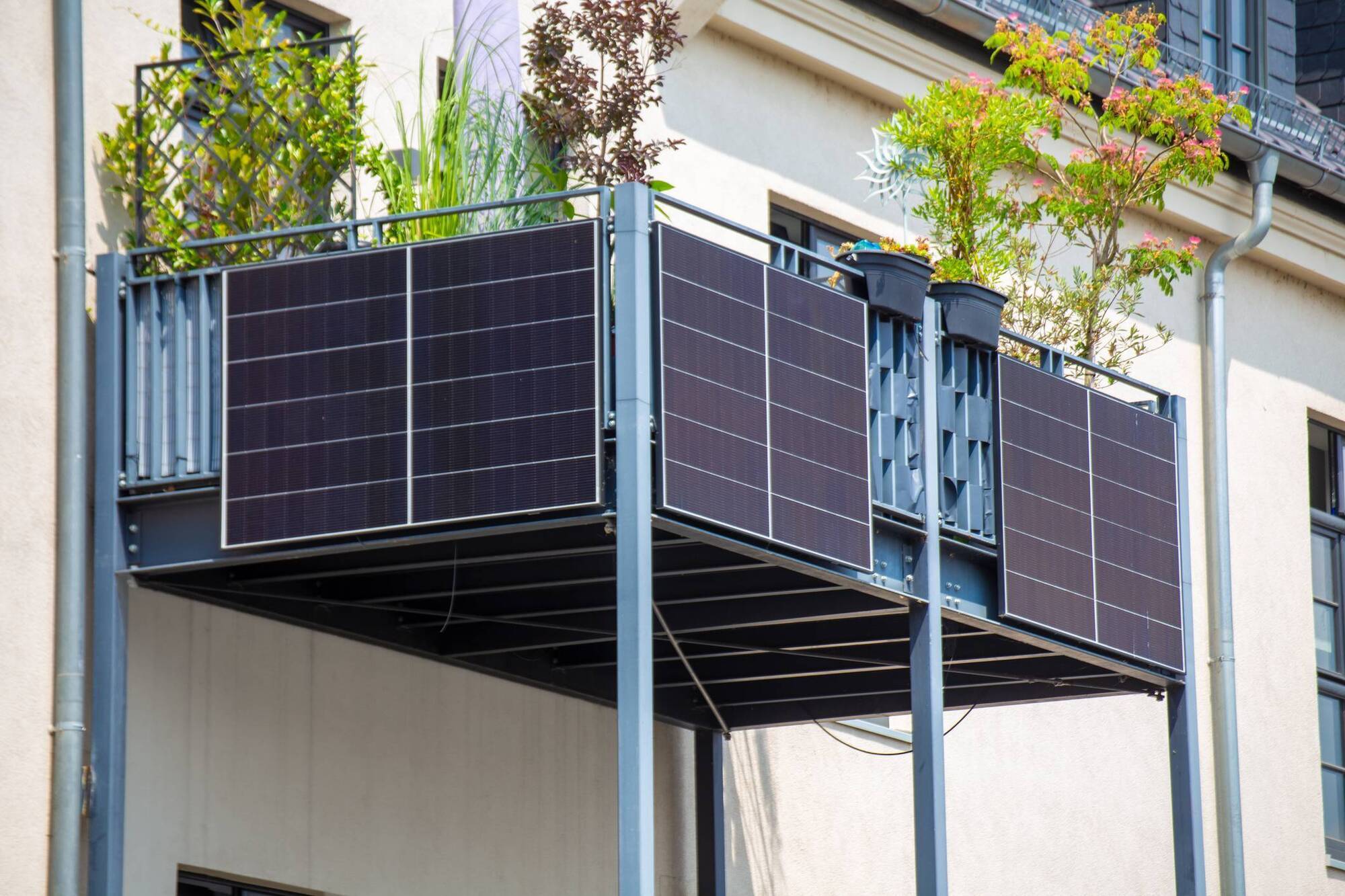
This sturdy balcony with supporting pillars has multiple solar panels to catch the arc of the sun. File picture


Question

I live in an apartment. Can I install a solar-PV balcony system to reduce my energy bills?

Answer

Usually, I would have a straight answer to a simple question, but in this case, I can only sum up what we know right now. Most Irish apartment dwellers are currently unable to enjoy the benefits of standard solar-photovoltaic (solar-PV) installations (the kind of thing that’s grant-aided through the Sustainable Energy Authority of Ireland (SEAI) because even in a penthouse, they do not have control of what goes on the roof they are under. What there is is a sliver of square metres in a balcony.

In many European countries, including Germany, Italy, France, Poland and the Netherlands, balcony solar is not only available but in some countries, is grant-aided. A set of panels (two would be standard) is set flush on the outside of an existing balcony railing or tilted at a slight upward-facing angle using triangular brackets. These work through a mini-inverter (to change the DC created by the array to AC) plugged into a domestic socket to supplement the grid supply.

Sangeeta Olson, who lives in Berlin, explains the familiar solar balcony system or Balkonkraftwerk, used by over 1.5 million German apartment dwellers. “Tenants with their primary residence in Berlin can receive a subsidy of up to €250 for their balcony solar power system through the SolarPLUS program of the Investitionsbank Berlin (IBB),” says Sangeeta. “To apply for the subsidy, the application must be submitted before the device is purchased or ordered. 

"The application is submitted online. Written consent for the solar balcony power system from the landlord is required. Only after the application has been approved by the IBB can you purchase the balcony power system and have it installed by a professional.”

So how much power do these grid-tied panels generate, considering, of course, shade, aspect and the usual interrupters in the weather?  “Depending on the size of the apartment and the number of appliances, it may not cover the entire electricity demand," says Sangeeta. 

"The modules usually do generate enough electricity to noticeably reduce your electricity bill. Appliances that run continuously, such as the refrigerator, can be partially powered by a plug-in solar system. Since the implementation of Solar Package 1, consumers in Germany can now use plug-in solar devices for private electricity generation up to a maximum total output of 800W. This 800W is fed directly into the home's electrical outlet via an inverter. Any excess power is fed into the public grid free of charge. These systems are becoming increasingly affordable, with quality devices with inverters and all necessary connections available for around €250.”

Registration and rules around professional installation/certification of solar balconies are being relaxed in many countries, including Spain. I could only find one balcony solar kit here in Ireland, from Windandsun.ie, and it comes in at a whopping €950 without any battery. It does include a micro-inverter, app operation and four panels/900w. The product description is very clear that it falls on the purchaser to ensure the system is legal in their situation. 

Much smaller stand-alone solar systems of between two and four panels have been used by van-lifers and off-grid homeowners, smallholders powering up out-farms without mains power in Ireland for many years. 

This type works from the panels to a battery (power-bank) with outlets on it. You simply plug some chosen appliances into it. Look up the Jackery range of power stations from €1049, eu.jackery.com, popular for camper vans. Any solar system fit for a balcony or camper is twice the price with a battery. Harvey Norman retails the EcoFlow 160w (foldable) Solar Panel kit. At €349, it’s ideal for trickling a trace of power into a power-bank to say run your computer or charge a phone — and you could (in theory) drape it over a balcony.

A fixed, grid-tied balcony system is a bigger prospect at 800w to 900w (a typical household would download around 12kWh from the grid per day, year-round). “Balcony solar is an emerging area of huge interest to any solar enthusiast, including us at Wizer," says Martin Desmond, who is the MD of Wizer Energy here in Cork."Making solar more accessible to more people, overcoming the initial entry costs on a panel-by-panel basis, could help a lot. Once people sample solar at this small scale, as time and circumstances change, they will feel much more confident vouching to install larger, more comprehensive systems.” 

Balcony solar panels could provide a simple solution for apartment dwellers, tiny homes and buildings not able to take a standard large area, making use of say fences and walls. File picture

Martin also suggests that small solar-PV systems like these make good use of locations like fences and walls for homes that don’t have a roof or ground site suited to standard solar-PV.

The Green Party brought the potential of balcony solar-PV to national attention on social media, and the discussion got as far as the Oireachtas on October 9, 2025. Deputy Barry Heneghan asked the Minister for Climate, Energy and the Environment to make a statement on the matter. We are still waiting for the Minister’s statement, but I was excited — excited enough to get in touch with ESB Networks, who sent me this nuanced reply from Corporate. Note the reference to the NC6 process — this is basically a nod of approval from ESB Networks, crucial for getting any grid-tied domestic solar-PV legally up and running. 

They don’t refer to any system not grid-tied, as working off a power bank, it would not come to ESB Network’s attention. It’s not a “no”, but I don’t think we’re there yet. “It isn’t ESB Networks’ role to approve or inspect the location of PV in this way. Essentially, this is with the customer to ensure all requirements (planning), regulations and certifications (electrical) are met during their installation. Before work commencement or parallel connection of the generator (PV in this case) with the electricity network, ESB Networks must be notified under the NC6.  

For information in terms of the electrical aspects, in Ireland, anyone wiring a solar PV system must be registered on the SEAI Solar PV Installer Register. This requires compliance with the Irish Wiring Regulations as published by the National Standards Authority of Ireland (NSAI), and the SEAI's Domestic Solar Photovoltaic Code of Practice. A registered installer must ensure all components are CE-marked, correctly designed, installed, and that the final system is commissioned and signed off, meeting all applicable building regulations and legislation.” ESB Networks.

This is the sort of technical and compliance porridge to mull over with a reputable solar-PV supplier or an electrician highly familiar with solar-PV. There remain genuine safety concerns both here and in the UK about solar systems going into a socket outlet. Some oversight would seem prudent.

If approved, such systems would likely have to be installed by a RECI-qualified individual on the SEAI list of registered installers. The ESBN treats it exactly as it would a standard solar-PV install. 

Even with everything bureaucratic powering through, and balcony systems approved, the size of the railings, their aspect, shading and all the usual elements that add up to a viable array would need to be worked out. The other sticking point (and this could prove tricky) is the regulations attached to any apartment building.

If regulations change, the viability and gain of a solar balcony system would be subject to survey in just the same way as any solar-PV installation. Here a tilt catches more light, but a tree potentially shades the area at certain times of the day. File picture

Blocks of flats might seem like a useful, lofty bit of the built environment for siting solar, but generally, even fluttering underwear from balcony railings is prohibited by (some) local authorities, building management and targeted in leases (partly due to the aesthetic impact). 

Solar-PV balcony systems are reasonably light (two typical panels come in under 25kg), but in fairness, Irish apartment balconies were not designed for the extra loading. If any of the structure of the panels themselves did fall, well, you can imagine the result on a busy town or city street. The process would and could easily be regularised with engineer inspections to ensure any balcony having panels installed on it was fit for purpose in all weathers, and the system perfectly secured and fire-safe.

Solar-PV is currently exempt from planning (with some T&Cs). Will this be extended to balcony systems? For renters — a light, 800-watt to 900-watt solar balcony system could move with you when you move, making it an excellent investment when the price point improves through the sort of government subsidies our German friends already enjoy. I’ve yet to hear back from the SEAI. Being the determined little sunshine I am, I will watch, wait and report back to you.

  • Got a home improvement or DIY question for our Home team? Email home@examiner.ie


x

More in this section

Revoiced

Newsletter

Sign up to the best reads of the week from irishexaminer.com selected just for you.

Cookie Policy Privacy Policy Brand Safety FAQ Help Contact Us Terms and Conditions

© Examiner Echo Group Limited